A particle has two velocities of equal magnitude inclined to each other at an angle . If one of them is halved, the angle between the other and the original resultant velocity is bisected by the new resultant. Then is:
- A
- B
- C
- D
Solution & Step-by-step Explanation
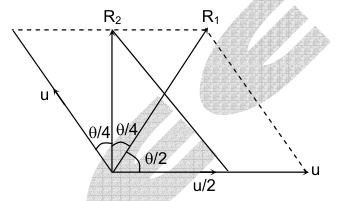
Let the velocities be and with .The original resultant makes an angle with each velocity.New velocities are and . Let the new resultant make an angle with the velocity .According to the question, the angle between the velocity and the original resultant () is bisected by .So, .Using the formula for the direction of resultant:
Solving this or substituting options, for : This is true. Thus .