A particle of mass is released from rest and follows a parabolic path as shown. Assuming that the displacement of the mass from the origin is small, which graph correctly depicts the position of the particle as a function of time?
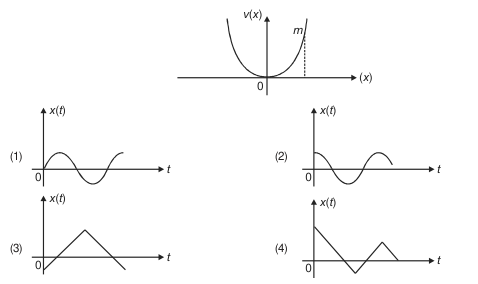
- A1
- B2
- C3
- D4

Try it yourself before checking the explanation above.

Consider a water tank as shown in the figure. It has one wall at x = L and is very wide in the z direction. When filled with a liquid of surface tension S and density ρ , the liquid surface makes an angle θ_0 ( θ_0 1 ) with the x -axis at x = L . If y(x) is the height of the surface, then the equation for y(x) is:(Take θ(x) ≈ θ(x) ≈ θ(x) = dy/dx and g as acceleration due to gravity) 
A microscope has an objective of focal length 2 cm , eyepiece of focal length 4 cm and the tube length of 40 cm . If the distance of distinct vision of eye is 25 cm , the magnification in the microscope is:
An electron (mass 9 × 10^-31 kg and charge 1.6 × 10^-19 C ) moving with speed c/100 ( c = speed of light) is injected into a magnetic field B of magnitude 9 × 10^-4 T perpendicular to its direction of motion. We wish to apply a uniform electric field E together with the magnetic field so that the electron does not deflect from its path. Then (speed of light c = 3 × 10^8 ms^-1 ):
There are two inclined surfaces of equal length ( L ) and same angle of inclination 45^ with the horizontal. One of them is rough and the other is perfectly smooth. A given body takes 2 times as much time to slide down on rough surface than on the smooth surface. The coefficient of kinetic friction ( μ_k ) between the object and the rough surface is close to:
The kinetic energies of two similar cars A and B are 100 J and 225 J respectively. On applying breaks, car A stops after 1000 m and car B stops after 1500 m . If F_A and F_B are the forces applied by the breaks on cars A and B, respectively, then the ratio F_A/F_B is:
The current passing through the battery in the given circuit is: 
Practice with timed mock tests and track your performance across Physics.