A sinusoid of 10 kHz is sampled at 15 k samples/s. The resulting signal is passed through an ideal low pass filter (LPF) with cut-off frequency of 25 kHz. The maximum frequency component at the output of the LPF (in kHz) is
Correct Answer
25-25
Solution & Step-by-step Explanation
Frequency of the signal (f) = 10 kHz
Sampling rate is 15 k samples/s i.e. fₛ=15 k samples/s
The cut-off frequency of low pass filter = 25 kHz
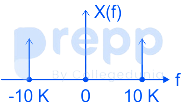
The Impulse frequency response of the given signal is shown below.
Redrawing the frequency spectrum after passing through the low pass filter (LPF) heaving the cut-off frequency of 25 kHz.
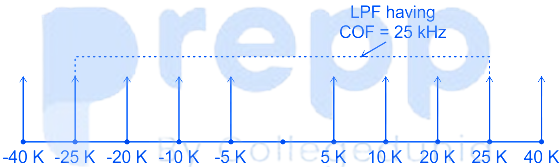
Frequencies present at filter output are = 5k, 10k, 20k, 25 kHz.
Maximum frequency present at filter output is 25 kHz
Alternate method:
After sampling, frequencies present will be: ± f ± nfₛ
Where, n = 0, 1, 2, 3, 4, ...
For n = 0, frequencies present = ±10 kHz
For n = 1, frequencies present = ± 10 k ± 15 k = ±25 kHz, ±5 kHz
After passing through ideal LPF having a cut-off frequency of 25 kHz, the highest frequency component present at filter output = 25 kHz.
Therefore, the maximum frequency present at filter output is 25 kHz
Sampling rate is 15 k samples/s i.e. fₛ=15 k samples/s
The cut-off frequency of low pass filter = 25 kHz
The Impulse frequency response of the given signal is shown below.
Redrawing the frequency spectrum after passing through the low pass filter (LPF) heaving the cut-off frequency of 25 kHz.
Frequencies present at filter output are = 5k, 10k, 20k, 25 kHz.
Maximum frequency present at filter output is 25 kHz
Alternate method:
After sampling, frequencies present will be: ± f ± nfₛ
Where, n = 0, 1, 2, 3, 4, ...
For n = 0, frequencies present = ±10 kHz
For n = 1, frequencies present = ± 10 k ± 15 k = ±25 kHz, ±5 kHz
After passing through ideal LPF having a cut-off frequency of 25 kHz, the highest frequency component present at filter output = 25 kHz.
Therefore, the maximum frequency present at filter output is 25 kHz