A spherical ball is dropped in a long column of a highly viscous liquid. The curve in the graph shown, which represents the speed of the ball () as a function of time () is:
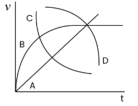
- AA
- BB
- CC
- DD
Solution & Step-by-step Explanation
When a ball is dropped in a viscous liquid, it initially accelerates due to gravity. However, as speed increases, the viscous drag force () also increases. Eventually, the upward forces (buoyancy + drag) balance the weight. At this point, acceleration becomes zero and the ball moves with a constant "terminal velocity".Curve B correctly shows speed increasing and then plateauing at a constant value.