HomeTestsSearchRankProfile
easyMCQPhysicsPhysics
8 attempts0% success rate1 mark (−0.25)

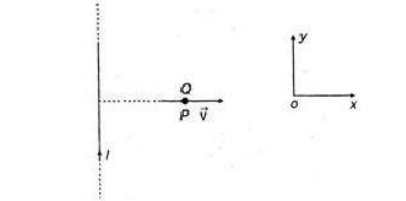
A very long straight wire carries a current I. At the instant when a charge + Q at point P has velocity , as shown, the force on the charge is :
image

  1. A
    opposite to ox
  2. B
    along ox
  3. C
    opposite to oy
  4. D
    along oy

Solution & Step-by-step Explanation

The force on a moving charge in a magnetic field is given by the Lorentz force equation, . Since there's no electric field mentioned, we only consider the magnetic part. The magnetic field around a long straight wire carrying a current is given by , where is the distance from the wire. The direction of is tangential to a circle centered on the wire and can be determined by the right-hand rule. For a charge moving parallel to the wire (as implied by the velocity being in the plane of the wire and the charge), the force due to the magnetic field will be perpendicular to both the velocity of the charge and the magnetic field. Given the charge is positive and moving as shown, and assuming the current in the wire is flowing in the positive -direction (out of the page), the magnetic field at point P would be directed into the page (using the right-hand rule). The cross product for a charge moving to the right (as implied) would result in a force directed along (since is along and is into the page). Therefore, the force on the charge is along .

Practice this question

Try it yourself before checking the explanation above.

A very long straight wire carries a current I. At the instant when a charge + Q at point P has velocity , as shown, the force on the charge is :

image
A
opposite to ox
B
along ox
C
opposite to oy
D
along oy

Share This Question

Related Questions

mediumMCQ

Consider a water tank as shown in the figure. It has one wall at x = L and is very wide in the z direction. When filled with a liquid of surface tension S and density ρ , the liquid surface makes an angle θ_0 ( θ_0 1 ) with the x -axis at x = L . If y(x) is the height of the surface, then the equation for y(x) is:(Take θ(x) ≈ θ(x) ≈ θ(x) = dy/dx and g as acceleration due to gravity) ![image](https://pub-7faa453bd1ec4bf0a04cc031c6f058de.r2.dev/images/e48999a7-2b29-4d5c-be16-ae2fd5fbcea5.png)

mediumMCQ

A microscope has an objective of focal length 2 cm , eyepiece of focal length 4 cm and the tube length of 40 cm . If the distance of distinct vision of eye is 25 cm , the magnification in the microscope is:

mediumMCQ

An electron (mass 9 × 10^-31 kg and charge 1.6 × 10^-19 C ) moving with speed c/100 ( c = speed of light) is injected into a magnetic field B of magnitude 9 × 10^-4 T perpendicular to its direction of motion. We wish to apply a uniform electric field E together with the magnetic field so that the electron does not deflect from its path. Then (speed of light c = 3 × 10^8 ms^-1 ):

mediumMCQ

There are two inclined surfaces of equal length ( L ) and same angle of inclination 45^ with the horizontal. One of them is rough and the other is perfectly smooth. A given body takes 2 times as much time to slide down on rough surface than on the smooth surface. The coefficient of kinetic friction ( μ_k ) between the object and the rough surface is close to:

mediumMCQ

The kinetic energies of two similar cars A and B are 100 J and 225 J respectively. On applying breaks, car A stops after 1000 m and car B stops after 1500 m . If F_A and F_B are the forces applied by the breaks on cars A and B, respectively, then the ratio F_A/F_B is:

easyMCQ

Which of the following options represents the variation of photoelectric current with intensity and frequency of light shown on the x-axis? ![image](https://pub-7faa453bd1ec4bf0a04cc031c6f058de.r2.dev/images/a9f0839b-e582-4a05-99a9-ba0021dc875f.png)

Ready for a Full Test?

Practice with timed mock tests and track your performance across Physics.

Discussion