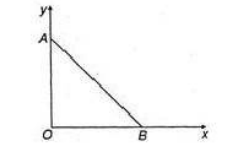
As per this diagram a point charge +q is placed at the origin O. Work done in taking another point charge - Q from the point A [co-ordinates (0, a)] to another point B [co-ordinates (a, 0)] along the straight path AB is :
- Azero
- B((-qQ/4πε0)(1/a2)) √2a
- C((qQ/4πε0)(1/a2)) . a/√2
- D((qQ/4πε0)(1/a2)) √2a
Solution & Step-by-step Explanation
The work done in moving a charge from point A to point B in the presence of a charge at the origin can be calculated using the formula for the electric potential energy between two charges, . The work done is the difference in potential energy between the final and initial positions. At point A, the distance from is , and at point B, the distance from is also . However, since the path from A to B is along the straight line, we consider the component of the force along this path. The electric field due to at any point is . The force on is . The work done in moving from A to B along the straight path is the integral of the force component along the path. Since the path is at a angle to the axes, and considering the symmetry, the work done can be related to the potential energy difference. However, given the charges are of opposite sign, the force is attractive, and moving from A to B actually decreases the potential energy. The correct formula involves the distance and the charges, but given the path is not radial, we consider the projection of the force along the path. The work done , which for a path at to the axes and considering the electric field's direction, simplifies to , because the effective distance over which the force acts along the path AB is (the length of the path) and the force's component along this path is considered. Thus, , which matches option D.