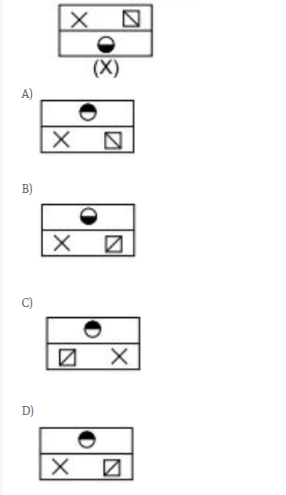
Choose the correct water-image of figure (X) from alternatives A, B, C and D.
- AA
- BB
- CC
- DD
Solution & Step-by-step Explanation
To find the correct water image of a figure, we invert the figure vertically (a top-to-bottom flip), while the left and right positions remain completely unchanged:
1. Position of Elements: In figure (X), the 'X' and the square box are in the upper half, and the shaded circle is in the lower half. In its water image, the circle will move to the upper half, while the 'X' and the square box will move to the lower half. Since left and right do not swap, 'X' remains on the left and the square box remains on the right. This eliminates option C.
2. Circle Inversion: The circle in the lower half of figure (X) has its bottom half shaded black. When flipped vertically, the top half of the circle becomes shaded black. This feature is common to all remaining options.
3. Square Box Inversion: In figure (X), the square box has a diagonal line running from the top-left corner to the bottom-right corner, with the shading in the lower-left triangular section. When flipped vertically:
* The diagonal line changes direction to run from the bottom-left corner to the top-right corner.
* The shaded region at the bottom-left flips to the top-left.
Comparing these observations with the given options, Option B perfectly matches the inverted characteristics.
1. Position of Elements: In figure (X), the 'X' and the square box are in the upper half, and the shaded circle is in the lower half. In its water image, the circle will move to the upper half, while the 'X' and the square box will move to the lower half. Since left and right do not swap, 'X' remains on the left and the square box remains on the right. This eliminates option C.
2. Circle Inversion: The circle in the lower half of figure (X) has its bottom half shaded black. When flipped vertically, the top half of the circle becomes shaded black. This feature is common to all remaining options.
3. Square Box Inversion: In figure (X), the square box has a diagonal line running from the top-left corner to the bottom-right corner, with the shading in the lower-left triangular section. When flipped vertically:
* The diagonal line changes direction to run from the bottom-left corner to the top-right corner.
* The shaded region at the bottom-left flips to the top-left.
Comparing these observations with the given options, Option B perfectly matches the inverted characteristics.