Consider the circuit shown in the figure.
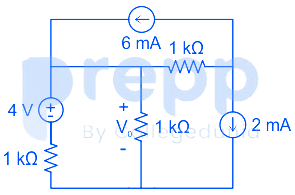
The value of v₀ (rounded off to one decimal place) is ______ V.
Correct Answer
Solution & Step-by-step Explanation
In the range: 1 - 1
Concept:
There are two types of Kirchhoff’s Laws :
Kirchhoff’s first law :
- This law is also known as junction rule or current law (KCL). According to it the algebraic sum of currents meeting at a junction is zero i.e. Σ i = 0.

- In a circuit, at any junction, the sum of the currents entering the junction must be equal the sum of the currents leaving the junction i.e., i1 + i3 = i2 + i4
- This law is simply a statement of “conservation of charge” as if current reaching a junction is not equal to the current leaving the junction, charge will not be conserved.
Kirchhoff’s second law:
- This law is also known as loop rule or voltage law (KVL) and according to it “thealgebraic sum of the changes in potential in the complete traversal of a mesh (closed-loop) is zero”, i.e. Σ V = 0.
- This law represents “conservation of energy” as if the sum of potential changes around a closed loop is not zero, unlimited energy could be gained by repeatedly carrying a charge around a loop.
- If there are n meshes in a circuit, the number of independent equations in accordance with loop rule will be (n - 1).
Analysis:
Given circuit diagram is redrawn as:
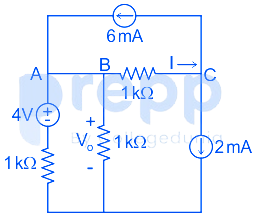
Consider current I in the branch BC.
Applying KCL at node B:
V = V = V₀
2V0 + I = 10 ---(1)
Applying KCL at node C:
I = 6 + 2
I = 8 mA
Putting value of I in (1), we get:
2V₀ + 8 = 10
V₀ = 1 V
Concept:
There are two types of Kirchhoff’s Laws :
Kirchhoff’s first law :
- This law is also known as junction rule or current law (KCL). According to it the algebraic sum of currents meeting at a junction is zero i.e. Σ i = 0.
- In a circuit, at any junction, the sum of the currents entering the junction must be equal the sum of the currents leaving the junction i.e., i1 + i3 = i2 + i4
- This law is simply a statement of “conservation of charge” as if current reaching a junction is not equal to the current leaving the junction, charge will not be conserved.
Kirchhoff’s second law:
- This law is also known as loop rule or voltage law (KVL) and according to it “thealgebraic sum of the changes in potential in the complete traversal of a mesh (closed-loop) is zero”, i.e. Σ V = 0.
- This law represents “conservation of energy” as if the sum of potential changes around a closed loop is not zero, unlimited energy could be gained by repeatedly carrying a charge around a loop.
- If there are n meshes in a circuit, the number of independent equations in accordance with loop rule will be (n - 1).
Analysis:
Given circuit diagram is redrawn as:
Consider current I in the branch BC.
Applying KCL at node B:
V = V = V₀
2V0 + I = 10 ---(1)
Applying KCL at node C:
I = 6 + 2
I = 8 mA
Putting value of I in (1), we get:
2V₀ + 8 = 10
V₀ = 1 V