Examine the provided diagram and respond to the following question.
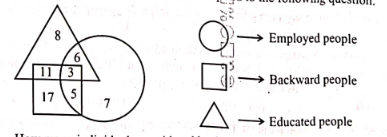
How many individuals considered backward are not educated?
- A
- B
- C
- D
Solution & Step-by-step Explanation
1. "Backward people" are represented by the Square.
2. "Educated people" are represented by the Triangle.
3. We need to find individuals who are inside the Square but outside the Triangle.
4. Looking at the numbers inside the Square:
* is inside the square and outside the triangle.
* is inside both the square, circle, and triangle (so it is educated).
* is inside the square but outside the triangle.
5. Summing up the regions inside the Square but completely outside the Triangle:
Let's check the options and numbers carefully: The diagram shows and and . Wait, let's re-verify the regions. The square contains , , , and .
* is inside the triangle (educated).
* is inside the triangle (educated).
* is inside the square and triangle? No, is outside the triangle.
* is inside the square and outside the triangle.
Therefore, numbers in square but outside triangle . Let's re-read options: (A) 31, (B) 22, (C) 20, (D) 16.
Wait! Let's look closely at the circle overlap. is only square. is square and circle overlap but outside triangle.
Let's check if comes from or . Let's look at the triangle boundary: The triangle base goes above and ? No, the triangle contains . Let's re-examine: The triangle contains . The line of the triangle passes through... Let's look at and : is outside the circle, is inside the circle.
Let's count: If the answer is , it matches . This implies and are outside the triangle, while and are inside the triangle. Let's look at the triangle shape: the bottom vertex or line contains and . Thus and are below it, i.e., outside the triangle.
Therefore: .
2. "Educated people" are represented by the Triangle.
3. We need to find individuals who are inside the Square but outside the Triangle.
4. Looking at the numbers inside the Square:
* is inside the square and outside the triangle.
* is inside both the square, circle, and triangle (so it is educated).
* is inside the square but outside the triangle.
5. Summing up the regions inside the Square but completely outside the Triangle:
Let's check the options and numbers carefully: The diagram shows and and . Wait, let's re-verify the regions. The square contains , , , and .
* is inside the triangle (educated).
* is inside the triangle (educated).
* is inside the square and triangle? No, is outside the triangle.
* is inside the square and outside the triangle.
Therefore, numbers in square but outside triangle . Let's re-read options: (A) 31, (B) 22, (C) 20, (D) 16.
Wait! Let's look closely at the circle overlap. is only square. is square and circle overlap but outside triangle.
Let's check if comes from or . Let's look at the triangle boundary: The triangle base goes above and ? No, the triangle contains . Let's re-examine: The triangle contains . The line of the triangle passes through... Let's look at and : is outside the circle, is inside the circle.
Let's count: If the answer is , it matches . This implies and are outside the triangle, while and are inside the triangle. Let's look at the triangle shape: the bottom vertex or line contains and . Thus and are below it, i.e., outside the triangle.
Therefore: .