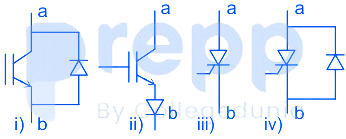
Figure shows 4 electronic switches (i), (ii), (iii) and (iv). Which of the switches can blockVoltages of either polarity(applied between terminals ‘a’ and ‘b’) when the active device is in OFF state?
- A(i), (ii) and (iii)
- B(ii), (iii) and (iv)
- C(ii) and (iii)
- D(i) and (iv)
Solution & Step-by-step Explanation
Concept:
Thyristor can block both forward and reverse voltage in off state.
Explanation:
Switch (i):
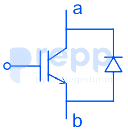
when Vₐ > V
Diode : OFF, Transistor : ON
when Vₐ < V
Diode : ON, transistor : OFF
Therefore, switch (i) can not block voltages of either polarity when the diode or transistor is in the OFF state.
Switch (ii):
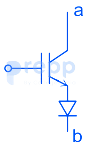
when Va > Vb
Diode : ON, Transistor : ON
when Va < Vb
Diode : OFF, transistor : OFF
Therefore, the switch (ii) can block voltages of either polarity when the diode & transistor are in OFF condition.
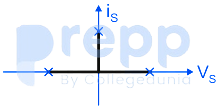
Switch (iii):

when Va > Vb
SCR : ON,
when Va < Vb
SCR : OFF
Therefore, switch can block voltages of either polarity when the SCR in OFF state.
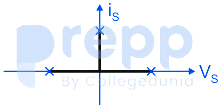
Switch (iv)
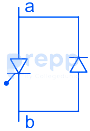
when Va > Vb
Diode : OFF
when Va < Vb
SCR : OFF
Therefore, switch (iv) can Not block voltages of either polarity when SCR or diode is in OFF state.
Thyristor can block both forward and reverse voltage in off state.
Explanation:
Switch (i):
when Vₐ > V
Diode : OFF, Transistor : ON
when Vₐ < V
Diode : ON, transistor : OFF
Therefore, switch (i) can not block voltages of either polarity when the diode or transistor is in the OFF state.
Switch (ii):
when Va > Vb
Diode : ON, Transistor : ON
when Va < Vb
Diode : OFF, transistor : OFF
Therefore, the switch (ii) can block voltages of either polarity when the diode & transistor are in OFF condition.
Switch (iii):
when Va > Vb
SCR : ON,
when Va < Vb
SCR : OFF
Therefore, switch can block voltages of either polarity when the SCR in OFF state.
Switch (iv)
when Va > Vb
Diode : OFF
when Va < Vb
SCR : OFF
Therefore, switch (iv) can Not block voltages of either polarity when SCR or diode is in OFF state.