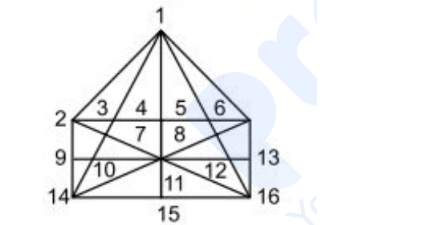
Find out the number of triangles in the figure.
- A60
- B32
- C39
- D46
Solution & Step-by-step Explanation
Let's calculate the total number of triangles systematically by dividing the shape into smaller components using the labeled regions:
1. Triangles composed of a single region:
Regions 2, 3, 4, 5, 6, 7, 8, 9, 10, 11, 12, 13, 14, and 16 form simple individual triangles.
Total = 14 triangles.
2. Triangles composed of 2 smaller regions:
Combinations such as (2,3), (5,6), (9,10), (11,12), (7,8), (3,4), (4,5), (10,11), (11,12), and symmetric pairings across the central vertical and horizontal lines.
Total = 14 triangles.
3. Triangles composed of 3 or 4 smaller regions:
Larger combined regions forming distinct triangular structures, such as the major upper triangular wings meeting at vertex 1, and the large quadrant triangles in the lower rectangular base.
Total = 12 triangles.
4. Largest outer combined triangles:
The full structural halves divided by the primary diagonal and central intersecting axes.
Total = 6 triangles.
Adding all these systematic counts together:
1. Triangles composed of a single region:
Regions 2, 3, 4, 5, 6, 7, 8, 9, 10, 11, 12, 13, 14, and 16 form simple individual triangles.
Total = 14 triangles.
2. Triangles composed of 2 smaller regions:
Combinations such as (2,3), (5,6), (9,10), (11,12), (7,8), (3,4), (4,5), (10,11), (11,12), and symmetric pairings across the central vertical and horizontal lines.
Total = 14 triangles.
3. Triangles composed of 3 or 4 smaller regions:
Larger combined regions forming distinct triangular structures, such as the major upper triangular wings meeting at vertex 1, and the large quadrant triangles in the lower rectangular base.
Total = 12 triangles.
4. Largest outer combined triangles:
The full structural halves divided by the primary diagonal and central intersecting axes.
Total = 6 triangles.
Adding all these systematic counts together: