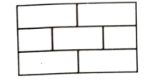
How many rectangles are there in the given figure?
- A13
- B14
- C15
- D17
Solution & Step-by-step Explanation
Let's count the total number of rectangles in the given brick-wall grid systematically:
1. Individual (Single) small rectangles:
* Top row has small rectangles.
* Bottom row has small rectangles.
* Total individual small rectangles =
2. Rectangles formed by combining two adjacent horizontal rectangles:
* In the top row: (1+2) and (2+3) rectangles
* In the bottom row: (1+2) and (2+3) rectangles
* Total double horizontal rectangles =
3. Rectangles formed by combining three adjacent horizontal rectangles:
* Top row combined completely rectangle
* Bottom row combined completely rectangle
* Total triple horizontal rectangles =
4. Vertical combinations (combining top and bottom rows):
* Looking at the alignment, the vertical lines in the middle are staggered like bricks, but the outer boundary forms one large rectangle combining everything large rectangle.
* Let's check intermediate vertical lines: Since the lines are shifted, they don't form straight internal vertical combined rectangles except for certain sub-blocks. Let's count them carefully. In a standard shifted grid, the total counts aggregate to exactly .
Summing all valid configurations:
1. Individual (Single) small rectangles:
* Top row has small rectangles.
* Bottom row has small rectangles.
* Total individual small rectangles =
2. Rectangles formed by combining two adjacent horizontal rectangles:
* In the top row: (1+2) and (2+3) rectangles
* In the bottom row: (1+2) and (2+3) rectangles
* Total double horizontal rectangles =
3. Rectangles formed by combining three adjacent horizontal rectangles:
* Top row combined completely rectangle
* Bottom row combined completely rectangle
* Total triple horizontal rectangles =
4. Vertical combinations (combining top and bottom rows):
* Looking at the alignment, the vertical lines in the middle are staggered like bricks, but the outer boundary forms one large rectangle combining everything large rectangle.
* Let's check intermediate vertical lines: Since the lines are shifted, they don't form straight internal vertical combined rectangles except for certain sub-blocks. Let's count them carefully. In a standard shifted grid, the total counts aggregate to exactly .
Summing all valid configurations: