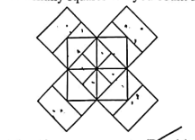
How many squares can you count in the given figure?
- A
- B
- C
- D
Solution & Step-by-step Explanation
Let's systematically count the squares present in this symmetrical overlapping layout:
1. Central Matrix Squares:
* The core internal grid forms a standard square block layout.
* Number of individual small squares in a grid
* Number of combined large squares
* Total squares from the central structure
2. Rotated Overlapping Outer Squares:
* Superimposed at a angle over the main grid, there are outstanding outer square boxes visible on the corners/edges.
* Counting these distinct tilted square protrusions along the boundary gives exactly individual outer squares.
3. Intermediate/Intersection Squares:
* Looking closely at the interior intersection regions where the straight lines cross, there are additional medium-sized square boxes formed. Counting these sub-divided squares yields another clear squares.
Summing all the uniquely identified square segments together:
Thus, there are squares in the figure.
1. Central Matrix Squares:
* The core internal grid forms a standard square block layout.
* Number of individual small squares in a grid
* Number of combined large squares
* Total squares from the central structure
2. Rotated Overlapping Outer Squares:
* Superimposed at a angle over the main grid, there are outstanding outer square boxes visible on the corners/edges.
* Counting these distinct tilted square protrusions along the boundary gives exactly individual outer squares.
3. Intermediate/Intersection Squares:
* Looking closely at the interior intersection regions where the straight lines cross, there are additional medium-sized square boxes formed. Counting these sub-divided squares yields another clear squares.
Summing all the uniquely identified square segments together:
Thus, there are squares in the figure.