Identify the figure that completes the pattern.
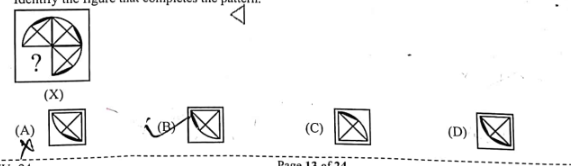
- AA
- BB
- CC
- DD
Solution & Step-by-step Explanation
The problem figure shows a circle divided into four quadrants with symmetric inner triangular grid lines and an outer bounding circular arc. We need to identify the correct piece for the missing bottom-left quadrant (marked with '?').
Let's analyze the symmetry:
1. There is an outer circular arc forming the boundary of the bottom-left quadrant curving from the bottom towards the left edge.
2. Inside the sector, a straight line runs diagonally from the outer corner (bottom-left) to the center of the circle.
3. Another line or arc segment establishes a symmetric boundary matching the adjacent quadrants. Specifically, looking at the top-left and bottom-right quadrants, they form mirror symmetry along the diagonal axes.
When we isolate the bottom-left corner sector piece:
* The circular arc must be at the bottom-left corner.
* A diagonal line extends from the absolute bottom-left corner up towards the inside top-right corner (which points to the center of the full circle).
* Another intersecting arc curved downwards matches the internal lines.
Comparing the orientation of the choices:
* Option (A) has a curve facing downwards-left but missing the proper internal circular arc mirror.
* Option (B) correctly contains the diagonal line segment from the bottom-left corner to the top-right corner, along with the required boundary arcs meeting the layout symmetrically.
Therefore, figure (B) completes the pattern accurately.
Let's analyze the symmetry:
1. There is an outer circular arc forming the boundary of the bottom-left quadrant curving from the bottom towards the left edge.
2. Inside the sector, a straight line runs diagonally from the outer corner (bottom-left) to the center of the circle.
3. Another line or arc segment establishes a symmetric boundary matching the adjacent quadrants. Specifically, looking at the top-left and bottom-right quadrants, they form mirror symmetry along the diagonal axes.
When we isolate the bottom-left corner sector piece:
* The circular arc must be at the bottom-left corner.
* A diagonal line extends from the absolute bottom-left corner up towards the inside top-right corner (which points to the center of the full circle).
* Another intersecting arc curved downwards matches the internal lines.
Comparing the orientation of the choices:
* Option (A) has a curve facing downwards-left but missing the proper internal circular arc mirror.
* Option (B) correctly contains the diagonal line segment from the bottom-left corner to the top-right corner, along with the required boundary arcs meeting the layout symmetrically.
Therefore, figure (B) completes the pattern accurately.