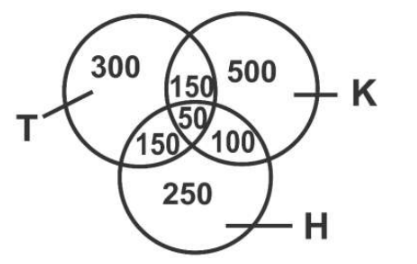
The following Venn diagram shows the result of a survey of persons in a city with respect to their knowledge of Kannada (K), Hindi (H) and Telugu (T).
Let the intersection regions between exactly two sets be represented by the values: (for K and H only), (for H and T only), and (for K and T only).
How many people know exactly two languages?
- A150
- B300
- C400
- D450
Solution & Step-by-step Explanation
To find the total number of people who know exactly two languages, we need to sum up the values present in the regions where exactly two circles intersect (excluding the central region where all three circles overlap).
The values belonging to exactly two language intersections are:
* Kannada and Hindi only =
* Hindi and Telugu only =
* Kannada and Telugu only =
Let's verify the options: . The sum is exactly .
Thus, people know exactly two languages.
The values belonging to exactly two language intersections are:
* Kannada and Hindi only =
* Hindi and Telugu only =
* Kannada and Telugu only =
Let's verify the options: . The sum is exactly .
Thus, people know exactly two languages.