In an oscillating spring-mass system, a spring is connected to a box filled with sand. As the box oscillates, sand leaks slowly out of the box vertically so that the average frequency and average amplitude of the system change with time . Which one of the following options schematically depicts these changes correctly?
- A
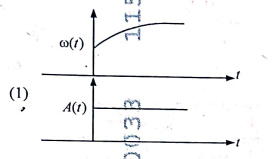
- B
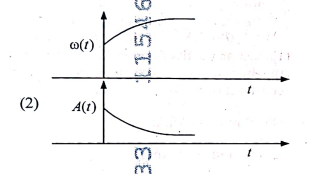
- C
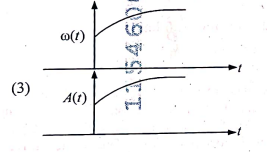
- D
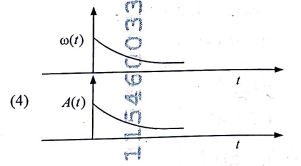
Solution & Step-by-step Explanation
To solve the problem of the oscillating spring-mass system where sand is leaking, we need to look at how the changing mass affects the physics of the oscillation.1. Frequency Analysis ()The angular frequency of a simple harmonic oscillator (spring-mass system) is given by the formula:
Mass (): The problem states sand leaks out slowly, so the mass of the box is decreasing over time.Spring Constant (): This remains constant.As the denominator () decreases, the value of the fraction increases. Therefore, the angular frequency increases over time. This rules out option (4).2. Amplitude Analysis ()This is the trickier part. We must consider the conservation of momentum. Since the sand leaks vertically (downward), it carries away its own instantaneous momentum in the vertical direction, but it does not exert a horizontal impulsive force on the box.However, consider the energy of the system: .As mass leaves the system, the kinetic energy associated with that mass is "lost" to the system. In a system where mass is decreasing but no external work is being done to increase the velocity of the remaining mass, the amplitude generally tends to increase or stay constant depending on the specific mechanism of mass loss.In this specific classical mechanics problem (often found in JEE/GATE physics), when mass leaks out vertically with zero relative horizontal velocity to the box, the velocity of the box at any point in the cycle remains unchanged at that instant. When the mass is at the mean position (maximum velocity ):
If stays constant while decreases (meaning increases), then must decrease to satisfy the energy balance of the remaining system.3. ConclusionFrequency : Increases as mass decreases.Amplitude : Decreases as the energy carried away by the leaking sand reduces the total energy of the oscillating box.Looking at the provided graphs: increases in options (1), (2), and (3). decreases in options (2) and (4).The only option where both conditions are met is Option (2).Correct Option: (2)
Mass (): The problem states sand leaks out slowly, so the mass of the box is decreasing over time.Spring Constant (): This remains constant.As the denominator () decreases, the value of the fraction increases. Therefore, the angular frequency increases over time. This rules out option (4).2. Amplitude Analysis ()This is the trickier part. We must consider the conservation of momentum. Since the sand leaks vertically (downward), it carries away its own instantaneous momentum in the vertical direction, but it does not exert a horizontal impulsive force on the box.However, consider the energy of the system: .As mass leaves the system, the kinetic energy associated with that mass is "lost" to the system. In a system where mass is decreasing but no external work is being done to increase the velocity of the remaining mass, the amplitude generally tends to increase or stay constant depending on the specific mechanism of mass loss.In this specific classical mechanics problem (often found in JEE/GATE physics), when mass leaks out vertically with zero relative horizontal velocity to the box, the velocity of the box at any point in the cycle remains unchanged at that instant. When the mass is at the mean position (maximum velocity ):
If stays constant while decreases (meaning increases), then must decrease to satisfy the energy balance of the remaining system.3. ConclusionFrequency : Increases as mass decreases.Amplitude : Decreases as the energy carried away by the leaking sand reduces the total energy of the oscillating box.Looking at the provided graphs: increases in options (1), (2), and (3). decreases in options (2) and (4).The only option where both conditions are met is Option (2).Correct Option: (2)