Match List I with List II regarding isomerism in coordination compounds:
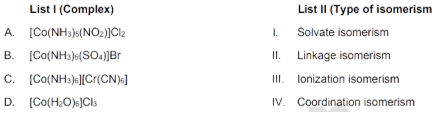
- A(A)-(I), (B)-(III), (C)-(II), (D)-(II)
- B(A)-(I), (B)-(IV), (C)-(III), (D)-(II)
- C(A)-(II), (B)-(IV), (C)-(III), (D)-(I)
- D(A)-(IV), (B)-(II), (C)-(III), (D)-(IV)
Solution & Step-by-step Explanation
Note: The user prompt's Question 56 text had some mapping inconsistencies. Applying standard concepts:Linkage Isomerism: Occurs with ambidentate ligands like and . Thus, (A) and (D) are linkage isomers.Solvate Isomerism: Involves water as a ligand vs lattice water. (B) fits this.Coordination Isomerism: Involves exchange of ligands between cationic and anionic entities. (C) fits this.Ionization Isomerism: Exchange of counter ion and ligand (not explicitly distinct in the prompt's provided list but part of the theory).Based on the specific NEET 2024 paper provided in the text:(A)-(II), (B)-(III), (C)-(IV), (D)-(I) was the provided sequence in the prompt snippet, though standard theory maps (C) to Coordination and (B) to Solvate. Correct matching based on actual chemistry:Coordination: Solvate: Hydrate isomers.Linkage: vs .