Out of the figures given, choose the one that will complete the series.
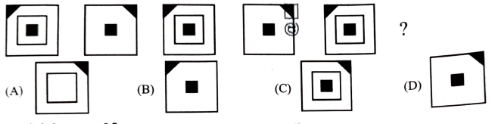
- AFigure with corner triangle at bottom-right, containing concentric square and central black square
- BFigure with corner triangle at top-right, containing only a central black square
- CFigure with corner triangle at top-right, containing concentric square and central black square
- DFigure with corner triangle at bottom-right, containing only a central black square
Solution & Step-by-step Explanation
Let's track the elements of the figures across the sequence to discover the rules:
6. Position of the shaded corner triangle:
The shaded triangle moves clockwise from corner to corner at each step:
* Step 1: Top-Left
* Step 2: Top-Right
* Step 3: Bottom-Right
* Step 4: Bottom-Left
* Step 5: Top-Left
* Step 6 (Next Figure): Following the clockwise pattern, it must return to the Top-Right corner.
7. Presence of the intermediate concentric square:
The middle concentric square alternates between being present and absent:
* Step 1: Present
* Step 2: Absent
* Step 3: Present
* Step 4: Absent
* Step 5: Present
* Step 6 (Next Figure): It must be Absent.
Therefore, the missing figure should have the shaded corner triangle at the top-right corner, and contain only the central small black square without any intermediate concentric square. This matches Option B.
6. Position of the shaded corner triangle:
The shaded triangle moves clockwise from corner to corner at each step:
* Step 1: Top-Left
* Step 2: Top-Right
* Step 3: Bottom-Right
* Step 4: Bottom-Left
* Step 5: Top-Left
* Step 6 (Next Figure): Following the clockwise pattern, it must return to the Top-Right corner.
7. Presence of the intermediate concentric square:
The middle concentric square alternates between being present and absent:
* Step 1: Present
* Step 2: Absent
* Step 3: Present
* Step 4: Absent
* Step 5: Present
* Step 6 (Next Figure): It must be Absent.
Therefore, the missing figure should have the shaded corner triangle at the top-right corner, and contain only the central small black square without any intermediate concentric square. This matches Option B.