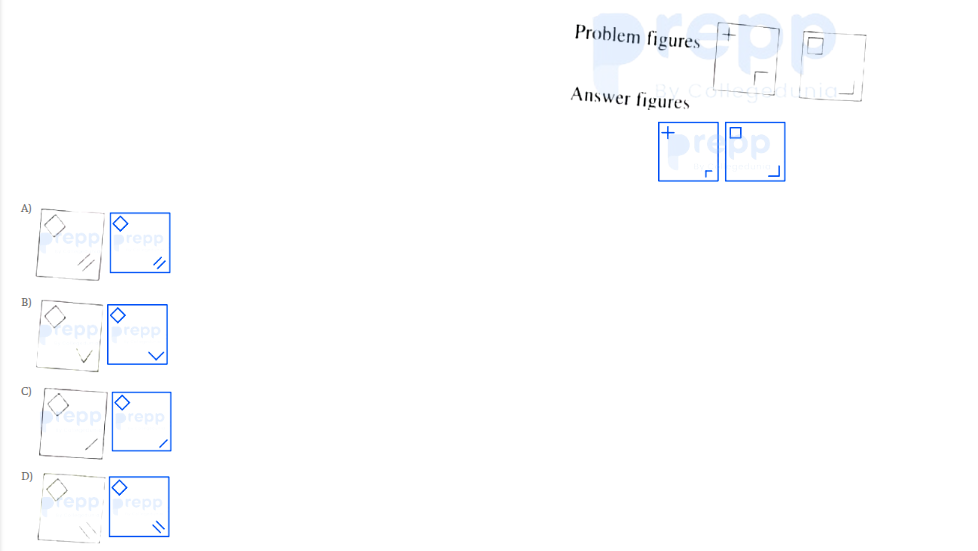
Refer to the given image_b9bc25.png for Q.122.
Direction: In the question below, two problem figures are given. These are followed by four answer figures indicated by (A), (B), (C) and (D). The two problem figures have some common characteristic features. You have to find out one of the answer figures which has the same commonality.
- AFigure (A)
- BFigure (B)
- CFigure (C)
- DFigure (D)
Solution & Step-by-step Explanation
By observing the two problem figures in image_b9bc25.png:
1. Both figures consist of a large outer square.
2. Both figures contain a small right-angle bracket in the bottom-right corner that runs parallel to the corner of the outer square.
3. Each figure has a different small geometric symbol near the top (a plus sign in the first, and a small square in the second).
Therefore, the common characteristic feature is the presence of a single right-angle bracket at the bottom-right corner duplicating the corner of the outer square.
Looking at the answer figures (A), (B), (C), and (D):
* Figure (A) has two parallel diagonal lines at the bottom-right.
* Figure (B) has a V-shape pointing downwards at the bottom-right.
* Figure (C) contains a single right-angle bracket at the bottom-right corner that perfectly parallels the outer square's corner, matching the common feature of the problem figures.
* Figure (D) has two parallel lines at the bottom-right.
Hence, Figure (C) is the correct choice.
1. Both figures consist of a large outer square.
2. Both figures contain a small right-angle bracket in the bottom-right corner that runs parallel to the corner of the outer square.
3. Each figure has a different small geometric symbol near the top (a plus sign in the first, and a small square in the second).
Therefore, the common characteristic feature is the presence of a single right-angle bracket at the bottom-right corner duplicating the corner of the outer square.
Looking at the answer figures (A), (B), (C), and (D):
* Figure (A) has two parallel diagonal lines at the bottom-right.
* Figure (B) has a V-shape pointing downwards at the bottom-right.
* Figure (C) contains a single right-angle bracket at the bottom-right corner that perfectly parallels the outer square's corner, matching the common feature of the problem figures.
* Figure (D) has two parallel lines at the bottom-right.
Hence, Figure (C) is the correct choice.