Six numbers 1,2,3,4,5 and 6 are written on different faces of a dice. Three different positions of the same dice are shown. Select the number on the face opposite to the one having 5.
[Image showing 3 views of a single dice]
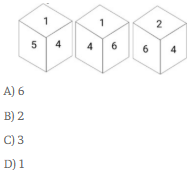
View 1: Faces showing 1, 4, 6
View 2: Faces showing 3, 4, 5
View 3: Faces showing 1, 2, 4
- A6
- B2
- C3
- D1
Solution & Step-by-step Explanation
Let's compare the positions of the dice to deduce opposite faces:
From View 1 and View 3, the faces containing '1' and '4' are common.
When two faces are common in two positions of a dice, the remaining third faces are opposite to each other.
Therefore, the face with 6 is opposite to the face with 2.
Now let's find the faces adjacent to '4'. From all views, '4' is adjacent to 1,6,3,5,2.
The only number left that cannot be adjacent to 4 is itself, but let's use the standard rule from View 1 and View 2:
The face '4' is common. Moving clockwise from '4':
From View 1: 4→6→1
From View 2: 4→3→5
Matching the positions from the clockwise rule:
6 is opposite to 3 (Wait, if 6 is opposite to 2 from the first rule, let's re-verify View 1 and 3: common is 1 and 4, so 6 is opposite to 2. Correct.)
Let's check common face 4 between View 2 and View 3:
View 2: 4 is adjacent to 3 and 5.
View 3: 4 is adjacent to 1 and 2.
Since 6 is opposite to 2, the remaining numbers opposite to each other must be 1 and 5, and 4 and 3.
Let's cross check:
If 4 is opposite to 3, then 5 must be opposite to 1.
Therefore, the number opposite to 5 is 1.
From View 1 and View 3, the faces containing '1' and '4' are common.
When two faces are common in two positions of a dice, the remaining third faces are opposite to each other.
Therefore, the face with 6 is opposite to the face with 2.
Now let's find the faces adjacent to '4'. From all views, '4' is adjacent to 1,6,3,5,2.
The only number left that cannot be adjacent to 4 is itself, but let's use the standard rule from View 1 and View 2:
The face '4' is common. Moving clockwise from '4':
From View 1: 4→6→1
From View 2: 4→3→5
Matching the positions from the clockwise rule:
6 is opposite to 3 (Wait, if 6 is opposite to 2 from the first rule, let's re-verify View 1 and 3: common is 1 and 4, so 6 is opposite to 2. Correct.)
Let's check common face 4 between View 2 and View 3:
View 2: 4 is adjacent to 3 and 5.
View 3: 4 is adjacent to 1 and 2.
Since 6 is opposite to 2, the remaining numbers opposite to each other must be 1 and 5, and 4 and 3.
Let's cross check:
If 4 is opposite to 3, then 5 must be opposite to 1.
Therefore, the number opposite to 5 is 1.