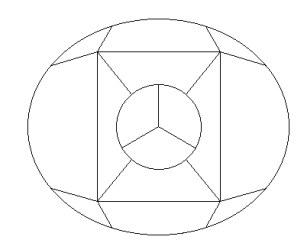
The 15 parts of the given figure are to be painted such that no two adjacent parts with shared boundaries (excluding corners) have the same color. The minimum number of colors required is
- A4
- B3
- C5
- D6
Solution & Step-by-step Explanation
To solve the problem of determining the minimum number of colors required to paint the given figure such that no two adjacent parts share the same color, we can use the concept of graph coloring.
Step-by-step solution:
- Each region in the figure can be considered a vertex in a graph. An edge is drawn between two vertices if the corresponding regions share a boundary.
- The problem then reduces to finding the chromatic number of the graph, which is the minimum number of colors needed to color the vertices so that no two adjacent vertices have the same color.
- The given figure is typically structured such that the chromatic number, in many cases like this, follows a four-color theorem which states any planar graph can be colored with no more than four colors.
- By examining the structure of the figure, we can attempt to color it using four colors, ensuring no adjacent parts share the same color.
Conclusion:
Based on the four-color theorem and the examination of the structure of the figure, the minimum number of colors required is 4. Thus, the correct answer is 4.
Step-by-step solution:
- Each region in the figure can be considered a vertex in a graph. An edge is drawn between two vertices if the corresponding regions share a boundary.
- The problem then reduces to finding the chromatic number of the graph, which is the minimum number of colors needed to color the vertices so that no two adjacent vertices have the same color.
- The given figure is typically structured such that the chromatic number, in many cases like this, follows a four-color theorem which states any planar graph can be colored with no more than four colors.
- By examining the structure of the figure, we can attempt to color it using four colors, ensuring no adjacent parts share the same color.
Conclusion:
Based on the four-color theorem and the examination of the structure of the figure, the minimum number of colors required is 4. Thus, the correct answer is 4.