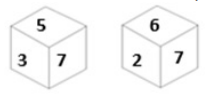
The faces of a dice are marked with the numbers and . Two different positions of this dice are described. In the first position, the numbers and are visible. In the second position, the numbers and are visible. Select the number that will be on the face opposite to the face showing .
- A3
- B6
- C7
- D2
Solution & Step-by-step Explanation
From the two given positions of the dice, the number is common to both positions.
* In the first position, is adjacent to and .
* In the second position, is adjacent to and .
This means that the face with number is adjacent to four faces: and . Since a face on a standard cube can only have four adjacent faces, the remaining unmentioned number must be directly opposite to it.
The remaining number from the set is .
Therefore, the face opposite to is .
* In the first position, is adjacent to and .
* In the second position, is adjacent to and .
This means that the face with number is adjacent to four faces: and . Since a face on a standard cube can only have four adjacent faces, the remaining unmentioned number must be directly opposite to it.
The remaining number from the set is .
Therefore, the face opposite to is .