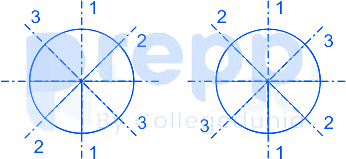
The figure below shows the front and rear view of a disc, which is shaded with identical patterns. The disc is flipped once with respect to any one of the fixed axes 1-1, 2-2 or 3-3 chosen uniformly at random.
What is the probability that the disc DOES NOT retain the same front and rear views after the flipping operation?
- A0
- B1/3
- C2/3
- D1
Solution & Step-by-step Explanation
Given:
There are two figures that represent the front and rear view of a disc.
Concept used:
Lines of symmetry are imaginary lines that pass through the center of the shape or object and divide it into identical halves.
Formula used:
Probability to does not retain same view = 1 - Probability to retain the same view
Calculation:
From the front and rear view of the disc, we conclude that the view is only symmetrical about 1-1 axis.
Therefore, the disc will retain the same front and rear views after the flipping operation after flipping about 1-1 axis out of three given axis.
∴ Probability to retain the same front and rear view of the disc = 1/3
∴ The probability that the disc DOES NOT retain the same front and rear views = 1 - 1/3 = 2/3
∴ The probability that the disc DOES NOT retain the same front and rear views after the flipping operation are 2/3.
There are two figures that represent the front and rear view of a disc.
Concept used:
Lines of symmetry are imaginary lines that pass through the center of the shape or object and divide it into identical halves.
Formula used:
Probability to does not retain same view = 1 - Probability to retain the same view
Calculation:
From the front and rear view of the disc, we conclude that the view is only symmetrical about 1-1 axis.
Therefore, the disc will retain the same front and rear views after the flipping operation after flipping about 1-1 axis out of three given axis.
∴ Probability to retain the same front and rear view of the disc = 1/3
∴ The probability that the disc DOES NOT retain the same front and rear views = 1 - 1/3 = 2/3
∴ The probability that the disc DOES NOT retain the same front and rear views after the flipping operation are 2/3.