82 Calculus questions from AIEEE with detailed answers and explanations. Free previous year questions and MCQs.
📚
82
Questions
🟢
0
Easy
🟡
78
Medium
🔴
4
Hard
Years:2026 (79)2004 (3)
Calculus — AIEEE(1–82 of 82)
Filter:
Q1mediummcqMathematicsAIEEE 20072026
0% accuracy
Let F(x)=f(x)+f(1/x), where f(x)=∫1x1+tlogetdt. Then F(e) equals:
Q2mediummcqMathematicsAIEEE 20072026
0% accuracy
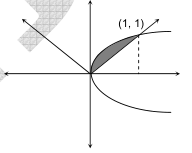
The area enclosed between the curves y2=x and y=∣x∣ is:
Q3mediummcqMathematicsAIEEE 20072026
0% accuracy
∫cosx+3sinxdx equals:
Q4mediummcqMathematicsAIEEE 20072026
0% accuracy
The solution for x of the equation ∫2xtt2−1dt=12π is:
Q5mediummcqMathematicsAIEEE 20062026
0% accuracy
The value of the integral ∫369−x+xxdx is:
Q6mediummcqMathematicsAIEEE 20062026
0% accuracy
∫0πxf(sinx)dx is equal to:
Q7mediummcqMathematicsAIEEE 20062026
0% accuracy
∫−π/2π/2[[x+π]+cos(x+3π)]dx is equal to (where [⋅] denotes the greatest integer function):
Q8mediummcqMathematicsAIEEE 20062026
0% accuracy
The function f(x)=2x+x2 has a local minimum at:
Q9mediummcqMathematicsAIEEE 20062026
0% accuracy
Angle between the tangents to the curve y=x2−5x+6 at the points (2,0) and (3,0) is:
Q10mediummcqMathematicsAIEEE 20062026
0% accuracy
The set of points where f(x)=1+∣x∣x is differentiable is:
Q11mediummcqMathematicsAIEEE 20062026
0% accuracy
A triangular park is enclosed on two sides by a fence and on the third side by a straight river bank. The two sides having fence are of same length x. The maximum area enclosed by the park is:
Q12mediummcqMathematicsAIEEE 20062026
0% accuracy
The value of ∫1a[x]f′(x)dx,a>1, where [x] denotes the greatest integer not exceeding x, is:
Q13mediummcqMathematicsAIEEE 20062026
0% accuracy
The differential equation whose solution is Ax2+By2=1, where A and B are arbitrary constants, is of:
Q14mediummcqMathematicsAIEEE 20062026
0% accuracy
If xmyn=(x+y)m+n, then dxdy is:
Q15mediummcqPhysicsAIEEE 20062026
0% accuracy
A particle located at x=0 at time t=0, starts moving along the positive x -direction with a velocity v that varies as v=αx. The displacement of the particle varies with time as:
Q16mediummcqMathematicsAIEEE 20072026
0% accuracy
A value of c for which the conclusion of Mean Value Theorem holds for the function f(x)=logex on the interval [1,3] is:
Q17mediummcqMathematicsAIEEE 20092026
1: The set {x:f(x)=f−1(x)}={0,−1} where f(x)=(x+1)2−1,x≥−1. 2: f is a bijection.
Q18mediummcqMathematicsAIEEE 20092026
∫0π[cotx]dx, where [⋅] denotes the greatest integer function, is equal to:
Q19mediummcqMathematicsAIEEE 20092026
For real x, let f(x)=x3+5x+1, then:
Q20mediummcqMathematicsAIEEE 20092026
The differential equation which represents the family of curves y=c1ec2x, where c1 and c2 are arbitrary constants is:
Q21mediummcqMathematicsAIEEE 20092026
Let y be an implicit function of x defined by x2x−2xxcoty−1=0. Then y′(1) equals:
Q22mediummcqMathematicsAIEEE 20092026
The area of the region bounded by the parabola (y−2)2=x−1, the tangent to the parabola at the point (2,3) and the x-axis is:
Q23mediummcqMathematicsAIEEE 20092026
Given P(x)=x4+ax3+bx2+cx+d such that x=0 is the only real root of P′(x)=0. If P(−1)<P(1), then in the interval [−1,1]:
The limit limn→∞n1[sec2n21+sec2n24+⋯+sec21] equals:
Q27mediummcqMathematicsAIEEE 20122026
Consider the function f(x)=∣x−2∣+∣x−5∣,x∈R.Statement 1: f′(4)=0 Statement 2: f is continuous in [2,5], differentiable in (2,5) and f(2)=f(5).
Q28mediummcqMathematicsAIEEE 20122026
If g(x)=∫0xcos4tdt, then g(x+π) equals:
Q29mediummcqMathematicsAIEEE 20122026
If f:R→R is a function defined by f(x)=[x]cos(22x−1π), where [x] denotes the greatest integer function, then f is:
Q30mediummcqMathematicsAIEEE 20122026
Let a,b∈R be such that the function f given by f(x)=ln∣x∣+bx2+ax,x=0 has extreme values at x=−1 and x=2.Statement 1: f has local maximum at x=−1 and at x=2.Statement 2: a=21 and b=−41.
Q31mediummcqMathematicsAIEEE 20122026
The population p(t) at time t of a certain mouse species satisfies the differential equation dtdp(t)=0.5p(t)−450. If p(0)=850, then the time at which the population becomes zero is:
Q32mediummcqMathematicsAIEEE 20122026
If the integral ∫tanx−25tanxdx=x+aln∣sinx−2cosx∣+k, then a is equal to:
Let I be the purchase value of an equipment and V(t) be the value after it has been used for t years. The value V(t) depreciates at a rate given by differential equation dtdV(t)=−k(T−t), where k>0 is a constant and T is the total life in years of the equipment. Then the scrap value V(T) of the equipment is:
Q37mediummcqPhysicsAIEEE 20122026
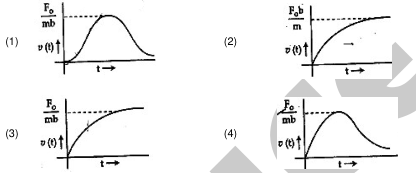
A particle of mass m is at rest at the origin at time t=0. It is subjected to a force F(t)=F0e−bt in the x direction. Its speed v(t) is depicted by which of the following curves?
An object, moving with a speed of 6.25m/s, is decelerated at a rate given by: dtdv=−2.5v where v is the instantaneous speed. The time taken by the object, to come to rest, would be:
Q43mediummcqMathematicsAIEEE2026
Let f:(−1,1)→R be a differentiable function with f(0)=−1 and f′(0)=1. Let g(x)=[f(2f(x)+2)]2. Then g′(0)=
Q44mediummcqMathematicsAIEEE2026
Let f:R→R be a positive increasing function with limx→∞f(x)f(3x)=1. Then limx→∞f(x)f(2x)=
Q45mediummcqMathematicsAIEEE2026
Let f:R→R be a continuous function defined by f(x)=ex+2e−x1.Statement-1: f(c)=31, for some c∈R.Statement-2: 0<f(x)≤221, for all x∈R.
Q46mediummcqMathematicsAIEEE2026
Let f:R→R be defined by f(x)={k−2x,2x+3,if x≤−1if x>−1. If f has a local minimum at x=−1, then a possible value of k is:
Q47mediummcqMathematicsAIEEE2026
The equation of the tangent to the curve y=x+x24, that is parallel to the x -axis, is:
Q48mediummcqMathematicsAIEEE 20092026
1: g∘f is differentiable at x=0 and its derivative is continuous at that point, where f(x)=x∣x∣ and g(x)=sinx. 2: g∘f is twice differentiable at x=0.
Q49mediummcqMathematicsAIEEE2026
The area enclosed between the curve y=loge(x+e) and the coordinate axes is:
Q50mediummcqMathematicsAIEEE2026
If the equation anxn+an−1xn−1+⋯+a1x=0,a1=0,n≥2, has a positive root x=α, then the equation nanxn−1+(n−1)an−1xn−2+⋯+a1=0 has a positive root, which is:
Q51mediummcqMathematicsAIEEE2026
The value of ∫−ππ1+cos2x2x(1+sinx)dx is:
Q52mediummcqMathematicsAIEEE2026
Let f(x) be a non-negative continuous function such that the area bounded by the curve y=f(x), x-axis and the ordinates x=π/4 and x=β>π/4 is βsinβ+4πcosβ+2β. Then f(π/2) is:
Q53mediummcqMathematicsAIEEE2026
Let f:R→R be a differentiable function having f(2)=6,f′(2)=481. Then limx→2x−2∫6f(x)4t3dt equals:
Q54mediummcqMathematicsAIEEE2026
∫{1+(logx)2(logx−1)}2dx is equal to:
Q55mediummcqMathematicsAIEEE2026
A spherical iron ball 10 cm in radius is coated with a layer of ice of uniform thickness that melts at a rate of 50 cm3/min. When the thickness of ice is 5 cm, then the rate at which the thickness of ice decreases, is:
Q56mediummcqMathematicsAIEEE2026
If xdxdy=y(logy−logx+1), then the solution of the equation is:
Q57mediummcqMathematicsAIEEE2026
The parabolas y2=4x and x2=4y divide the square region bounded by the lines x=4,y=4 and the coordinate axes into three parts. If S1,S2,S3 are respectively the areas of these parts numbered from top to bottom, then S1:S2:S3 is:
Q58mediummcqMathematicsAIEEE-CBSE-ENG-032026
The real number x when added to its inverse gives the minimum value of the sum at x equal to:
Q59mediummcqMathematicsAIEEE2026
If I1=∫012x2dx,I2=∫012x3dx,I3=∫122x2dx and I4=∫122x3dx, then:
Q60mediummcqMathematicsAIEEE2026
If f is a real-valued differentiable function satisfying ∣f(x)−f(y)∣≤(x−y)2 for x,y∈R and f(0)=0, then f(1) equals:
Q61mediummcqMathematicsAIEEE2026
Let f be differentiable for all x. If f(1)=−2 and f′(x)≥2 for x∈[1,6], then:
Q62mediummcqMathematicsAIEEE2026
Suppose f(x) is differentiable at x=1 and limh→0hf(1+h)=5, then f′(1) equals:
Q63mediummcqMathematicsAIEEE2026
Let α and β be the distinct roots of ax2+bx+c=0, then limx→α(x−α)21−cos(ax2+bx+c) is equal to:
Q64mediummcqMathematicsAIEEE2026
A function is matched below against an interval where it is supposed to be increasing. Which of the following pairs is incorrectly matched?
Q65mediummcqMathematicsAIEEE2026
The normal to the curve x=a(cosθ+θsinθ), y=a(sinθ−θcosθ) at any point θ is such that:
Q66mediummcqMathematicsAIEEE-CBSE-ENG-032026
If f(x)=xn, then the value of f(1)−1!f′(1)+2!f′′(1)−3!f′′′(1)+⋯+(−1)nn!fn(1) is:
Q67mediummcqMathematicsAIEEE-CBSE-ENG-032026
Let f(x) be a function satisfying f′(x)=f(x) with f(0)=1 and g(x) be a function that satisfies f(x)+g(x)=x2. Then the value of the integral ∫01f(x)g(x)dx, is:
Q68mediummcqMathematicsAIEEE-CBSE-ENG-032026
The area of the region bounded by the curves y=∣x−1∣ and y=3−∣x∣ is:
Q69mediummcqMathematicsAIEEE-CBSE-ENG-032026
Let dxdF(x)=xesinx, x>0. If ∫14x3esinx3dx=F(k)−F(1), then one of the possible values of k, is:
Q70mediummcqMathematicsAIEEE-CBSE-ENG-032026
limn→∞[n413+23+33+⋯+n3]−limn→∞[n514+24+34+⋯+n4] is:
Q71mediummcqMathematicsAIEEE-CBSE-ENG-032026
The value of the integral I=∫01x(1−x)ndx is:
Q72mediummcqMathematicsAIEEE-CBSE-ENG-032026
The value of limx→0xsinx∫0x2sec2tdt is:
Q73mediummcqMathematicsAIEEE-CBSE-ENG-032026
If f(a+b−x)=f(x), then ∫abxf(x)dx is equal to:
Q74mediummcqMathematicsAIEEE-CBSE-ENG-032026
If f(y)=ey, g(y)=y for y>0 and F(t)=∫0tf(t−y)g(y)dy, then:
Q75mediummcqMathematicsAIEEE-CBSE-ENG-032026
If the function f(x)=2x3−9ax2+12a2x+1, where a>0, attains its maximum and minimum at p and q respectively such that p2=q, then a equals:
Q76mediummcqMathematicsAIEEE-CBSE-ENG-032026
If f(x)={xe−(∣x∣1+x1),0,x=0x=0 then f(x) is:
Q77mediummcqMathematicsAIEEE-CBSE-ENG-032026
Let f(a)=g(a)=k and their n th derivatives fn(a),gn(a) exist and are not equal for some n. Further if limx→af(x)−g(x)f(a)g(x)−f(a)g(a)−g(a)f(x)+g(a)f(a)=4, then the value of k is:
Q78mediummcqMathematicsAIEEE-CBSE-ENG-032026
If limx→0xlog(3+x)−log(3−x)=k, the value of k is:
Q79mediummcqMathematicsAIEEE-CBSE-ENG-032026
limx→π[π−2x]2tan[1−sin(x/2)] is:
Q80hardmcqMathematicsAIEEE 20042004
0% accuracy
If x=ey+ey+...to⋅∞,x>0 then dxdy is
Q81hardmcqMathematicsAIEEE 20042004
0% accuracy
A function y=f(x) has a second order derivative f′′(x)=6(x−1). If its graph passes through the point (2,1) and at that point the tangent to the graph is y=3x−5, then the function is
Q82mediummcqMathematicsAIEEE 20042004
0% accuracy
Let f(x)=4x−π1−tanx,x=4π,x∈[0,2π]. If f(x) is continuous in [0,2π], then f(4π) is
AIEEE Calculus — FAQ
How many Calculus questions come in AIEEE?▼
Our database has 82 Calculus questions from AIEEE covering 2004 to 2026.
What difficulty are AIEEE Calculus questions?▼
The 82 AIEEE Calculus questions include 0 easy, 78 medium and 4 hard level questions.
Where can I find more Calculus questions for other exams?▼
Visit /tag/calculus to see all Calculus questions across all exams including Mathematics Mock Test - 10, Mathematics Mock Test - 5, Mathematics Mock Test - 3.