HomeTestsSearchRankProfile

Plant Reproduction Questions

Practice 28 Plant Reproduction questions with detailed answers and explanations. Free MCQs, PYQs, and mock test questions for NEET, JEE, GATE, SSC and more.

📚
28
Total Questions
🟢
12
Easy
🟡
16
Medium
🔴
0
Hard

About Plant Reproduction — practice questions, PYQs & concepts

Plant Reproduction is a frequently-tested topic on Biology, General Awareness, Mathematics and Science. ExamTest.live currently lists 28 Plant Reproduction questions spanning previous-year papers from 2018 to 2026, each with worked solutions and a step-by-step explanation. Use the filters on this page to focus on a specific exam, difficulty level or year — every answer key is free, no sign-up required.

Plant Reproduction weight in competitive exams

Across our Plant Reproduction question bank, the largest sources are Biology (21), General Awareness (3), Mathematics and Science (2), General Science (1) and Environmental Studies (1). Click any exam chip above to drill down to that exam-specific question set.

How to use this page

  • Start easy: 12 easy Plant Reproduction questions are available — build fluency before moving up.
  • Target weak years: Use the year filter to focus on the most recent 2026 paper or older PYQs you have not attempted.
  • Time yourself: Every question shows the average solve time so you can benchmark your speed against other students.
  • Read every explanation: Even on questions you got right — the explanation often surfaces a faster approach you can reuse.
All Plant Reproduction Questions(128 of 28)

Filter:
Q1mediummcqBiologyCompetitive Exam Practice Paper2026
0% accuracy
'Globule' and 'Nucule' is found in :
Q2mediummcqBiologyCompetitive Exam Practice Paper2026
0% accuracy
Transfer of pollen from anther to the stigma of the same flower is referred to as:
Q3easymcqBiologyNEET 20222026
Given below are two statements:Statement I: Cleistogamous flowers are invariably autogamous.Statement II: Cleistogamy is disadvantageous as there is no chance for cross pollination.In the light of the above statements, choose the correct answer from the options given below:
Q4mediummcqGeneral ScienceCompetitive Exam Paper2026
Pollen is produced in which part of the flower?
Q5mediummcqMathematics and ScienceUPTET Paper 2 (Maths & Science)2026
Seedless fruits are of no use in
Q6mediummcqEnvironmental StudiesUPTET 2021 Memory Based Paper 12026
Which structure is triploid () in angiospermous plants?
Q7mediummcqGeneral AwarenessIndian Competitive Exam2026
The following are three processes of reproduction in plants:(a) Vegetative,(b) Sexual,(c) AsexualWhich of them is adopted by algae?
Q8mediummcqGeneral AwarenessUP Police Constable2026
In plants/trees, after fertilisation the ovary matures to form the:
Q9mediummcqGeneral AwarenessUP Police Constable2026
Out of the following options, choose the name of a spore-producing plant:
Q10easymcqBiologyNEET 20232026
Given below are two statements: one is labelled as Assertion A and the other is labelled as Reason R:Assertion A: A flower is defined as modified shoot wherein the shoot apical meristem changes to floral meristem.Reason R: Internode of the shoot gets condensed to produce different floral appendages laterally at successive nodes instead of leaves.In the light of the above statements, choose the correct answer:
Q11mediummcqBiologyNEET 20232026
In angiosperm, the haploid, diploid and triploid structures of a fertilized embryo sac sequentially are:
Q12easymcqBiologyNEET 20232026
Large, colourful, fragrant flowers with nectar are seen in:
Q13easymcqBiologyNEET 20232026
What is the function of tassels in the corn cob?
Q14mediummcqBiologyNEET 20222026
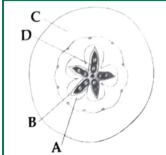
Which part of the fruit, labelled in the given figure makes it a false fruit?
image
Q15easymcqBiologyNEET 20222026
Identify the incorrect statement related to Pollination:
Q16easymcqBiologyNEET 20212026
In some members of which of the following pairs of families, pollen grains retain their viability for months after release?
Q17easymcqBiologyNEET 20212026
The term used for transfer of pollen grains from anthers of one plant to stigma of a different plant which, during pollination, brings genetically different types of pollen grains to stigma, is:
Q18easymcqBiologyNEET 20212026
A typical angiosperm embryo sac at maturity is:
Q19easymcqMathematics and ScienceUPTET Paper 2 (Maths & Science)2018
True fruits develop from
Q20mediummcqBiologyBiology
What would be the number of chromosomes in the cells of the aleurone layer in a plant species with 8 chromosomes in its synergids ?
Q21mediummcqBiologyBiology
In angiosperms, microsporogenesis and megasporogenesis:
Q22easymcqBiologyBiology
Which one of the following fruits is parthenocarpic?
Q23easymcqBiologyBiology
The coconut water and the edible part of coconut are equivalent to:
Q24mediummcqBiologyBiology
Even in the absence of pollinating agents, seed-setting is assured in:
Q25mediummcqBiologyBiology
Both autogamy and geitonogamy are prevented in:
Q26easymcqBiologyBiology
An organic substance that can withstand environmental extremes and cannot be degraded by any enzyme is:
Q27mediummcqBiologyBiology
In angiosperms, functional megaspore develops into:
Q28mediummcqBiologyBiology
Which one of the following pairs is wrongly matched while the remaining three are correct?

Frequently Asked Questions

How many Plant Reproduction questions are on ExamTest.live?
We have 28 Plant Reproduction questions spread across 1 pages, covering easy, medium, and hard difficulty levels with detailed explanations.
Are Plant Reproduction MCQs free?
Yes. All Plant Reproduction questions, answers, and explanations on ExamTest.live are completely free. No account or subscription required.
Which exams include Plant Reproduction questions?
Plant Reproduction questions are commonly asked in Biology, General Awareness, Mathematics and Science, General Science, Environmental Studies. You can filter by exam using the links above.
How do I practice Plant Reproduction questions effectively?
Start with easy questions to build confidence, then tackle medium and hard ones. Use the filter buttons to sort by difficulty. Reveal the answer only after attempting each question, and read the explanation thoroughly.