AIEEE 2003
current electricity Questions
37 current electricity questions from AIEEE 2003 with detailed answers and explanations. Free previous year questions and MCQs.
📚
37
Questions
🟢
8
Easy
🟡
25
Medium
🔴
4
Hard
Years:2026 (37)
current electricity — AIEEE 2003(1–37 of 37)
Filter:
Alternating current cannot be measured by a D.C. ammeter because:
In an LCR series a.c. circuit, the voltage across each of the components, and is . The voltage across the combination will be:
The electrochemical equivalent of a metal is per coulomb. The mass of the metal liberated at the cathode when a current is passed for will be:
The thermo emf of a thermocouple varies with the temperature of the hot junction as in volts where the ratio is . If the cold junction is kept at , then the neutral temperature is:
Time taken by a heater to heat one litre of water from to is:
In a metre bridge experiment, a null point is obtained at from one end of the wire when resistance is balanced against another resistance . If , then where will be the new position of the null point from the same end, if one decides to balance a resistance of against ?
An electric current is passed through a circuit containing two wires of the same material connected in parallel. If the length and radii of the wires are in the ratio of and , then the ratio of the currents passing through the wires will be:
The resistance of the series combination of two resistances is . When they are joined in parallel, the total resistance is . If , then the minimum possible value of is:
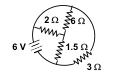
A battery is connected to a network of resistors. If the equivalent resistance of the network is , the total current supplied by the battery is:
In a LCR circuit, capacitance is changed from to . For the resonant frequency to remain unchanged, the inductance should be changed from to:
The resistance of a wire is at and at . The resistance of the wire at will be:
A material has twice the specific resistance (resistivity) of . A circular wire made of has twice the diameter of a wire made of . For the two wires to have the same resistance, the ratio of their respective lengths must be:
Kirchhoff’s first law () and second law () are respectively based on the conservation of:
In a Wheatstone’s bridge, three resistances and are connected in three arms and the fourth arm is formed by two resistances and connected in parallel. The condition for the bridge to be balanced is:
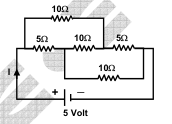
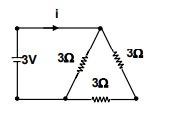
The current drawn from the source in the following circuit is:
The resistance of a bulb filament is at a temperature of . If its temperature coefficient of resistance be per , its resistance will become at a temperature of:
An electric bulb is rated . The power consumed by it when operated on will be:
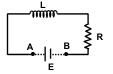
An inductor (), a resistor () and a battery () are connected in series. After a long time, the battery is disconnected after short-circuiting. The current in the circuit after the short-circuit is:
Current enters at point A and leaves at point D of a conducting block. To find the voltage between points B and C, we assume current spreads over a hemispherical surface. The electric field at distance is . The potential difference is:
A battery ( internal resistance) and a battery ( internal resistance) are connected in parallel to a resistor. The current in the resistor is:
This question contains Statement-1 and Statement-2. Of the four choices given after the statements, choose the one that best describes the two statements.
Statement 1: The temperature dependence of resistance is usually given as . The resistance of a wire changes from to when its temperature is increased from to . This implies that .
Statement 2: is valid only when the change in the temperature is small and .
Statement 1: The temperature dependence of resistance is usually given as . The resistance of a wire changes from to when its temperature is increased from to . This implies that .
Statement 2: is valid only when the change in the temperature is small and .
Two conductors have the same resistance at but their temperature coefficients of resistance are and . The respective temperature coefficients of their series and parallel combinations are nearly:
A resistor and capacitor in series is connected through a switch to direct supply. Across the capacitor is a neon bulb that lights up at . Calculate the value of to make the bulb light up after the switch has been closed. ()
If a wire is stretched to make it longer, its resistance will:
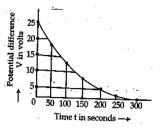
The figure shows an experimental plot for discharging of a capacitor in an R-C circuit. The time constant of this circuit lies between:(Note: Graph shows at , at , at )
The length of a given cylindrical wire is increased by . Due to the consequent decrease in diameter, the percentage change in the resistance of the wire will be:
Two electric bulbs marked and are connected in series to a supply. Which of the bulbs will fuse?
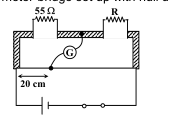
Shown in the figure is a meter-bridge setup with null deflection in the galvanometer. One resistor is and the balancing length from left is . The value of the unknown resistor on the right side is:
In an oscillating circuit the maximum charge on the capacitor is . The charge on the capacitor when the energy is stored equally between the electric and magnetic field is:
The thermo e.m.f. of a thermo-couple is at room temperature. A galvanometer of resistance, capable of detecting current as low as , is connected with the thermocouple. The smallest temperature difference that can be detected by this system is:
A strip of copper and another of germanium are cooled from room temperature to . The resistance of:
A , bulb is connected across a mains supply. The power consumed will be:
The length of a wire of a potentiometer is , and the e.m.f. of its standard cell is volt. It is employed to measure the e.m.f. of a battery whose internal resistance is . If the balance point is obtained at from the positive end, the e.m.f. of the battery is:
A battery with negligible internal resistance is connected in a circuit as shown. (Circuit consists of three resistors, two in parallel, then in series with the third). The current in the circuit will be:
An ammeter reads up to . Its internal resistance is . To increase the range to , the value of the required shunt is:
AIEEE 2003 current electricity — FAQ
How many current electricity questions come in AIEEE 2003?▼
Our database has 37 current electricity questions from AIEEE 2003 covering 2026 to 2026.
What difficulty are AIEEE 2003 current electricity questions?▼
The 37 AIEEE 2003 current electricity questions include 8 easy, 25 medium and 4 hard level questions.
Where can I find more current electricity questions for other exams?▼
Visit /tag/current-electricity to see all current electricity questions across all exams including Physics, AIEEE 2004, AIEEE 2003.