Physics
electrostatics Questions
43 electrostatics questions from Physics with detailed answers and explanations. Free previous year questions and MCQs.
📚
43
Questions
🟢
8
Easy
🟡
25
Medium
🔴
10
Hard
electrostatics — Physics(1–43 of 43)
Filter:
A parallel plate capacitor made of circular plates is being charged such that the surface charge density on its plates is increasing at a constant rate with time. The magnetic field arising due to displacement current is:
Two identical charged conducting spheres A and B have their centres separated by a certain distance. Charge on each sphere is and the force of repulsion between them is . A third identical uncharged conducting sphere is brought in contact with sphere A first and then with B and finally removed from both. New force of repulsion between spheres A and B (Radii of A and B are negligible compared to the distance of separation so that for calculating force between them they can be considered as point charges) is best given as:
An electric dipole with dipole moment is aligned with the direction of a uniform electric field of magnitude . The dipole is then rotated through an angle of with respect to the electric field. The change in the potential energy of the dipole is:
The plates of a parallel plate capacitor are separated by . Two slabs of different dielectric constant and with thickness and , respectively are inserted in the capacitor. Due to this, the capacitance becomes two times larger than when there is nothing between the plates. If , the value of is:
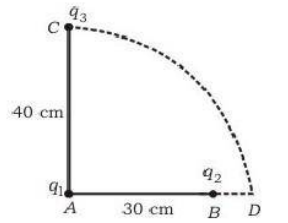
Two charges q1 and q2 are placed 30 cm apart, as shown in the figure. A third charge q3 is moved along the arc of a circle of radius 40 cm from C to D. The change in the potential energy of the system is (q3/4πε0)k, where k is :
A parallel plate condenser has a uniform electric field (V/m) in the space between the plates. If the distance between the plates is (m) and area of each plate is (), the energy (joules) stored in the condenser is:
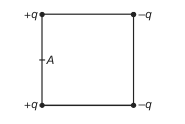
Four electric charges and are placed at the corners of a square of side . The electric potential at point , midway between the two charges and , is:
A charge is enclosed by a Gaussian spherical surface of radius . If the radius is doubled, then the outward electric flux will:
Three-point charges , and are placed at points , and , respectively. The magnitude and direction of the electric dipole moment vector of this charge assembly are:
Two condensers, one of capacity and the other of capacity are connected to a volt battery, as shown. The work done in charging fully both the condensers is:
A hollow cylinder has a charge coulomb within it (at the geometrical centre). If is the electric flux associated with the curved surface , the flux linked with the plane surface is:
Charges and are placed at points and , respectively; distance apart. is the midpoint. The work done in moving a charge along the semicircle is:
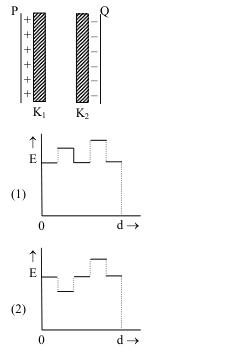
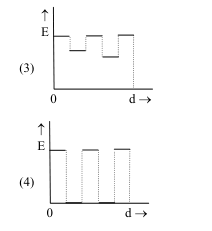
Two thin dielectric slabs of dielectric constants and () are inserted between plates of a parallel plate capacitor. The variation of electric field ' ' between the plates with distance ' ' as measured from plate is correctly shown by:
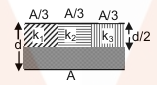
A parallel-plate capacitor of area , separation and capacitance is filled with four dielectric materials as shown. If a single dielectric material is to be used to have the same capacitance , then its dielectric constant is:
An electric dipole is placed at an angle of with an electric field intensity . It experiences a torque equal to . The charge on the dipole, if the dipole length is , is:
Two identical charged spheres suspended from a common point by two massless strings of lengths , are initially at a distance apart because of their mutual repulsion. The charges begin to leak from both the spheres at a constant rate. As a result, the spheres approach each other with a velocity . Then varies as a function of the distance between the spheres, as:
A parallel plate capacitor has a uniform electric field in the space between the plates. If the distance between the plates is and area of each plate is , the energy stored in the capacitor is:
An electric dipole of moment is placed in an electric field of intensity . The dipole acquires a position such that the axis of the dipole makes an angle with the direction of the field. Assuming that the potential energy of the dipole to be zero when , the torque and the potential energy of the dipole will respectively be:
Four point charges and are placed, one at each corner of the square. The relation between and for which the potential at the centre of the square is zero is:
What is the flux through a cube of side ‘ ’ if a point charge of is at one of its corners?
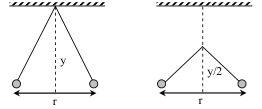
Two pith balls carrying equal charges are suspended from a common point by strings of equal length. The equilibrium separation between them is . Now the strings are rigidly clamped at half the height (). The equilibrium separation between the balls now becomes:
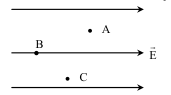
and are three points in a uniform electric field directed along the positive x-axis. is further left than , and is further left than . The electric potential is:
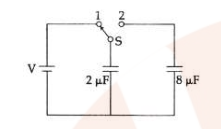
A capacitor of is charged as shown in the diagram. When the switch is turned to position 2, the percentage of its stored energy dissipated is:
A conducting sphere of radius is given a charge . The electric potential and the electric field at the centre of the sphere respectively are:
In a region the potential is represented by , where is in volts and are in meters. The electric force experienced by a charge of situated at point is:
A parallel plate air capacitor has capacity , distance of separation between plates is and potential difference is applied between the plates. Force of attraction between the plates of the parallel plate air capacitor is:
If potential (in volts) in a region is expressed as , the electric field (in N/C) at point is:
Two metallic spheres of radii and are given charges of and , respectively. If these are connected by a conducting wire, the final charge on the bigger sphere is:
Charges are at corners of isosceles (sides ). are midpoints of . Work done in moving from to is:
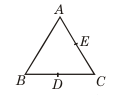
The electric potential at a point is given by . The electric field at that point is:
Three capacitors each of capacitance and of breakdown voltage are joined in series. The capacitance and breakdown voltage of the combination will be:
Three concentric spherical shells have radii and () and have surface charge densities and respectively. If and denote the potentials of the three shells, then for , we have:
The electric potential at a point in free space due to a charge coulomb is volts. The electric field at that point is:
A thin conducting ring of radius is given a charge . The electric field at the centre of the ring due to the charge on the part of the ring is . The electric field at the centre due to the charge on the part of the ring is:
The energy required to charge a parallel plate condenser of plate separation and plate area of cross-section such that the uniform electric field between the plates is , is:
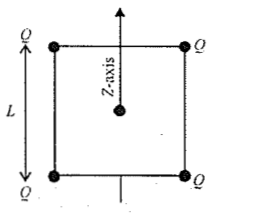
Four point charges of same magnitude () are placed at four corners of a rigid square frame as shown in figure. The plane of the frame is perpendicular to -axis. If a point charge is placed at a distance away from the above frame () then:
Two concentric conducting thin spherical shells and having radii and () are charged to and (). The electrical field along a line (passing through the centre) is:
Two infinitely long parallel conducting plates having surface charge densities and respectively, are separated by a small distance. The medium between the plates is vacuum. If is the dielectric permittivity of vacuum, then the electric field in the region between the plates is:
Two charges q1 and q2 are placed 30 cm apart, as shown in the figure. A third charge q3 is moved along the arc of a circle of radius 40 cm from C to D. The change in the potential energy of the system is (q3/4πε0)k, where k is :
As per this diagram a point charge +q is placed at the origin O. Work done in taking another point charge - Q from the point A [co-ordinates (0, a)] to another point B [co-ordinates (a, 0)] along the straight path AB is :
Two charges q1 and q2 are placed 30 cm apart, as shown in the figure. A third charge q3 is moved along the arc of a circle of radius 40 cm from C to D. The change in the potential energy of the system is (q3/4πε 0)k, where k is :
Physics electrostatics — FAQ
How many electrostatics questions come in Physics?▼
Our database has 43 electrostatics questions from Physics.
What difficulty are Physics electrostatics questions?▼
The 43 Physics electrostatics questions include 8 easy, 25 medium and 10 hard level questions.
Where can I find more electrostatics questions for other exams?▼
Visit /tag/electrostatics to see all electrostatics questions across all exams including AIEEE, NEET 2019, AIEEE 2007.