AIEEE 2003
electrostatics Questions
34 electrostatics questions from AIEEE 2003 with detailed answers and explanations. Free previous year questions and MCQs.
📚
34
Questions
🟢
4
Easy
🟡
22
Medium
🔴
8
Hard
Years:2026 (34)
electrostatics — AIEEE 2003(1–34 of 34)
Filter:
Four charges equal to are placed at the four corners of a square and a charge is at its centre. If the system is in equilibrium, the value of is:
A charged particle is shot towards another charged particle which is fixed. With a speed , it approaches up to a closest distance and then returns. If were given a speed , the closest distance of approach would be:
A charged oil drop is suspended in a uniform field of so that it neither falls nor rises. The charge on the drop will be: (Take mass of the drop and )
Two spherical conductors and having equal radii and carrying equal charges repel each other with a force when kept apart at some distance. A third spherical conductor having same radius as that of but uncharged is brought in contact with , then brought in contact with and finally removed away from both. The new force of repulsion between and is:
An electric charge is placed at the origin of co-ordinate system. Two points and are situated at and respectively. The potential difference between the points and will be:
A parallel plate condenser with a dielectric of dielectric constant between the plates has a capacity and is charged to a potential volts. The dielectric slab is slowly removed from between the plates and then reinserted. The net work done by the system in this process is:
An electric dipole is placed at an angle of to a non-uniform electric field. The dipole will experience:
Two spherical conductors and of radii and are separated by a distance of and are uniformly charged. If the spheres are connected by a conducting wire, then in equilibrium, the ratio of the magnitude of the electric fields at the surface of spheres and is:
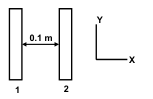
Two infinitely large insulating plates are uniformly charged such that the potential difference between them is . The plates are separated by . An electron is released from rest on the inner surface of plate 1. What is its speed when it hits plate 2? (, )
If and are the accelerations due to gravity on the surfaces of the earth and the moon respectively and if Millikan's oil drop experiment could be performed on the two surfaces, one will find the ratio of electronic charge on the moon to electronic charge on the earth to be:
A battery is used to charge a parallel plate capacitor till the potential difference between the plates becomes equal to the electromotive force of the battery. The ratio of the energy stored in the capacitor and the work done by the battery will be:
Charges are placed at the vertices of a square respectively. Let be the electric field and the potential at the centre. If the charges on and are interchanged with those on and respectively, then:

The potential at a point (measured in ) due to some charges situated on the -axis is given by Volts. The electric field at is given by:
A charge is placed at each of the opposite corners of a square. A charge is placed at each of the other two corners. If the net electrical force on is zero, then the equals:
This question contains Statement-1 and Statement-2. Of the four choices given after the statements,
choose the one that best describes the two statements.
Statement – 1: For a charged particle moving from point P to point Q, the net work done by an
electrostatic field on the particle is independent of the path connecting point P to point Q.
Statement-2: The net work done by a conservative force on an object moving along a closed loop is
zero
choose the one that best describes the two statements.
Statement – 1: For a charged particle moving from point P to point Q, the net work done by an
electrostatic field on the particle is independent of the path connecting point P to point Q.
Statement-2: The net work done by a conservative force on an object moving along a closed loop is
zero
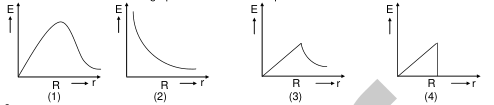
In a uniformly charged sphere of total charge and radius , the electric field is plotted as a function of distance from the centre. The graph which would correspond to the above will be:
Two points and are maintained at the potentials of and respectively. The work done in moving electrons from to is:
Two identical charged spheres are suspended by strings of equal lengths. The strings make an angle of with each other. When suspended in a liquid of density , the angle remains the same. If density of the material of the sphere is , the dielectric constant of the liquid is:
Let there be a spherically symmetric charge distribution with charge density varying as up to , and for . The electric field at a distance from the origin is given by:
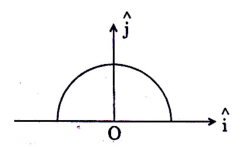
A thin semi-circular ring of radius has a positive charge distributed uniformly over it. The net electric field at the centre is:
Two identical charged spheres suspended from a common point by two massless strings of length are initially a distance () apart because of their mutual repulsion. The charge begins to leak from both the spheres at a constant rate. As a result the charges approach each other with a velocity . Then as a function of distance between them:
The electrostatic potential inside a charged spherical ball is given by where is the distance from the centre; are constants. Then the charge density inside ball is:
Statement 1: When a charge is taken from the centre to the surface of an insulating solid sphere of radius and uniform charge density , its potential energy changes by .Statement 2: The electric field at a distance from the centre of the sphere is .
Two thin wire rings each having a radius are placed at a distance apart with their axes coinciding. The charges on the two rings are and . The potential difference between the centres of the two rings is:
Let be the charge density distribution for a solid sphere of radius and total charge . For a point ' ' inside the sphere at distance from the centre of the sphere, the magnitude of electric field is:
A parallel plate capacitor with air between the plates has a capacitance of . The separation between its plates is ‘ ’. The space between the plates is now filled with two dielectrics. One has and thickness while the other has and thickness . Capacitance of the capacitor is now:
A thin spherical shell of radius has charge spread uniformly. Which graph represents the electric field for ?
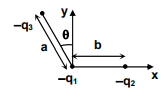
Three charges , and are placed as shown in the figure. ( at origin, at , at ). The -component of the force on is proportional to:
The work done in placing a charge of coulomb on a condenser of capacity micro-farad is:
A thin spherical conducting shell of radius has a charge . Another charge is placed at the centre of the shell. The electrostatic potential at a point at a distance from the centre of the shell is:
A sheet of aluminium foil of negligible thickness is introduced between the plates of a capacitor. The capacitance of the capacitor:
If the electric flux entering and leaving an enclosed surface respectively is and , the electric charge inside the surface will be:
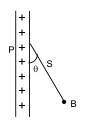
A charged ball hangs from a silk thread which makes an angle with a large charged conducting sheet , as shown in the figure. The surface charge density of the sheet is proportional to:
AIEEE 2003 electrostatics — FAQ
How many electrostatics questions come in AIEEE 2003?▼
Our database has 34 electrostatics questions from AIEEE 2003 covering 2026 to 2026.
What difficulty are AIEEE 2003 electrostatics questions?▼
The 34 AIEEE 2003 electrostatics questions include 4 easy, 22 medium and 8 hard level questions.
Where can I find more electrostatics questions for other exams?▼
Visit /tag/electrostatics to see all electrostatics questions across all exams including Physics, NEET 2019, NEET 2021.