HomeTestsSearchRankProfile

Plant Morphology Questions

Practice 37 Plant Morphology questions with detailed answers and explanations. Free MCQs, PYQs, and mock test questions for NEET, JEE, GATE, SSC and more.

📚
37
Total Questions
🟢
14
Easy
🟡
20
Medium
🔴
3
Hard
Practice by Exam:Biology(37)

About Plant Morphology — practice questions, PYQs & concepts

Plant Morphology is a frequently-tested topic on Biology. ExamTest.live currently lists 37 Plant Morphology questions spanning previous-year papers from 2026 to 2026, each with worked solutions and a step-by-step explanation. Use the filters on this page to focus on a specific exam, difficulty level or year — every answer key is free, no sign-up required.

Plant Morphology weight in competitive exams

Across our Plant Morphology question bank, the largest sources are Biology (37). Click any exam chip above to drill down to that exam-specific question set.

How to use this page

  • Start easy: 14 easy Plant Morphology questions are available — build fluency before moving up.
  • Target weak years: Use the year filter to focus on the most recent 2026 paper or older PYQs you have not attempted.
  • Time yourself: Every question shows the average solve time so you can benchmark your speed against other students.
  • Read every explanation: Even on questions you got right — the explanation often surfaces a faster approach you can reuse.

All Plant Morphology Questions(137 of 37)

Filter:
Q1mediummcqBiologyCompetitive Exams2026
What is the root-like structure at the base of an algae (seaweed) that binds the algae to a hard substrate like a stone?
Q2hardmcqBiologyNEET 20232026
Family Fabaceae differs from Solanaceae and Liliaceae. With respect to the stamens, pick out the characteristics specific to family Fabaceae but not found in Solanaceae or Liliaceae.
Q3mediummcqBiologyNEET 20232026
Axile placentation is observed in:
Q4mediummcqBiologyNEET 20222026
Identify the correct set of statements:(a) The leaflets are modified into pointed hard thorns in Citrus and Bougainvillea(b) Axillary buds form slender and spirally coiled tendrils in cucumber and pumpkin(c) Stem is flattened and fleshy on Opuntia and modified to perform the function of leaves(d) Rhizophora shows vertically upward growing roots that help to get oxygen for respiration(e) Subaerially growing stems in grasses and strawberry help in vegetative propagationChoose the correct answer from the options given below:
Q5mediummcqBiologyNEET 20222026
The flowers are Zygomorphic in:(a) Mustard(b) Gulmohar(c) Cassia(d) Datura(e) ChilliChoose the correct answer from the options given below:
Q6mediummcqBiologyNEET 20222026
Which one of the following plants shows vexillary aestivation and diadelphous stamens?
Q7hardmcqBiologyNEET 20212026
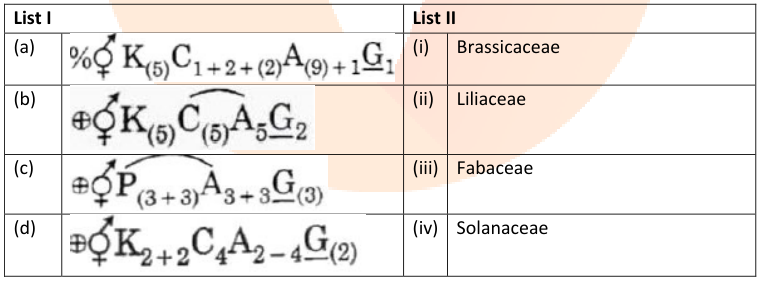
Match List-I (Floral Formulas) with List-II (Families):
image
Q8mediummcqBiologyNEET 2020 E12026
The roots that originate from the base of the stem are:
Q9mediummcqBiologyNEET 2020 E12026
Ray florets have:
Q10mediummcqBiologyNEET 2020 E12026
The ovary is half inferior in:
Q11easymcqBiologyNEET 20212026
Diadelphous stamens are found in:
Q12mediummcqBiologyBiology
0% accuracy
The ovary is half inferior in flowers of:
Q13mediummcqBiologyBiology
0% accuracy
Flowers are Zygomorphic in:
Q14mediummcqBiologyBiology
0% accuracy
A drupe develops in:
Q15mediummcqBiologyBiology
0% accuracy
The correct floral formula of chilli is:
image
Q16easymcqBiologyBiology
Placentation in tomato and lemon is:
Q17mediummcqBiologyBiology
An aggregate fruit is one which develops from:
Q18easymcqBiologyBiology
An example of an edible underground stem is:
Q19easymcqBiologyBiology
When the margins of sepals or petals overlap one another without any particular direction, the condition is termed as:
Q20easymcqBiologyBiology
Placenta and pericarp are both edible portions in:
Q21easymcqBiologyBiology
The seed coat is not thin and membranous in:
Q22mediummcqBiologyBiology
In China rose, the flowers are:
Q23mediummcqBiologyBiology
Among bitter gourd, mustard, brinjal, pumpkin, china rose, lupin, cucumber, sunnhemp, gram, guava, bean, chilli, plum, petunia, tomato, rose, withania, potato, onion, aloe and tulip, how many plants have hypogynous flowers?
Q24easymcqBiologyBiology
The fruit is chambered, developed from an inferior ovary and has seeds with succulent testa in:
Q25mediummcqBiologyBiology
Cymose inflorescence is present in:
Q26easymcqBiologyBiology
Vexillary aestivation is characteristic of the family:
Q27easymcqBiologyBiology
Phyllode is present in:
Q28mediummcqBiologyBiology
The gynoecium consists of many free pistils in flowers of:
Q29mediummcqBiologyBiology
How many plants in the list given below have composite fruits that develop from an inflorescence?Walnut, poppy, radish, fig, pineapple, apple, tomato, mulberry.
Q30mediummcqBiologyBiology
How many plants in the list given below have marginal placentation?Mustard, Gram, Tulip, Asparagus, Arhar, Sun hemp, Chilli, Colchicine, Onion, Moong, Pea, Tobacco, Lupin
Q31hardmcqBiologyBiology
An example of a seed with endosperm, perisperm, and caruncle is:
Q32easymcqBiologyBiology
Cotyledons and testa respectively are edible parts in:
Q33easymcqBiologyBiology
An example of axile placentation is:
Q34easymcqBiologyBiology
A fruit developed from hypanthodium inflorescence is called:
Q35easymcqBiologyBiology
The fleshy receptacle of syconus of fig encloses a number of:
Q36easymcqBiologyBiology
Replum is present in the ovary of flower of:
Q37mediummcqBiologyBiology
A dry indehiscent single-seeded fruit formed from a bicarpellary syncarpous inferior ovary is:

Frequently Asked Questions

How many Plant Morphology questions are on ExamTest.live?
We have 37 Plant Morphology questions spread across 1 pages, covering easy, medium, and hard difficulty levels with detailed explanations.
Are Plant Morphology MCQs free?
Yes. All Plant Morphology questions, answers, and explanations on ExamTest.live are completely free. No account or subscription required.
Which exams include Plant Morphology questions?
Plant Morphology questions are commonly asked in Biology. You can filter by exam using the links above.
How do I practice Plant Morphology questions effectively?
Start with easy questions to build confidence, then tackle medium and hard ones. Use the filter buttons to sort by difficulty. Reveal the answer only after attempting each question, and read the explanation thoroughly.