Physics
ray optics Questions
28 ray optics questions from Physics with detailed answers and explanations. Free previous year questions and MCQs.
📚
28
Questions
🟢
6
Easy
🟡
13
Medium
🔴
9
Hard
ray optics — Physics(1–28 of 28)
Filter:
In a certain camera, a combination of four similar thin convex lenses are arranged axially in contact. Then the power of the combination and the total magnification in comparison to the power () and magnification () for each lens will be, respectively:
A microscope has an objective of focal length , eyepiece of focal length and the tube length of . If the distance of distinct vision of eye is , the magnification in the microscope is:
A biconvex lens has a radius of curvature of magnitude . Which one of the following options describes best the image formed of an object of height placed from the lens? (Assume refractive index )
An air bubble in a glass slab with refractive index is deep when viewed from one surface and deep when viewed from the opposite face. The thickness (in cm) of the slab is:
Two identical glass () equiconvex lenses of focal length each are kept in contact. The space between the two lenses is filled with water (). The focal length of the combination is:
A person can see clearly objects only when they lie between and from his eyes. In order to increase the maximum distance of distinct vision to infinity, the type and power of the correcting lens, the person has to use, will be:
The angle of incidence for a ray of light at a refracting surface of a prism is . The angle of prism is . If the ray suffers minimum deviation through the prism, the angle of minimum deviation and refractive index of the material of the prism respectively, are:
Match the corresponding entries of column 1 with column 2. [Where is the magnification produced by the mirror]Column 1: (A) , (B) , (C) , (D) Column 2: (a) Convex mirror, (b) Concave mirror, (c) Real image, (d) Virtual image
An astronomical telescope has objective and eyepiece of focal lengths and respectively. To view an object away from the objective, the lenses must be separated by a distance:
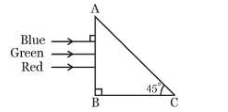
A beam of light consisting of red, green and blue colours is incident on a right angled prism. The refractive index of the material of the prism for the above red, green and blue wavelengths are and respectively. The prism will:
In an astronomical telescope in normal adjustment, a straight black line of the length is drawn on the objective lens. The eye-piece forms a real image of this line. The length of this image is . The magnification of the telescope is:
The angle of a prism is 'A'. One of its refracting surfaces is silvered. Light rays falling at an angle of incidence on the first surface returns back through the same path after suffering reflection at the silvered surface. The refractive index , of the prism is:
If the focal length of objective lens is increased then magnifying power of:
A ray of light is incident at an angle on one face of a prism of angle (small) and emerges normally from the opposite face. If the refractive index is , the angle is nearly equal to:
A concave mirror of focal length is placed at a distance of from a convex lens of focal length . A beam of light coming from infinity and falling on this combination returns to infinity. The distance ‘ ’ must equal:
The magnifying power of a telescope is . When it is adjusted for parallel rays the distance between the objective and eyepiece is . The focal length of lenses are:
When a biconvex lens of glass having refractive index is dipped in a liquid, it acts as a plane sheet of glass. This implies that the liquid must have refractive index:
For the angle of minimum deviation of a prism to be equal to its refracting angle (), the prism must be made of a material whose refractive index ():
A rod of length lies along the principal axis of a concave mirror of focal length in such a way that its end closer to the pole is away. The length of the image is:
A boy is trying to start a fire by focusing Sunlight on a piece of paper using an equiconvex lens of focal length . The diameter of the Sun is and its mean distance from the earth is . What is the diameter of the Sun's image on the paper?
Two thin lenses of focal lengths and are in contact and coaxial. The power of the combination is:
Assertion: The resolving power of a telescope is more if the diameter of the objective lens is more.Reason: Objective lens of large diameter collects more light.
Assertion: Diamond glitters brilliantly.Reason: Diamond does not absorb sunlight.
Assertion: By roughening the surface of a glass sheet its transparency can be reduced.Reason: Glass sheet with rough surface absorbs more light.
The apparent depth of water in cylindrical water tank of diameter is reducing at the rate of when water is being drained out at a constant rate. The amount of water drained in per minute is (, ):
A telescope has an objective lens of focal length and an eye piece with focal length . If this telescope is used to see a tall building at a distance of , what is the height of the image of the building formed by the objective lens?
Physics ray optics — FAQ
How many ray optics questions come in Physics?▼
Our database has 28 ray optics questions from Physics.
What difficulty are Physics ray optics questions?▼
The 28 Physics ray optics questions include 6 easy, 13 medium and 9 hard level questions.
Where can I find more ray optics questions for other exams?▼
Visit /tag/ray-optics to see all ray optics questions across all exams including NEET 2019, NEET 2021, NEET 2022.