HomeTestsSearchRankProfile

Ray Optics Questions

Practice 59 Ray Optics questions with detailed answers and explanations. Free MCQs, PYQs, and mock test questions for NEET, JEE, GATE, SSC and more.

📚
59
Total Questions
🟢
13
Easy
🟡
30
Medium
🔴
16
Hard
Practice by Exam:Physics(57)PHYSICS(2)

About Ray Optics — practice questions, PYQs & concepts

Ray Optics is a frequently-tested topic on Physics, PHYSICS. ExamTest.live currently lists 59 Ray Optics questions spanning previous-year papers from 2026 to 2026, each with worked solutions and a step-by-step explanation. Use the filters on this page to focus on a specific exam, difficulty level or year — every answer key is free, no sign-up required.

Ray Optics weight in competitive exams

Across our Ray Optics question bank, the largest sources are Physics (57) and PHYSICS (2). Click any exam chip above to drill down to that exam-specific question set.

How to use this page

  • Start easy: 13 easy Ray Optics questions are available — build fluency before moving up.
  • Target weak years: Use the year filter to focus on the most recent 2026 paper or older PYQs you have not attempted.
  • Time yourself: Every question shows the average solve time so you can benchmark your speed against other students.
  • Read every explanation: Even on questions you got right — the explanation often surfaces a faster approach you can reuse.
All Ray Optics Questions(159 of 59)

Filter:
Q1easymcqPhysicsNEET (UG) 20172026
0% accuracy
The ratio of resolving powers of an optical microscope for two wavelengths and is:
Q2mediummcqPhysicsNEET (UG) 20172026
0% accuracy
A thin prism having refracting angle is made of glass of refractive index . This prism is combined with another thin prism of glass of refractive index . This combination produces dispersion without deviation. The refracting angle of the second prism should be:
Q3mediummcqPhysicsNEET (UG) 20172026
0% accuracy
A beam of light is incident normally on a plane mirror fixed at a distance from a source. When the mirror is rotated through a small angle , the reflected spot move through a distance on a scale. The angle is given by:
Q4hardmcqPhysicsNEET 20192026
0% accuracy
Two similar thin equi-convex lenses, of focal length each, are kept coaxially in contact with each other such that the focal length of the combination is . When the space between the two lenses is filled with glycerin (which has the same refractive index () as that of glass) then the equivalent focal length is . The ratio will be:
Q5mediummcqPhysicsAIEEE 20072026
0% accuracy
Two lenses of power and are in contact with each other. The focal length of the combination is:
Q6easymcqPhysicsAIEEE 20062026
0% accuracy
The refractive index of glass is for red light and for blue light. Let and be the angle of minimum deviation for red and blue light respectively in a thin prism of this glass. Then:
Q7easymcqPhysicsNEET 20192026
0% accuracy
Pick the wrong answer in the context with rainbow.
Q8easymcqPhysicsNEET 20192026
0% accuracy
In total internal reflection when the angle of incidence is equal to the critical angle for the pair of media in contact, what will be angle of refraction?
Q9hardmcqPhysicsNEET 20212026
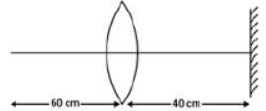
A point object is placed at a distance of from a convex lens of focal length . If a plane mirror were put perpendicular to the principal axis of the lens and at a distance of from it, the final image would be formed at a distance of:
image
Q10mediummcqPhysicsNEET (UG) 20182026
The refractive index of the material of a prism is and the angle of the prism is . One of the two refracting surfaces of the prism is made a mirror inwards, by silver coating. A beam of monochromatic light entering the prism from the other face will retrace its path (after reflection from the silvered surface) if its angle of incidence on the prism is:
Q11mediummcqPhysicsNEET (UG) 20182026
An object is placed at a distance of from a concave mirror of focal length . If the object is displaced through a distance of towards the mirror, the displacement of the image will be:
Q12easymcqPHYSICSNEET 20192026
A biconvex lens has power . It is cut into two symmetrical halves by a plane containing the principal axis. The power of one part will be:
Q13mediummcqPHYSICSNEET 20192026
A double convex lens has a focal length of . The radius of curvature of one of the surfaces is double of the other. What would be the radii if the refractive index of the material of the lens is ?
Q14mediummcqPhysicsNEET 2020 E12026
A ray is incident at an angle of incidence on one surface of a small angle prism (with angle of prism ) and emerges normally from the opposite surface. If the refractive index of the material of the prism is , then the angle of incidence is nearly equal to:
Q15easymcqPhysicsNEET 20212026
A lens of large focal length and large aperture is best suited as an objective of an astronomical telescope since:
Q16mediummcqPhysicsNEET 20212026
A convex lens ‘A’ of focal length and a concave lens ‘B’ of focal length are kept along the same axis with a distance ‘ ’ between them. If a parallel beam of light falling on ‘A’ leaves ‘B’ as a parallel beam, then the distance ‘ ’ in cm will be:
Q17mediummcqPhysicsNEET 20212026
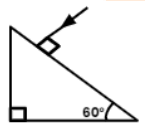
Find the value of angle of emergence from the prism. Refractive index of the glass is .
image
Q18hardmcqPhysicsNEET 20172026
A thin prism having refracting angle is made of glass of refractive index . This prism is combined with another thin prism of glass of refractive index . This combination produces dispersion without deviation. The refracting angle of second prism should be:
Q19mediummcqPhysicsNEET 20222026
A biconvex lens has radii of curvature, each. If the refractive index of the material of the lens is , the power of the lens is:
Q20mediummcqPhysicsNEET 20222026
A light ray falls on a glass surface of refractive index , at an angle . The angle between the refracted and reflected rays would be:
Q21hardmcqPhysicsNEET 20222026
Two transparent media A and B are separated by a plane boundary. The speed of light in those media are and , respectively. The critical angle for a ray of light for these two media is:
Q22hardmcqPhysicsNEET 20232026
Light travels a distance in time in air and in time in another denser medium. What is the critical angle for this medium?
Q23hardmcqPhysicsNEET 20232026
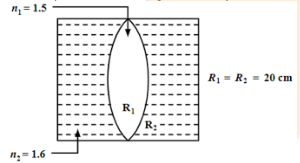
In the figure shown here, what is the equivalent focal length of the combination of lenses? (Assume all layers are thin, , outer lenses , inner lens )
image
Q24easymcqPhysicsNEET 20232026
Two thin lenses are of same focal lengths (), but one is convex and the other one is concave. When they are placed in contact with each other, the equivalent focal length of the combination will be:
Q25mediummcqPhysicsAIEEE2026
A student measures the focal length of a convex lens by measuring object distance ‘ ’ and image distance ‘ ’. The graph between and should look like:
Q26mediummcqPhysicsAIEEE 20092026
In an optics experiment, with the position of the object fixed, a student varies the position of a convex lens and for each position, the screen is adjusted to get a clear image of the object. A graph between the object distance and the image distance , from the lens, is plotted using the same scale for the two axes. A straight line passing through the origin and making an angle of with the x-axis meets the experimental curve at . The coordinates of will be:
Q27mediummcqPhysicsAIEEE 20092026
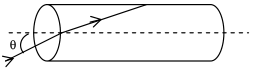
A transparent solid cylindrical rod has a refractive index of . It is surrounded by air. A light ray is incident at the mid point of one end of the rod. The incident angle for which the light ray grazes along the wall of the rod is:
image
Q28hardmcqPhysicsFIITJEE AIEEE 2011 (Set Q)2026
A car is fitted with a convex side-view mirror of focal length . A second car behind the first car is overtaking the first car at relative speed of . The speed of the image of the second car as seen in the mirror of the first one is:
Q29mediummcqPhysicsJEE Main2026
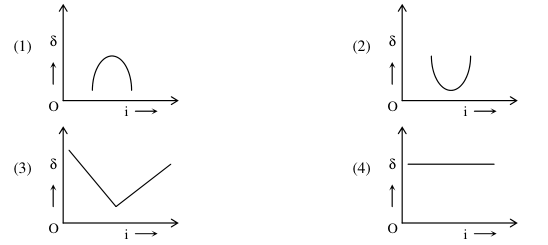
The graph between angle of deviation () and angle of incidence () for a triangular prism is represented by:
image
Q30mediummcqPhysicsJEE Main2026
Diameter of plano-convex lens is and thickness at the centre is . If speed of light in material of lens is , the focal length of the lens is:
Q31mediummcqPhysicsNEET 20172026
A beam of light from a source is incident normally on a plane mirror fixed at a certain distance from the source. The beam is reflected back as a spot on a scale placed just above the source . When the mirror is rotated through a small angle , the spot of the light is found to move through a distance on the scale. The angle is given by:
Q32mediummcqPhysicsPhysics
3% accuracy
In a certain camera, a combination of four similar thin convex lenses are arranged axially in contact. Then the power of the combination and the total magnification in comparison to the power () and magnification () for each lens will be, respectively:
Q33mediummcqPhysicsPhysics
14% accuracy
A microscope has an objective of focal length , eyepiece of focal length and the tube length of . If the distance of distinct vision of eye is , the magnification in the microscope is:
Q34mediummcqPhysicsPhysics
0% accuracy
Which of the following is not due to total internal reflection?
Q35mediummcqPhysicsPhysics
0% accuracy
A biconvex lens has a radius of curvature of magnitude . Which one of the following options describes best the image formed of an object of height placed from the lens? (Assume refractive index )
Q36hardmcqPhysicsPhysics
For the angle of minimum deviation of a prism to be equal to its refracting angle (), the prism must be made of a material whose refractive index ():
Q37mediummcqPhysicsPhysics
An air bubble in a glass slab with refractive index is deep when viewed from one surface and deep when viewed from the opposite face. The thickness (in cm) of the slab is:
Q38mediummcqPhysicsPhysics
What should be the maximum acceptance angle at the air-core interface of an optical fibre if and are the refractive indices of the core and the cladding, respectively?
Q39mediummcqPhysicsPhysics
A telescope has an objective lens of focal length and an eye piece with focal length . If this telescope is used to see a tall building at a distance of , what is the height of the image of the building formed by the objective lens?
Q40hardmcqPhysicsPhysics
The apparent depth of water in cylindrical water tank of diameter is reducing at the rate of when water is being drained out at a constant rate. The amount of water drained in per minute is (, ):
Q41easymcqPhysicsPhysics
Assertion: By roughening the surface of a glass sheet its transparency can be reduced.Reason: Glass sheet with rough surface absorbs more light.
Q42easymcqPhysicsPhysics
Assertion: Diamond glitters brilliantly.Reason: Diamond does not absorb sunlight.
Q43mediummcqPhysicsPhysics
Assertion: The resolving power of a telescope is more if the diameter of the objective lens is more.Reason: Objective lens of large diameter collects more light.
Q44easymcqPhysicsPhysics
Two thin lenses of focal lengths and are in contact and coaxial. The power of the combination is:
Q45hardmcqPhysicsPhysics
A boy is trying to start a fire by focusing Sunlight on a piece of paper using an equiconvex lens of focal length . The diameter of the Sun is and its mean distance from the earth is . What is the diameter of the Sun's image on the paper?
Q46mediummcqPhysicsPhysics
A rod of length lies along the principal axis of a concave mirror of focal length in such a way that its end closer to the pole is away. The length of the image is:
Q47hardmcqPhysicsPhysics
Two identical glass () equiconvex lenses of focal length each are kept in contact. The space between the two lenses is filled with water (). The focal length of the combination is:
Q48easymcqPhysicsPhysics
When a biconvex lens of glass having refractive index is dipped in a liquid, it acts as a plane sheet of glass. This implies that the liquid must have refractive index:
Q49mediummcqPhysicsPhysics
The magnifying power of a telescope is . When it is adjusted for parallel rays the distance between the objective and eyepiece is . The focal length of lenses are:
Q50mediummcqPhysicsPhysics
A concave mirror of focal length is placed at a distance of from a convex lens of focal length . A beam of light coming from infinity and falling on this combination returns to infinity. The distance ‘ ’ must equal:
Q51easymcqPhysicsPhysics
A ray of light is incident at an angle on one face of a prism of angle (small) and emerges normally from the opposite face. If the refractive index is , the angle is nearly equal to:
Q52easymcqPhysicsPhysics
If the focal length of objective lens is increased then magnifying power of:
Q53mediummcqPhysicsPhysics
The angle of a prism is 'A'. One of its refracting surfaces is silvered. Light rays falling at an angle of incidence on the first surface returns back through the same path after suffering reflection at the silvered surface. The refractive index , of the prism is:
Q54hardmcqPhysicsPhysics
In an astronomical telescope in normal adjustment, a straight black line of the length is drawn on the objective lens. The eye-piece forms a real image of this line. The length of this image is . The magnification of the telescope is:
Q55hardmcqPhysicsPhysics
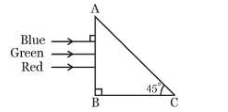
A beam of light consisting of red, green and blue colours is incident on a right angled prism. The refractive index of the material of the prism for the above red, green and blue wavelengths are and respectively. The prism will:
image
Q56hardmcqPhysicsPhysics
An astronomical telescope has objective and eyepiece of focal lengths and respectively. To view an object away from the objective, the lenses must be separated by a distance:
Q57hardmcqPhysicsPhysics
Match the corresponding entries of column 1 with column 2. [Where is the magnification produced by the mirror]Column 1: (A) , (B) , (C) , (D) Column 2: (a) Convex mirror, (b) Concave mirror, (c) Real image, (d) Virtual image
Q58mediummcqPhysicsPhysics
The angle of incidence for a ray of light at a refracting surface of a prism is . The angle of prism is . If the ray suffers minimum deviation through the prism, the angle of minimum deviation and refractive index of the material of the prism respectively, are:
Q59hardmcqPhysicsPhysics
A person can see clearly objects only when they lie between and from his eyes. In order to increase the maximum distance of distinct vision to infinity, the type and power of the correcting lens, the person has to use, will be:

Frequently Asked Questions

How many Ray Optics questions are on ExamTest.live?
We have 59 Ray Optics questions spread across 1 pages, covering easy, medium, and hard difficulty levels with detailed explanations.
Are Ray Optics MCQs free?
Yes. All Ray Optics questions, answers, and explanations on ExamTest.live are completely free. No account or subscription required.
Which exams include Ray Optics questions?
Ray Optics questions are commonly asked in Physics, PHYSICS. You can filter by exam using the links above.
How do I practice Ray Optics questions effectively?
Start with easy questions to build confidence, then tackle medium and hard ones. Use the filter buttons to sort by difficulty. Reveal the answer only after attempting each question, and read the explanation thoroughly.