Physics
Thermodynamics Questions
41 Thermodynamics questions from Physics with detailed answers and explanations. Free previous year questions and MCQs.
📚
41
Questions
🟢
8
Easy
🟡
26
Medium
🔴
7
Hard
Thermodynamics — Physics(1–41 of 41)
Filter:
A container has two chambers of volumes and separated by a partition made of a thermal insulator. The chambers contains and moles of ideal gas at pressures and , respectively. When the partition is removed, the mixture attains an equilibrium pressure of:
Two gases A and B are filled at the same pressure in separate cylinders with movable pistons of radius and , respectively. On supplying an equal amount of heat to both the systems reversibly under constant pressure, the pistons of gas A and B are displaced by and , respectively. If the change in their internal energy is the same, then the ratio is equal to:
An oxygen cylinder of volume has of oxygen. After some oxygen is withdrawn from the cylinder, its gauge pressure drops to at temperature . The mass of the oxygen withdrawn from the cylinder is nearly equal to:[Given, , molecular mass of , ]
The temperature of inversion of a thermocouple is 620°C and the neutral temperature is 300°C. what is the temperature of cold junction ?
An ideal gas heat engine operates in Carnot cycle between 227°C and 127°C. It absorbs 6 x 10^4 cal of heat at higher temperature. Amount of heat converted to work is :
During an isothermal expansion, a confined ideal gas does of work against its surrounding. This implies that:
When of ice at melts to water at , the resulting change in its entropy, taking latent heat of ice to be is approximately:
Certain quantity of water cools from to in the first and to in the next . The temperature of the surroundings is:
A given sample of an ideal gas occupies a volume at a pressure and absolute temperature . The mass of each molecule of the gas is . Which of the following gives the density of the gas?
A monoatomic gas at a pressure , having a volume expands isothermally to a volume and then adiabatically to a volume . The final pressure of the gas is: (take )
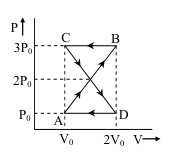
A thermodynamic system undergoes cyclic process as shown in figure. The work done by the system in the cycle is:[Image shows a figure of two identical triangles meeting at a point, forming an 8-shape. Loop 1 is clockwise, Loop 2 is anti-clockwise.]
Two vessels separately contain two ideal gases and at the same temperature, the pressure of being twice that of . Under such conditions, the density of is found to be times the density of . The ratio of molecular weight of and is:
of a gas occupies liters at NTP. The specific heat capacity of the gas at constant volume is . If the speed of sound in this gas at NTP is , then the molar heat capacity at constant pressure is (Take gas constant ):
The coefficient of performance of a refrigerator is . If the temperature inside freezer is , the temperature of the surroundings to which it rejects heat is:
An ideal gas is compressed to half its initial volume by means of several processes. Which of the process results in the maximum work done on the gas?
The value of coefficient of volume expansion of glycerin is . The fractional change in the density of glycerin for a rise of in its temperature is:
The molecules of a given mass of a gas have r.m.s velocity of at and pressure. When the temperature and pressure of the gas are respectively and , the r.m.s. velocity of its molecules in is:
A gas is compressed isothermally to half its initial volume. The same gas is compressed separately through an adiabatic process until its volume is again reduced to half. Then:
A refrigerator works between and . It is required to remove of heat every second in order to keep the temperature of the refrigerated space constant. The power required is: (Take )
Two identical bodies are made of a material for which the heat capacity increases with temperature. One of these is at , while the other one is at . If the two bodies are brought into contact, then assuming no heat loss, the final common temperature is:
A body cools from a temperature to in . The room temperature is . Assume that Newton's law of cooling is applicable. The temperature of the body at the end of next will be:
One mole of an ideal monatomic gas undergoes a process described by the equation . The heat capacity of the gas during this process is:
The temperature inside a refrigerator is and the room temperature is . The amount of heat delivered to the room for each joule of electrical energy consumed ideally will be:
The internal energy change in a system that has absorbed of heat and done of work is:
An ideal gas heat engine operates in Carnot cycle between 227°C and 127°C. It absorbs 6 x 10⁴ cal of heat at higher temperature. Amount of heat converted to work is :
Assertion: Reversible systems are difficult to find in real world.Reason: Most processes are dissipative in nature.
Assertion: Air quickly leaking out of a balloon becomes cooler.Reason: The leaking air undergoes adiabatic expansion.
Assertion: In pressure-temperature ( -) phase diagram of water, the slope of the melting curve is found to be negative.Reason: Ice contracts on melting to water.
A Carnot engine whose sink is at has an efficiency of . By how much should the temperature of the source be increased so as to increase its efficiency by of original efficiency?
The molar specific heat at a constant pressure of an ideal gas is . The ratio of specific heat at constant pressure to that at constant volume is:
If , , and denote respectively the heat added, change in internal energy, and the work done in a closed cycle process, then:
Steam at is passed into of water at . When water acquires a temperature of , the mass of water present will be: [Take specific heat of water and latent heat of steam ]
A diatomic gas () at is compressed adiabatically so temp rises from to . Final pressure is:
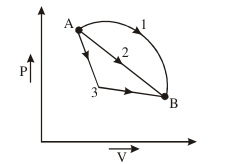
An ideal gas goes from state to state via three different processes. If indicate the heat absorbed and indicate the change in internal energy:
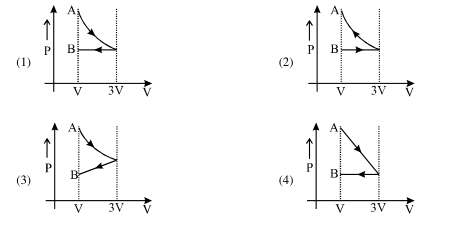
One mole of an ideal gas goes from an initial state to final state via two processes: It first undergoes isothermal expansion from volume to and then its volume is reduced from to at constant pressure. The correct diagram representing the two processes is:
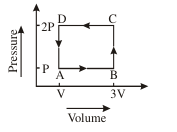
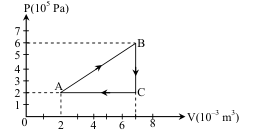
A thermodynamic system is taken through the cycle as shown in figure. Heat rejected by the gas during the cycle is:
The molar specific heats of an ideal gas at constant pressure and volume are denoted by and , respectively. If and is the universal gas constant, then is equal to:
A gas is taken through the cycle , where , , and in coordinates ( in , in ). What is the net work done by the gas?
Physics Thermodynamics — FAQ
How many Thermodynamics questions come in Physics?▼
Our database has 41 Thermodynamics questions from Physics.
What difficulty are Physics Thermodynamics questions?▼
The 41 Physics Thermodynamics questions include 8 easy, 26 medium and 7 hard level questions.
Where can I find more Thermodynamics questions for other exams?▼
Visit /tag/thermodynamics to see all Thermodynamics questions across all exams including Chemistry, AIEEE, AIEEE 2004.