Physics
mechanics Questions
128 mechanics questions from Physics with detailed answers and explanations. Free previous year questions and MCQs.
📚
128
Questions
🟢
35
Easy
🟡
67
Medium
🔴
26
Hard
mechanics — Physics (Page 2)(101–128 of 128)
Filter:
The displacement x of a particle varies with time t as x = ae-αt + beβt, where a, b, α and β are positive constants. The velocity of the particle will :
A particle executing simple harmonic motion of amplitude 5 cm has maximum speed of 31.4 cm/s. The frequency of its oscillation is :
A bomb of mass 30 kg at rest explodes into two pieces of masses 18 kg and 12 kg. The velocity of 18 kg mass is 6 ms-1. The kinetic energy of the other mass is :
A particle of mass is situated at the centre of a spherical shell of same mass and radius . The gravitational potential at a point situated at distance from the centre, will be:
A geostationary satellite is orbiting the earth at a height of above the surface, being the radius of the earth. The time period of another satellite in hours at a height of from the surface of the earth is:
The height at which the weight of a body becomes th its weight on the surface of earth (radius ) is:
A particle has initial velocity and acceleration . The magnitude of velocity after seconds will be:
Two spheres and of masses and respectively collide. is at rest initially and is moving with velocity along x-axis. After collision has a velocity in a direction perpendicular to the original direction. The mass moves after collision in the direction:
The horizontal range and the maximum height of a projectile are equal. The angle of projection of the projectile is:
A solid cylinder of mass is rolling on a horizontal surface with velocity . It collides with a horizontal spring of force constant . The maximum compression produced in the spring will be:
A car of mass is moving on a level circular track of radius . If is the static friction, the maximum speed is:
Three masses are placed on the x-axis: at origin, at and at . The distance of the centre of mass from the origin is:
A mass on a string rotates on a table. If radius is decreased by factor of by pulling the string, the kinetic energy will:
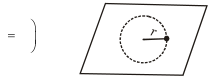
A belt moves at . A box is dropped on it (). Distance the box moves relative to belt before coming to rest on it is:
A mass moving with velocity (along -axis) collides and sticks to a mass moving with velocity (along -axis). The final velocity of the combination is:
A ball is dropped from a high rise platform at starting from rest. After another ball is thrown downwards from the same platform with a speed . The two balls meet at . What is the value of ? (Take )
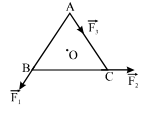
is an equilateral triangle with as its centre. and represent three forces acting along the sides and respectively. If the total torque about is zero then the magnitude of is:
The radii of circular orbits of two satellites and of the earth, are and , respectively. If the speed of satellite is , then the speed of satellite will be:
Two particles which are initially at rest, move towards each other under the action of their internal attraction. If their speeds are and at any instant, then the speed of centre of mass of the system will be:
A gramophone record is revolving with an angular velocity . A coin is placed at a distance from the centre of the record. The static coefficient of friction is . The coin will revolve with the record if:
A ball moving with velocity collides head on with another stationary ball of double the mass. If the coefficient of restitution is then their velocities (in ) after collision will be:
An engine pumps water through a hose pipe. Water passes through the pipe and leaves it with a velocity of . The mass per unit length of water in the pipe is . What is the power of the engine?
A man of mass is standing in a gravity free space at a height of above the floor. He throws a stone of mass downwards with a speed . When the stone reaches the floor, the distance of the man above the floor will be:
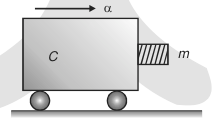
A block of mass is in contact with the cart as shown in the figure. The coefficient of static friction between the block and the cart is . The acceleration of the cart that will prevent the block from falling satisfies:
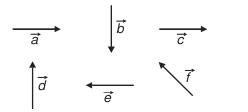
Six vectors, through have the magnitudes and directions indicated in the figure. Which of the following statements is true?
A particle moves a distance in time according to equation . The acceleration of the particle is proportional to:
Physics mechanics — FAQ
How many mechanics questions come in Physics?▼
Our database has 128 mechanics questions from Physics.
What difficulty are Physics mechanics questions?▼
The 128 Physics mechanics questions include 35 easy, 67 medium and 26 hard level questions.
Where can I find more mechanics questions for other exams?▼
Visit /tag/mechanics to see all mechanics questions across all exams including AIEEE, NEET 2019, AIEEE 2003.