Physics
mechanics Questions
128 mechanics questions from Physics with detailed answers and explanations. Free previous year questions and MCQs.
📚
128
Questions
🟢
35
Easy
🟡
67
Medium
🔴
26
Hard
mechanics — Physics(1–100 of 128)
Filter:
A ball of mass is dropped from a height of . The ball hits the ground and rises to a height of . The impulse imparted to the ball during its collision with the ground is (Take ):
There are two inclined surfaces of equal length () and same angle of inclination with the horizontal. One of them is rough and the other is perfectly smooth. A given body takes 2 times as much time to slide down on rough surface than on the smooth surface. The coefficient of kinetic friction () between the object and the rough surface is close to:
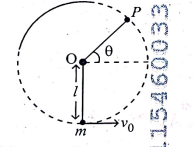
A bob of heavy mass is suspended by a light string of length . The bob is given a horizontal velocity as shown in figure. If the string gets slack at some point making an angle from the horizontal, the ratio of the speed of the bob at point to its initial speed is:
A bomb of mass 30 kg at rest explodes into two pieces of masses 18 kg and 12 kg. The velocity of 18 kg mass is 6 ms^-1. The kinetic energy of the other mass is :
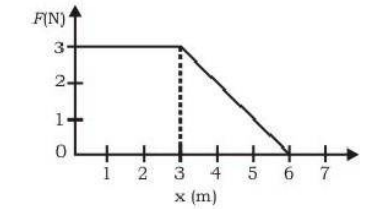
A force F acting on an object varies with distance x as shown here. The force is in N and x is in m. The work done by the force in moving the object from x = 0 to x = 6 m is :
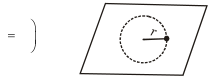
A stone tied to the end of a string of 1 m long is whirled in a horizontal circle with a constant speed. If the stone makes 22 revolutions in 44 s, what is the magnitude and direction of acceleration of the stone ?
A particle executing simple harmonic motion of amplitude 5 cm has maximum speed of 31.4 cm/s. The frequency of its oscillation is :
A drum of radius R and mass M, rolls down without slipping along an inclined plane of angle θ. The frictional force :
For a satellite moving in an orbit around the earth, the ratio of kinetic energy to potential energy is :
A ball is thrown vertically upward. It has a speed of 10 m/s when it has reached one half of its maximum height. How high does the ball rise ?
Two boys are standing at the ends A and B of a ground, where AB = a. The boy at B starts running in a direction perpendicular to AB with velocity v1. The boy at A starts running simultaneously with velocity v and catches the other boy in a time t, where t is :
The displacement x of a particle varies with time t as x = ae^(-αt) + be^(βt), where a, b, α and β are positive constants. The velocity of the particle will :
The phase difference between the instantaneous velocity and acceleration of a particle executing simple harmonic motion is:
Two satellites of earth, and , are moving in the same orbit. The mass of is four times the mass of . Which one of the following statements is true?
A mass of is put on a flat pan attached to a vertical spring. The spring constant is . What should be the minimum amplitude of the motion, so that the mass gets detached from the pan? ()
A car moves from to with a uniform speed and returns to with a uniform speed . The average speed for this round trip is:
A block is pushed momentarily along a horizontal surface with an initial velocity . If is the coefficient of sliding friction between and the surface, block will come to rest after a time:
A particle of mass moves in the plane with a velocity along the straight line . If the angular momentum of the particle with respect to origin is when it is at and when it is at , then:
A wheel has an angular acceleration of and an initial angular speed of . In a time of , it has rotated through an angle (in radian) of:
A uniform rod of length and mass is free to rotate about point . The rod is released from rest in the horizontal position. Given that the moment of inertia of the rod about is , the initial angular acceleration of the rod will be:
A particle executes simple harmonic oscillation with an amplitude . The period of oscillation is . The minimum time taken by the particle to travel half of the amplitude from the equilibrium position is:
A particle moving along -axis has acceleration at time given by , where and are constants. The particle at has zero velocity. In the time interval between and the instant when , the particle’s velocity () is:
A vertical spring with force constant is fixed on a table. A ball of mass at a height above the free upper end of the spring falls vertically on the spring so that the spring is compressed by a distance . The net work done in the process is:
and are two vectors and is the angle between them, if , the value of is:
The particle executing simple harmonic motion has a kinetic energy . The maximum values of the potential energy and the total energy are respectively:
The position of a particle with respect to time along the -axis is given by where is in metre and in second. What will be the position of this particle when it achieves maximum speed along the direction?
A particle starting from the origin moves in a straight line in the plane. Its coordinates at a later time are . The path of the particle makes with the -axis an angle of:
A particle of mass is situated at the centre of a spherical shell of same mass and radius . The gravitational potential at a point situated at distance from the centre, will be:
A ball is dropped from a high rise platform at starting from rest. After another ball is thrown downwards from the same platform with a speed . The two balls meet at . What is the value of ? (Take )
A mass moving with velocity (along -axis) collides and sticks to a mass moving with velocity (along -axis). The final velocity of the combination is:
A mass on a string rotates on a table. If radius is decreased by factor of by pulling the string, the kinetic energy will:
The displacement x of a particle varies with time t as x = ae-αt + beβt, where a, b, α and β are positive constants. The velocity of the particle will :
Three masses are placed on the x-axis: at origin, at and at . The distance of the centre of mass from the origin is:
A car of mass is moving on a level circular track of radius . If is the static friction, the maximum speed is:
The horizontal range and the maximum height of a projectile are equal. The angle of projection of the projectile is:
Two spheres and of masses and respectively collide. is at rest initially and is moving with velocity along x-axis. After collision has a velocity in a direction perpendicular to the original direction. The mass moves after collision in the direction:
A particle has initial velocity and acceleration . The magnitude of velocity after seconds will be:
A geostationary satellite is orbiting the earth at a height of above the surface, being the radius of the earth. The time period of another satellite in hours at a height of from the surface of the earth is:
A force F acting on an object varies with distance x as shown here. The force is in N and x is in m. The work done by the force in moving the object from x = 0 to x = 6 m is :
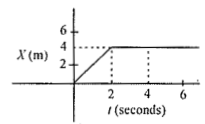
In the figure given, the position-time graph of a particle of mass is shown. The impulse at is:
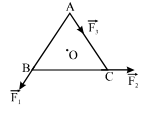
is an equilateral triangle with as its centre. and represent three forces acting along the sides and respectively. If the total torque about is zero then the magnitude of is:
When a mass is rotating in a plane about a fixed point, its angular momentum is directed along:
A spherical planet has a mass and diameter . A particle of mass falling freely near the surface of this planet will experience an acceleration due to gravity, equal to:
The potential energy of a particle in a force field is , where and are positive constants and is the distance of particle from the centre. For stable equilibrium the distance of the particle is:
Two persons of masses and respectively, are at the opposite ends of a boat. The length of the boat is and weighs . The man walks up to the man and sits with him. If the boat is in still water the centre of mass of the system shifts by:
The damping force on an oscillator is directly proportional to the velocity. The units of the constant of proportionality are:
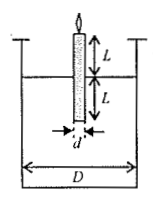
A candle of diameter is floating on a liquid in a cylindrical container of diameter as shown in figure. If it is burning at the rate of then the top of the candle will:
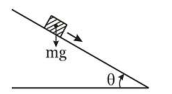
The upper half of an inclined plane of inclination is perfectly smooth while the lower half is rough. A block starting from rest at the top of the plane will again come to rest at the bottom, if the coefficient of friction between the block and lower half of the plane is given by:
An explosion breaks a rock into three parts in a horizontal plane. Two of them go off at right angles to each other. The first part of mass moves with a speed of and the second part of mass moves with speed. If the third part flies off with speed, then its mass is:
If vectors and are functions of time, then the value of at which they are orthogonal to each other is:
A roller coaster is designed such that riders experience "weightlessness" as they go round the top of a hill whose radius of curvature is . The speed of the car at the top of the hill is between:
A satellite is moving in an elliptical orbit around the earth. The mass of the satellite is very small compared to the mass of the earth. Then:
The position vector of a particle as a function of time is given by:
Where is in meters, is in seconds and and denote unit vectors along - and -directions, respectively. Which one of the following statements is wrong for the motion of particle?
Where is in meters, is in seconds and and denote unit vectors along - and -directions, respectively. Which one of the following statements is wrong for the motion of particle?
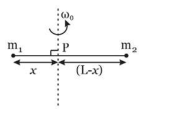
Point masses and are placed at the opposite ends of a rigid rod of length , and negligible mass. The rod is to be set rotating about an axis perpendicular to it. The position of point on this rod through which the axis should pass so that the work required to set the rod rotating with angular velocity is minimum, is given by:
When a ball is thrown up vertically with velocity , it reaches a maximum height of . If one wishes to triple the maximum height then the ball should be thrown with velocity:
If is the force acting on a particle having position vector and be the torque of this force about the origin, then:
A force is acting at a point . The value of for which angular momentum about origin is conserved is:
The radii of circular orbits of two satellites and of the earth, are and , respectively. If the speed of satellite is , then the speed of satellite will be:
A plank with a box on it at one end is gradually raised about the other end. As the angle of inclination with the horizontal reaches , the box starts to slip and slides down the plank in . The coefficients of static and kinetic friction between the box and the plank will be, respectively:
An engine pumps water continuously through a hose. Water leaves the hose with a velocity and is the mass per unit length of the water jet. What is the rate at which kinetic energy is imparted to water?
A ball is thrown vertically downwards from a height of with an initial velocity . It collides with the ground, loses percent of its energy in collision and rebounds to the same height. The initial velocity is: (Take )
A belt moves at . A box is dropped on it (). Distance the box moves relative to belt before coming to rest on it is:
On a frictionless surfaces, a block of mass moving at speed collides elastically with another block of same mass which is initially at rest. After collision the first block moves at an angle to its initial direction and has a speed . The second block’s speed after the collision is:
A horizontal platform is rotating with uniform angular velocity around the vertical axis passing through its centre. At some instant of time a viscous fluid of mass is dropped at the centre and is allowed to spread out and finally fall. The angular velocity during this period:
An explosion blows a rock into three parts. Two parts go off at right angles to each other: a part moving at and a part moving at . If the third part flies off with a velocity of , its mass would be:
A solid cylinder of mass is rolling on a horizontal surface with velocity . It collides with a horizontal spring of force constant . The maximum compression produced in the spring will be:
A particle starts its motion from rest under the action of a constant force. If the distance covered in the first seconds is and that covered in the first seconds is , then:
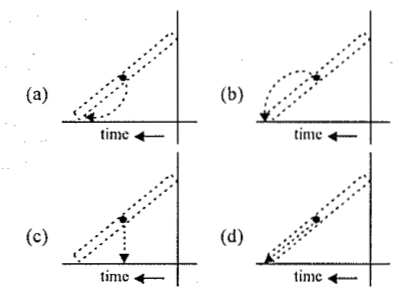
A ladder is leaned against a smooth wall and it is allowed to slip on a frictionless floor. Which figure represents trace of its centre of mass?
A body of mass is thrown upwards with a velocity . It momentarily comes to rest after attaining a height of . How much energy is lost due to air friction? ()
The height at which the weight of a body becomes th its weight on the surface of earth (radius ) is:
Two bodies of mass and have position vectors and respectively. The centre of mass of this system has a position vector:
A person is standing in an elevator. In which situation he finds his weight less?
A particle moves a distance in time according to equation . The acceleration of the particle is proportional to:
A bomb of mass 30 kg at rest explodes into two pieces of masses 18 kg and 12 kg. The velocity of 18 kg mass is 6 ms-1. The kinetic energy of the other mass is :
A car of mass negotiates a banked curve of radius on a frictionless road. If the banking angle is , the speed of the car is:
A block of mass is moving in -direction with a constant speed of . It is subjected to a retarding force during its travel from to . Its final kinetic energy will be:
The motion of a particle along a straight line is described by equation: where is in metre and in second. The retardation of the particle when its velocity becomes zero, is:
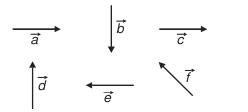
Six vectors, through have the magnitudes and directions indicated in the figure. Which of the following statements is true?
Assertion: Frictional forces are conservative forces.Reason: Potential energy can be associated with frictional forces.
The Young’s modulus of steel is twice that of brass. Two wires of same length and of same area of cross section, one of steel and another of brass are suspended from the same roof. If we want the lower ends of the wires to be at the same level, then the weights added to the steel and brass wires must be in the ratio of:
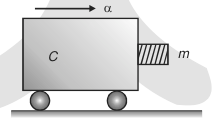
A block of mass is in contact with the cart as shown in the figure. The coefficient of static friction between the block and the cart is . The acceleration of the cart that will prevent the block from falling satisfies:
An automobile moves on a road with a speed of . The radius of its wheels is and the moment of inertia of the wheel about its axis of rotation is . If the vehicle is brought to rest in , the magnitude of average torque transmitted by its brakes to the wheel is:
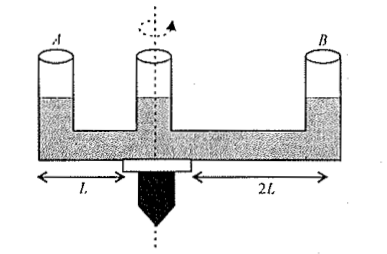
A given shaped glass tube having uniform cross section is filled with water and is mounted on a rotatable shaft as shown in figure. If the tube is rotated with a constant angular velocity then:
A remote-sensing satellite of earth revolves in a circular orbit at a height of above the surface of earth. If earth’s radius is and , then the orbital speed of the satellite is:
A body, under the action of a force , acquires an acceleration of . The mass of this body must be:
A force F acting on an object varies with distance x as shown here. The force is in N and x is in m. The work done by the force in moving the object from x = 0 to x = 6 m is :
Assertion: For a system of particles under central force field, the total angular momentum is conserved.Reason: The torque acting on such a system is zero.
A man of mass is standing in a gravity free space at a height of above the floor. He throws a stone of mass downwards with a speed . When the stone reaches the floor, the distance of the man above the floor will be:
Two particles and move with constant velocities and . At the initial moment their position vectors are and respectively. The condition for particles and for their collision is:
The mass of a lift is . When the tension in the supporting cable is , then its acceleration is:
Two stones of masses and are whirled in horizontal circles, the heavier one in a radius and the lighter one in radius . The tangential speed of the lighter stone is times that of the heavier stone when they experience same centripetal forces. The value of is:
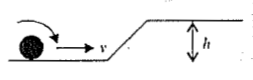
A solid sphere is rolling on a frictionless surface, shown in figure with a translational velocity . If it is to climb the inclined surface then should be:
A bus is moving with a speed of on a straight road. A scooterist wishes to overtake the bus in . If the bus is at a distance of from the scooterist, with what speed should the scooterist chase the bus?
An engine pumps water through a hose pipe. Water passes through the pipe and leaves it with a velocity of . The mass per unit length of water in the pipe is . What is the power of the engine?
A ball moving with velocity collides head on with another stationary ball of double the mass. If the coefficient of restitution is then their velocities (in ) after collision will be:
A particle executing simple harmonic motion of amplitude 5 cm has maximum speed of 31.4 cm/s. The frequency of its oscillation is :
A gramophone record is revolving with an angular velocity . A coin is placed at a distance from the centre of the record. The static coefficient of friction is . The coin will revolve with the record if:
Physics mechanics — FAQ
How many mechanics questions come in Physics?▼
Our database has 128 mechanics questions from Physics.
What difficulty are Physics mechanics questions?▼
The 128 Physics mechanics questions include 35 easy, 67 medium and 26 hard level questions.
Where can I find more mechanics questions for other exams?▼
Visit /tag/mechanics to see all mechanics questions across all exams including AIEEE, NEET 2019, AIEEE 2003.