HomeTestsSearchRankProfile

Photoelectric Effect Questions

Practice 40 Photoelectric Effect questions with detailed answers and explanations. Free MCQs, PYQs, and mock test questions for NEET, JEE, GATE, SSC and more.

📚
40
Total Questions
🟢
5
Easy
🟡
24
Medium
🔴
11
Hard
Practice by Exam:Physics(39)PHYSICS(1)

About Photoelectric Effect — practice questions, PYQs & concepts

Photoelectric Effect is a frequently-tested topic on Physics, PHYSICS. ExamTest.live currently lists 40 Photoelectric Effect questions spanning previous-year papers from 2026 to 2026, each with worked solutions and a step-by-step explanation. Use the filters on this page to focus on a specific exam, difficulty level or year — every answer key is free, no sign-up required.

Photoelectric Effect weight in competitive exams

Across our Photoelectric Effect question bank, the largest sources are Physics (39) and PHYSICS (1). Click any exam chip above to drill down to that exam-specific question set.

How to use this page

  • Start easy: 5 easy Photoelectric Effect questions are available — build fluency before moving up.
  • Target weak years: Use the year filter to focus on the most recent 2026 paper or older PYQs you have not attempted.
  • Time yourself: Every question shows the average solve time so you can benchmark your speed against other students.
  • Read every explanation: Even on questions you got right — the explanation often surfaces a faster approach you can reuse.
All Photoelectric Effect Questions(140 of 40)

Filter:
Q1mediummcqPhysicsAIEEE 20042026
50% accuracy
The work function of a substance is . Then the longest wavelength of light that can cause photoelectron emission from this substance is approximately:
Q2easymcqPhysicsAIEEE 20042026
50% accuracy
According to Einstein’s photoelectric equation, the plot of the kinetic energy of the emitted photo electrons from a metal vs the frequency of the incident radiation gives a straight line whose slope:
Q3hardmcqPhysicsNEET (UG) 20172026
0% accuracy
The photoelectric threshold wavelength of silver is . The velocity of the electron ejected from a silver surface by ultraviolet light of wavelength is nearly: (Given and )
Q4mediummcqPhysicsAIEEE 20062026
0% accuracy
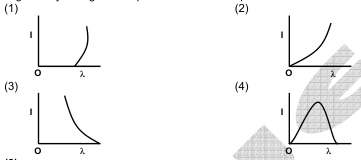
The anode voltage of a photocell is kept fixed. The wavelength of the light falling on the cathode is gradually changed. The plate current of the photocell varies as follows:
image
Q5mediummcqPhysicsAIEEE 20062026
0% accuracy
The threshold frequency for a metallic surface corresponds to an energy of , and the stopping potential for a radiation incident on this surface is . The incident radiation lies in the:
Q6easymcqPhysicsAIEEE 20062026
0% accuracy
The time taken by a photoelectron to come out after the photon strikes is approximately:
Q7hardmcqPhysicsNEET 20172026
The photoelectric threshold wavelength of silver is . The velocity of the electron ejected from a silver surface by ultraviolet light of wavelength is [Given and ]:
Q8mediummcqPhysicsNEET (UG) 20182026
When the light of frequency (where is threshold frequency), is incident on a metal plate, the maximum velocity of electrons emitted is . When the frequency of the incident radiation is increased to , the maximum velocity of electrons emitted from the same plate is . The ratio of to is:
Q9mediummcqPHYSICSNEET 20192026
The work function of the photosensitive material is . The longest wavelength of light that can cause photoelectric emission from the substance is (approximately):
Q10mediummcqPhysicsNEET 2020 E12026
Light of frequency times the threshold frequency is incident on a photosensitive material. What will be the photoelectric current if the frequency is halved and intensity is doubled?
Q11hardmcqPhysicsNEET 20212026
An electromagnetic wave of wavelength is incident on a photosensitive surface of negligible work function. If mass is of photoelectron emitted from the surface has de-Broglie wavelength , then:
Q12hardmcqPhysicsNEET 20222026
When two monochromatic light of frequency and are incident on a photoelectric metal, their stopping potential becomes and respectively. The threshold frequency for this metal is:
Q13easymcqPhysicsNEET 20232026
The work functions of Caesium (Cs), Potassium (K) and Sodium (Na) are , and respectively. If incident electromagnetic radiation has an incident energy of , which of these photosensitive surfaces may emit photoelectrons?
Q14mediummcqPhysicsAIEEE2026
A photocell is illuminated by a small bright source placed away. When the same source of light is placed away, the number of electrons emitted by photo cathode would:
Q15mediummcqPhysicsAIEEE 20032026
Two identical photo cathodes receive light of frequencies and . If the velocities of the photoelectrons (of mass ) coming out are respectively and , then:
Q16mediummcqPhysicsAIEEE 20092026
The surface of a metal is illuminated with the light of . The kinetic energy of the ejected photoelectrons was found to be . The work function of the metal is ():
Q17mediummcqPhysicsAIEEE2026
Statement-1: When ultraviolet light is incident on a photocell, its stopping potential is and the maximum kinetic energy of the photoelectrons is . When the ultraviolet light is replaced by X-rays, both and increase.Statement-2: Photoelectrons are emitted with speeds ranging from zero to a maximum value because of the range of frequencies present in the incident light.
Q18mediummcqPhysicsFIITJEE AIEEE 2011 (Set Q)2026
Statement-1 : A metallic surface is irradiated by a monochromatic light of frequency (the threshold frequency). The maximum kinetic energy and the stopping potential are and respectively. If the frequency incident on the surface is doubled, both the and are also doubled.Statement-2 : The maximum kinetic energy and the stopping potential of photoelectrons emitted from a surface are linearly dependent on the frequency of incident light.
Q19mediummcqPhysicsJEE Main2026
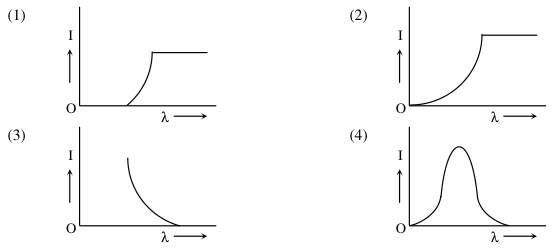
The anode voltage of a photocell is kept fixed. The wavelength of the light falling on the cathode is gradually changed. The plate current of the photocell varies as follows:
image
Q20easymcqPhysicsPhysics
0% accuracy
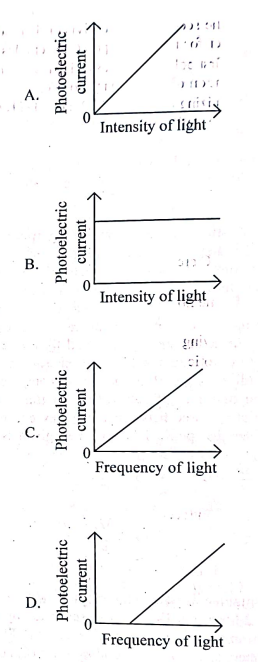
Which of the following options represents the variation of photoelectric current with intensity and frequency of light shown on the x-axis?

image
Q21mediummcqPhysicsPhysics
0% accuracy
The work functions for metals A, B and C are respectively 1.92 eV, 2.0 eV and 5 eV. According to Einstein's equation, the metals which will emit photoelectrons for a radiation of wavelength 4100 Å is/are :
Q22mediummcqPhysicsPhysics
0% accuracy
Photoelectric emission occurs only when the incident light has more than a certain minimum:
Q23mediummcqPhysicsPhysics
0% accuracy
Light of two different frequencies whose photons have energies and respectively illuminate a metallic surface whose work function is successively. The ratio of maximum speeds of emitted electrons will be:
Q24mediummcqPhysicsPhysics
0% accuracy
In photoelectric emission process from a metal of work function , the kinetic energy of most energetic electrons is . The corresponding stopping potential is:
Q25mediummcqPhysicsPhysics
A photosensitive metallic surface has work function, hv0. If photons of energy 2hv0 fall on this surface, the electrons come out with a maximum velocity of 4 x 10⁶ m/s. When the photon energy is increased to 5hv0, then maximum velocity of photoelectrons will be :
Q26hardmcqPhysicsPhysics
Photons with energy are incident on a cathode in a photoelectric cell. The maximum energy of emitted photoelectrons is . When photons of energy are incident on , no photoelectrons will reach the anode , if the stopping potential of relative to is:
Q27hardmcqPhysicsPhysics
A source emits monochromatic light of wavelength . When placed away, it liberates photoelectrons from a photosensitive metallic surface. When the source is moved to a distance of , the number of photoelectrons liberated, will be reduced by a factor of:
Q28hardmcqPhysicsPhysics
The work function of a surface of a photosensitive material is . The wavelength of the incident radiation for which the stopping potential is lies in the:
Q29easymcqPhysicsPhysics
The number of photo electrons emitted for light of a frequency (higher than the threshold frequency ) is proportional to:
Q30mediummcqPhysicsPhysics
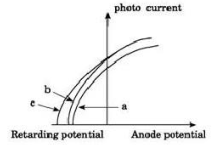
The Figure shows a plot of photo current versus anode potential for a photo sensitive surface for three different radiations. Which one of the following is a correct statement?
image
Q31mediummcqPhysicsPhysics
A source is producing of wavelength . Another source is producing of wavelength . Then (power of )/(power of ) is equal to:
Q32mediummcqPhysicsPhysics
The potential difference that must be applied to stop the fastest photo electrons emitted by a nickel surface, having work function , when ultraviolet light of falls on it, must be:
Q33mediummcqPhysicsPhysics
Threshold frequency for a metal is . If light of frequency is incident, the cut-off voltage is nearly:
Q34mediummcqPhysicsPhysics
Two radiations of photon energies and illuminate a surface of work function successively. The ratio of the maximum speeds of the emitted electrons is:
Q35hardmcqPhysicsPhysics
Monochromatic radiation emitted when electron on hydrogen atom jumps from first excited to the ground state irradiates a photosensitive material. The stopping potential is measured to be . The threshold frequency of the material is:
Q36mediummcqPhysicsPhysics
For photoelectric emission, the cutoff frequency is . If radiation of frequency impinges on the plate, the maximum velocity of emitted electrons is:
Q37mediummcqPhysicsPhysics
When the energy of the incident radiation is increased by , the kinetic energy of the photoelectrons emitted from a metal surface increased from to . The work function of the metal is:
Q38hardmcqPhysicsPhysics
Light of wavelength is incident on a metal with work function . The de Broglie wavelength of the emitted electron is:
Q39hardmcqPhysicsPhysics
A photoelectric surface is illuminated successively by monochromatic light of wavelength and . If the maximum kinetic energy of the emitted photoelectrons in the second case is times that in the first case, the work function of the surface of the material is:
Q40hardmcqPhysicsPhysics
When a metallic surface is illuminated with radiation of wavelength , the stopping potential is . If the same surface is illuminated with radiation of wavelength , the stopping potential is . The threshold wavelength for the metallic surface is:

Frequently Asked Questions

How many Photoelectric Effect questions are on ExamTest.live?
We have 40 Photoelectric Effect questions spread across 1 pages, covering easy, medium, and hard difficulty levels with detailed explanations.
Are Photoelectric Effect MCQs free?
Yes. All Photoelectric Effect questions, answers, and explanations on ExamTest.live are completely free. No account or subscription required.
Which exams include Photoelectric Effect questions?
Photoelectric Effect questions are commonly asked in Physics, PHYSICS. You can filter by exam using the links above.
How do I practice Photoelectric Effect questions effectively?
Start with easy questions to build confidence, then tackle medium and hard ones. Use the filter buttons to sort by difficulty. Reveal the answer only after attempting each question, and read the explanation thoroughly.