HomeTestsSearchRankProfile

Plant Anatomy Questions

Practice 36 Plant Anatomy questions with detailed answers and explanations. Free MCQs, PYQs, and mock test questions for NEET, JEE, GATE, SSC and more.

📚
36
Total Questions
🟢
10
Easy
🟡
21
Medium
🔴
5
Hard
Practice by Exam:Biology(36)

About Plant Anatomy — practice questions, PYQs & concepts

Plant Anatomy is a frequently-tested topic on Biology. ExamTest.live currently lists 36 Plant Anatomy questions spanning previous-year papers from 2026 to 2026, each with worked solutions and a step-by-step explanation. Use the filters on this page to focus on a specific exam, difficulty level or year — every answer key is free, no sign-up required.

Plant Anatomy weight in competitive exams

Across our Plant Anatomy question bank, the largest sources are Biology (36). Click any exam chip above to drill down to that exam-specific question set.

How to use this page

  • Start easy: 10 easy Plant Anatomy questions are available — build fluency before moving up.
  • Target weak years: Use the year filter to focus on the most recent 2026 paper or older PYQs you have not attempted.
  • Time yourself: Every question shows the average solve time so you can benchmark your speed against other students.
  • Read every explanation: Even on questions you got right — the explanation often surfaces a faster approach you can reuse.
All Plant Anatomy Questions(136 of 36)

Filter:
Q1mediummcqBiologyNEET (UG) 20172026
0% accuracy
Identify the wrong statement in context of heartwood:
Q2mediummcqBiologyNEET 20232026
Identify the correct statements:A. Lenticels are the lens-shaped openings permitting the exchange of gases.B. Bark formed early in the season is called hard bark.C. Bark is a technical term that refers to all tissues exterior to vascular cambium.D. Bark refers to periderm and secondary phloem.E. Phellogen is single-layered in thickness.Choose the correct answer from the options given below:
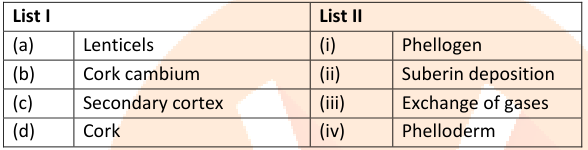
Q3mediummcqBiologyNEET 20212026
Match List-I with List-II:
image
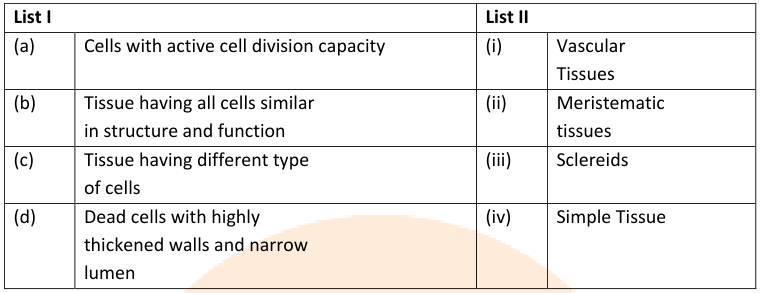
Q4mediummcqBiologyNEET 20212026
Match List-I with List-II:
image
Q5mediummcqBiologyNEET 20212026
Select the correct pair:
Q6mediummcqBiologyNEET 20222026
In old trees the greater part of secondary xylem is dark brown and resistant to insect attack due to:(a) Secretion of secondary metabolites and their deposition in the lumen of vessels.(b) Deposition of organic compounds like tannins and resins in the central layers of the stem.(c) Deposition of suberin and aromatic substances in the outer layer of the stem.(d) Deposition of tannins, gum, resin and aromatic substances in the peripheral layers of the stem.(e) Presence of parenchyma cells, functionally active xylem elements and essential oils.Choose the correct answer from the options given below:
Q7hardmcqBiologyNEET 20222026
Read the following statements about the vascular bundles:(a) In roots, xylem and phloem in a vascular bundle are arranged in an alternate manner along the different radii.(b) Conjoint closed vascular bundles do not possess cambium.(c) In open vascular bundles, cambium is present in between xylem and phloem.(d) The vascular bundles of dicotyledonous stem possess endarch protoxylem.(e) In monocotyledonous root, usually there are more than six xylem bundles present.Choose the correct answer from the options given below:
Q8hardmcqBiologyNEET 20222026
The anatomy of springwood shows some peculiar features. Identify the correct set of statements about springwood:(a) It is also called early wood(b) In the spring season cambium produces xylem elements with narrow vessels(c) It is lighter in colour(d) The springwood along with autumnwood shows alternate concentric rings forming annual rings(e) It has lower densityChoose the correct answer from the options given below:
Q9mediummcqBiologyNEET 20232026
Given below are two statements:Statement I: Endarch and exarch are the terms often used for describing the position of secondary xylem in the plant body.Statement II: Exarch condition is the most common feature of the root system.In the light of the above statements, choose the correct answer from the options given below:
Q10mediummcqBiologyNEET 20232026
Given below are two statements: one is labelled as Assertion A and the other is labelled as Reason R:Assertion A: Late wood has fewer xylary elements with narrow vessels.Reason R: Cambium is less active in winters.In the light of the above statements, choose the correct answer:
Q11mediummcqBiologyBiology
0% accuracy
The "Eyes" of the potato tuber are:
Q12mediummcqBiologyBiology
0% accuracy
Ground tissue includes:
Q13mediummcqBiologyBiology
0% accuracy
In land plants the guard cells differ from other epidermal cells in having:
Q14mediummcqBiologyBiology
0% accuracy
The cork cambium, cork and secondary cortex are collectively called:
Q15mediummcqBiologyBiology
Gymnosperms are also called soft wood spermatophytes because they lack:
Q16easymcqBiologyBiology
Tracheids differ from other tracheary elements (vessels) in:
Q17mediummcqBiologyBiology
You are given a fairly old piece of dicot stem and a dicot root. Which of the following anatomical structures will you use to distinguish between them?
Q18easymcqBiologyBiology
The age of a tree can be estimated by:
Q19easymcqBiologyBiology
Lenticels are involved in:
Q20easymcqBiologyBiology
Interfascicular cambium develops from the cells of:
Q21easymcqBiologyBiology
Companion cells are closely associated with:
Q22mediummcqBiologyBiology
The common bottle cork is a product of:
Q23mediummcqBiologyBiology
Which one of the following statements pertaining to plant structure is correct?
Q24easymcqBiologyBiology
Closed vascular bundles lack:
Q25mediummcqBiologyBiology
Water containing cavities in vascular bundles are found in:
Q26mediummcqBiologyBiology
Heartwood differs from sapwood in:
Q27easymcqBiologyBiology
The chief water conducting elements of xylem in gymnosperms are:
Q28easymcqBiologyBiology
Which one of the following is NOT a lateral meristem?
Q29hardmcqBiologyBiology
In barley stem, vascular bundles are:
Q30hardmcqBiologyBiology
Palisade parenchyma is absent in leaves of:
Q31hardmcqBiologyBiology
The annular and spirally thickened conducting elements generally develop in the protoxylem when the root or stem is:
Q32mediummcqBiologyBiology
An anatomically fairly old dicotyledonous root is distinguished from the dicotyledonous stem by:
Q33easymcqBiologyBiology
The length of different internodes in a culm of sugarcane is variable because of:
Q34easymcqBiologyBiology
Vascular tissues in flowering plants develop from:
Q35mediummcqBiologyBiology
For a critical study of secondary growth in plants, which one of the following pairs is suitable:
Q36mediummcqBiologyBiology
Passage cells are thin-walled cells found in:

Frequently Asked Questions

How many Plant Anatomy questions are on ExamTest.live?
We have 36 Plant Anatomy questions spread across 1 pages, covering easy, medium, and hard difficulty levels with detailed explanations.
Are Plant Anatomy MCQs free?
Yes. All Plant Anatomy questions, answers, and explanations on ExamTest.live are completely free. No account or subscription required.
Which exams include Plant Anatomy questions?
Plant Anatomy questions are commonly asked in Biology. You can filter by exam using the links above.
How do I practice Plant Anatomy questions effectively?
Start with easy questions to build confidence, then tackle medium and hard ones. Use the filter buttons to sort by difficulty. Reveal the answer only after attempting each question, and read the explanation thoroughly.