HomeTestsSearchRankProfile

Wave Optics Questions

Practice 36 Wave Optics questions with detailed answers and explanations. Free MCQs, PYQs, and mock test questions for NEET, JEE, GATE, SSC and more.

📚
36
Total Questions
🟢
6
Easy
🟡
24
Medium
🔴
6
Hard
Practice by Exam:Physics(34)PHYSICS(2)

About Wave Optics — practice questions, PYQs & concepts

Wave Optics is a frequently-tested topic on Physics, PHYSICS. ExamTest.live currently lists 36 Wave Optics questions spanning previous-year papers from 2026 to 2026, each with worked solutions and a step-by-step explanation. Use the filters on this page to focus on a specific exam, difficulty level or year — every answer key is free, no sign-up required.

Wave Optics weight in competitive exams

Across our Wave Optics question bank, the largest sources are Physics (34) and PHYSICS (2). Click any exam chip above to drill down to that exam-specific question set.

How to use this page

  • Start easy: 6 easy Wave Optics questions are available — build fluency before moving up.
  • Target weak years: Use the year filter to focus on the most recent 2026 paper or older PYQs you have not attempted.
  • Time yourself: Every question shows the average solve time so you can benchmark your speed against other students.
  • Read every explanation: Even on questions you got right — the explanation often surfaces a faster approach you can reuse.
All Wave Optics Questions(136 of 36)

Filter:
Q1mediummcqPhysicsNEET 20192026
0% accuracy
In a double slit experiment, when light of wavelength was used, the angular width of the first minima formed on a screen placed away, was found to be . What will be the angular width of the first minima, if the entire experimental apparatus is immersed in water? ()
Q2mediummcqPhysicsNEET (UG) 20172026
0% accuracy
Two Polaroids and are placed with their axis perpendicular. Unpolarised light is incident on . A third polaroid is kept in between such that its axis makes with . The intensity of transmitted light through is:
Q3hardmcqPhysicsNEET (UG) 20172026
0% accuracy
Young’s double slit experiment is first performed in air and then in a medium other than air. It is found that bright fringe in the medium lies where dark fringe lies in air. The refractive index of the medium is nearly:
Q4easymcqPhysicsNEET 20192026
0% accuracy
Which colour of the light has the longest wavelength?
Q5mediummcqPhysicsAIEEE 20072026
0% accuracy
In a Young's double slit experiment the intensity at a point where the path difference is ( being the wavelength of the light used) is . If denotes the maximum intensity, is equal to:
Q6mediummcqPhysicsNEET 20222026
In a Young's double slit experiment, a student observes fringes in a certain segment of screen when a monochromatic light of wavelength is used. If the wavelength of light is changed to , then the number of fringes he would observe in the same region of the screen is:
Q7mediummcqPHYSICSNEET 20192026
In Young's double-slit experiment, if there is no initial phase difference between the light from the two slits, a point on the screen corresponding to the fifth minimum has a path difference:
Q8mediummcqPHYSICSNEET 20192026
The angular width of the central maximum in the Fraunhofer diffraction for is . When the same slit is illuminated by another monochromatic light, the angular width decreases by . The wavelength of this light is:
Q9mediummcqPhysicsNEET 2020 E12026
The Brewsters angle for an interface should be:
Q10mediummcqPhysicsNEET 2020 E12026
In Young’s double slit experiment, if the separation between coherent sources is halved and the distance of the screen from the coherent sources is doubled, then the fringe width becomes:
Q11mediummcqPhysicsNEET 2020 E12026
Assume that light of wavelength is coming from a star. The limit of resolution of telescope whose objective has a diameter of is:
Q12mediummcqPhysicsNEET (UG) 20182026
Unpolarised light is incident from air on a plane surface of a material of refractive index ' '. At a particular angle of incidence ' ', it is found that the reflected and refracted rays are perpendicular to each other. Which of the following options is correct for this situation?
Q13mediummcqPhysicsNEET 20232026
For Young's double slit experiment, two statements are given below:Statement I: If the screen is moved away from the plane of slits, the angular separation of the fringes remains constant.Statement II: If the monochromatic source is replaced by another monochromatic source of larger wavelength, the angular separation of fringes decreases.In the light of the above statements, choose the correct answer:
Q14easymcqPhysicsNEET (UG) 20242026
If the monochromatic source in Young's double slit experiment is replaced by white light, then:
Q15mediummcqPhysicsAIEEE 20092026
A mixture of light, consisting of wavelength and an unknown wavelength, illuminates Young’s double slit and gives rise to two overlapping interference patterns on the screen. The central maximum of both lights coincide. Further, it is observed that the third bright fringe of known light coincides with the bright fringe of the unknown light. From this data, the wavelength of the unknown light is:
Q16mediummcqPhysicsFIITJEE AIEEE 2011 (Set Q)2026
Statement-1 : When light reflects from the air-glass plate interface, the reflected wave suffers a phase change of .Statement-2 : The centre of the interference pattern in Newton's rings is dark.
Q17hardmcqPhysicsAIEEE 20122026
In Young's double slit experiment, one of the slit is wider than other, so that the amplitude of the light from one slit is double of that from other slit. If be the maximum intensity, the resultant intensity when they interfere at phase difference is given by:
Q18mediummcqPhysicsJEE Main2026
A beam of unpolarised light of intensity is passed through a polaroid and then through another polaroid which is oriented so that its principal plane makes an angle of relative to that of . The intensity of the emergent light is:
Q19mediummcqPhysicsJEE Main2026
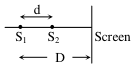
Two coherent point sources and are separated by a small distance as shown. The fringes obtained on the screen will be:
image
Q20mediummcqPhysicsNEET (UG) 20182026
In Young's double slit experiment the separation between the slits is , the wavelength of the light used is and distance between the screen and slits is . It is found that the angular width of the fringes is . To increase the fringe angular width to (with same and ) the separation between the slits needs to be changed to:
Q21mediummcqPhysicsNEET 20172026
Two Polaroids and are placed with their axis perpendicular to each other. Unpolarised light is incident on . A third polaroid is kept in between and such that its axis makes an angle with that of . The intensity of transmitted light through is:
Q22easymcqPhysicsNEET 20172026
The ratio of resolving powers of an optical microscope for two wavelengths and is:
Q23hardmcqPhysicsNEET 20172026
Young’s double slit experiment is first performed in air and then in a medium other than air. It is found that bright fringe in the medium lies where dark fringe lies in air. The refractive index of the medium is nearly:
Q24mediummcqPhysicsPhysics
3% accuracy
An unpolarized light beam travelling in air is incident on a medium of refractive index at Brewster's angle. Then:
Q25mediummcqPhysicsPhysics
0% accuracy
The intensity of transmitted light when a polaroid sheet, placed between two crossed polaroids at from the polarization axis of one of the polaroids, is ( is the intensity of polarised light after passing through the first polaroid):
Q26hardmcqPhysicsPhysics
A linear aperture whose width is is placed immediately in front of a lens of focal length . The aperture is illuminated normally by a parallel beam of wavelength . The distance of the first dark band of the diffraction pattern from the centre of the screen is:
Q27mediummcqPhysicsPhysics
In a diffraction pattern due to a single slit of width , the first minimum is observed at an angle when light of wavelength is incident on the slit. The first secondary maximum is observed at an angle of:
Q28hardmcqPhysicsPhysics
The intensity at the maximum in a Young’s double slit experiment is . Distance between two slits is , where is the wavelength of light used in the experiment. What will be the intensity in front of one of the slits on the screen placed at a distance ?
Q29mediummcqPhysicsPhysics
Two slits in Young’s experiment have widths in the ratio . The ratio of intensity at the maxima and minima in the interference pattern, is:
Q30mediummcqPhysicsPhysics
At the first minimum adjacent to the central maximum of a single-slit diffraction pattern, the phase difference between the Huygen's wavelet from the edge of the slit and the wavelet from the midpoint of the slit is:
Q31easymcqPhysicsPhysics
In the Young's double-slit experiment, the intensity of light at a point on the screen where the path difference is is , ( being the wave length of light used). The intensity at a point where the path difference is , will be:
Q32mediummcqPhysicsPhysics
A beam of light of from a distant source falls on a single slit wide and the resulting diffraction pattern is observed on a screen away. The distance between first dark fringes on either side of the central bright fringe is:
Q33easymcqPhysicsPhysics
Assertion: The clouds in sky generally appear to be whitish.Reason: Diffraction due to clouds is efficient in equal measure at all wavelengths.
Q34mediummcqPhysicsPhysics
In case of linearly polarised light, the magnitude of the electric field vector:
Q35easymcqPhysicsPhysics
When exposed to sunlight, thin films of oil on water often exhibit brilliant colours due to the phenomenon of:
Q36hardmcqPhysicsPhysics
The interference pattern is obtained with two coherent light sources of intensity ratio . In the interference pattern, the ratio will be:

Frequently Asked Questions

How many Wave Optics questions are on ExamTest.live?
We have 36 Wave Optics questions spread across 1 pages, covering easy, medium, and hard difficulty levels with detailed explanations.
Are Wave Optics MCQs free?
Yes. All Wave Optics questions, answers, and explanations on ExamTest.live are completely free. No account or subscription required.
Which exams include Wave Optics questions?
Wave Optics questions are commonly asked in Physics, PHYSICS. You can filter by exam using the links above.
How do I practice Wave Optics questions effectively?
Start with easy questions to build confidence, then tackle medium and hard ones. Use the filter buttons to sort by difficulty. Reveal the answer only after attempting each question, and read the explanation thoroughly.