HomeTestsSearchRankProfile

Microbes In Human Welfare Questions

Practice 35 Microbes In Human Welfare questions with detailed answers and explanations. Free MCQs, PYQs, and mock test questions for NEET, JEE, GATE, SSC and more.

📚
35
Total Questions
🟢
15
Easy
🟡
20
Medium
🔴
0
Hard

About Microbes in Human Welfare — practice questions, PYQs & concepts

Microbes in Human Welfare is a frequently-tested topic on Biology, BIOLOGY, Botany. ExamTest.live currently lists 35 Microbes in Human Welfare questions spanning previous-year papers from 2026 to 2026, each with worked solutions and a step-by-step explanation. Use the filters on this page to focus on a specific exam, difficulty level or year — every answer key is free, no sign-up required.

Microbes in Human Welfare weight in competitive exams

Across our Microbes in Human Welfare question bank, the largest sources are Biology (32), BIOLOGY (2) and Botany (1). Click any exam chip above to drill down to that exam-specific question set.

How to use this page

  • Start easy: 15 easy Microbes in Human Welfare questions are available — build fluency before moving up.
  • Target weak years: Use the year filter to focus on the most recent 2026 paper or older PYQs you have not attempted.
  • Time yourself: Every question shows the average solve time so you can benchmark your speed against other students.
  • Read every explanation: Even on questions you got right — the explanation often surfaces a faster approach you can reuse.
All Microbes In Human Welfare Questions(135 of 35)

Filter:
Q1easymcqBiologyNEET (UG) 20172026
0% accuracy
Which of the following is correctly matched for the product produced by them?
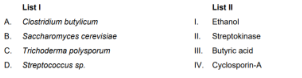
Q2mediummatch/followingBotanyNEET 2024 R1@NUM: 1232026
Match List I with List II:
image
Q3mediummcqBiologyNEET 2020 E12026
Match the following columns and select the correct option.
| Column - I | Column - II |
| :--- | :--- |
| (a) Clostridium butylicum | (i) Cyclosporin-A |
| (b) Trichoderma polysporum | (ii) Butyric Acid |
| (c) Monascus purpureus | (iii) Citric Acid |
| (d) Aspergillus niger | (iv) Blood cholesterol lowering agent |
Q4mediummcqBiologyNEET 2020 E12026
Which of the following is put into Anaerobic sludge digester for further sewage treatment?
Q5easymcqBIOLOGYNEET 20192026
Among the following pairs of microbes, which pair has both the microbes that can be used as biofertilizers?
Q6mediummcqBIOLOGYNEET 20192026
For a biocontrol agent to be part of an integrated pest management, it should be:
Q7easymcqBiologyNEET (UG) 20182026
Conversion of milk to curd improves its nutritional value by increasing the amount of:
Q8mediummcqBiologyBiology
0% accuracy
Ethanol is commercially produced through a particular species of:
Q9mediummcqBiologyBiology
0% accuracy
An organism used as biofertilizer for raising soyabean crop is:
Q10mediummcqBiologyBiology
0% accuracy
The most common substrate used in distilleries for the production of ethanol is:
Q11mediummcqBiologyBiology
0% accuracy
Continuous addition of sugars in 'fed batch' fermentation is done to:
Q12mediummcqBiologyBiology
0% accuracy
Which of the followings is mainly produced by the activity of anaerobic bacteria on sewage?
Q13mediummcqBiologyBiology
0% accuracy
Which one of the following helps in absorption of phosphorus from soil by plants?
Q14mediummcqBiologyBiology
0% accuracy
Secondary sewage treatment is mainly a:
Q15mediummcqBiologyBiology
0% accuracy
Which one of the following is not a biofertilizer?
Q16mediummcqBiologyBiology
Which one of the following pairs is wrongly matched?
Q17easymcqBiologyBiology
Nitrogen fixation in root nodules of Alnus is brought about by:
Q18easymcqBiologyBiology
Trichoderma harzianum has proved to be a useful microorganism for:
Q19easymcqBiologyBiology
Modern detergents contain enzyme preparations of:
Q20mediummcqBiologyBiology
Which one of the following pairs is wrongly matched?
Q21mediummcqBiologyBiology
Which of the following is NOT used as a biopesticide?
Q22easymcqBiologyBiology
The bacterium Bacillus thuringiensis is widely used in contemporary biology as:
Q23mediummcqBiologyBiology
Match the following list of microbes and their importance:(a) Saccharomyces cerevisiae — (i) Production of immunosuppressive agents(b) Monascus purpureus — (ii) Ripening of Swiss cheese(c) Trichoderma polysporum — (iii) Commercial production of ethanol(d) Propionibacterium shermanii — (iv) Production of blood-cholesterol lowering agents
Q24easymcqBiologyBiology
A good producer of citric acid is:
Q25easymcqBiologyBiology
Monascus purpureus is a yeast used commercially in the production of:
Q26mediummcqBiologyBiology
Which one of the following microbes forms symbiotic association with plants and helps them in their nutrition?
Q27mediummcqBiologyBiology
Which one of the following is an example of carrying out biological control of pests/diseases using microbes?
Q28easymcqBiologyBiology
Yeast is used in the production of:
Q29mediummcqBiologyBiology
The domestic sewage in large cities:
Q30easymcqBiologyBiology
In gobar gas (biogas), the maximum amount is that of:
Q31mediummcqBiologyBiology
Select the correct statement from the following:
Q32easymcqBiologyBiology
Which one of the following is NOT used in organic farming?
Q33easymcqBiologyBiology
Curing of tea leaves is brought by the activity of:
Q34easymcqBiologyBiology
A common biocontrol agent for the control of plant diseases is:
Q35easymcqBiologyBiology
The common nitrogen-fixer in paddy fields is:

Frequently Asked Questions

How many Microbes In Human Welfare questions are on ExamTest.live?
We have 35 Microbes In Human Welfare questions spread across 1 pages, covering easy, medium, and hard difficulty levels with detailed explanations.
Are Microbes In Human Welfare MCQs free?
Yes. All Microbes In Human Welfare questions, answers, and explanations on ExamTest.live are completely free. No account or subscription required.
Which exams include Microbes In Human Welfare questions?
Microbes In Human Welfare questions are commonly asked in Biology, BIOLOGY, Botany. You can filter by exam using the links above.
How do I practice Microbes In Human Welfare questions effectively?
Start with easy questions to build confidence, then tackle medium and hard ones. Use the filter buttons to sort by difficulty. Reveal the answer only after attempting each question, and read the explanation thoroughly.