AIEEE 2004
vectors Questions
35 vectors questions from AIEEE 2004 with detailed answers and explanations. Free previous year questions and MCQs.
📚
35
Questions
🟢
3
Easy
🟡
24
Medium
🔴
8
Hard
Years:2026 (35)
vectors — AIEEE 2004(1–35 of 35)
Filter:
A force is applied over a particle which displaces it from its origin to the point . The work done on the particle in joules is:
A particle has two velocities of equal magnitude inclined to each other at an angle . If one of them is halved, the angle between the other and the original resultant velocity is bisected by the new resultant. Then is:
The values of for which the points with position vectors , and respectively are the vertices of a right-angled triangle with are:
Let and be non-zero vectors such that If is the acute angle between the vectors and then equals
Let be such that If the projection along is equal to that of along and are perpendicular to each other then equals
If are non-coplanar vectors and is a real number, then the vectors and are non-coplanar for
A particle is acted upon by constant forces and which displace it from a point to the point The work done in standard units by the forces is given by
Let and be three non-zero vectors such that no two of these are collinear. If the vector is collinear with and is collinear with then equals
If , where and are any three vectors such that and , then and are:
is a triangle, right-angled at . The resultant of the forces acting along and with magnitudes and respectively is a force along , where is the foot of the perpendicular from onto . The magnitude of the resultant is:
Let , and . If the vector lies in the plane of and , then equals:
If a line makes an angle of with the positive directions of each of -axis and -axis, then the angle that the line makes with the positive direction of the -axis is:
If and are unit vectors and is the acute angle between them, then is a unit vector for:
The resultant of two forces and is a force of . If the direction of force were reversed, the resultant would be . The value of is:
Let be non-coplanar vectors and are real numbers, then the equality holds for:
Let be a parallelogram such that , and be an acute angle. If is the vector that coincides with the altitude directed from the vertex to the side , then is given by:
A particle has an initial velocity and an acceleration of . Its speed after is:
The projections of a vector on the three coordinate axis are respectively. The direction cosines of the vector are:
The vectors and are not perpendicular and and are two vectors satisfying: and . Then the vector is equal to:
Let and be two unit vectors. If the vectors and are perpendicular to each other, then the angle between and is:
A particle is moving eastwards with a velocity of . In the velocity changes to northwards. The average acceleration in this time is:
The vector lies in the plane of the vectors and and bisects the angle between and . Then which one of the following gives possible values of and ?
The non-zero vectors and are related by and . Then the angle between and is:
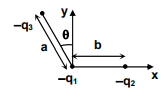
Three charges , and are placed as shown in the figure. ( at origin, at , at ). The -component of the force on is proportional to:
A tetrahedron has vertices at , , and . Then the angle between the faces and will be:
If and vectors , and are non-coplanar, then the product equals:
Consider points and with position vectors , , and respectively. Then is a:
A particle acted on by constant forces and is displaced from the point to the point . The total work done by the forces is:
AIEEE 2004 vectors — FAQ
How many vectors questions come in AIEEE 2004?▼
Our database has 35 vectors questions from AIEEE 2004 covering 2026 to 2026.
What difficulty are AIEEE 2004 vectors questions?▼
The 35 AIEEE 2004 vectors questions include 3 easy, 24 medium and 8 hard level questions.
Where can I find more vectors questions for other exams?▼
Visit /tag/vectors to see all vectors questions across all exams including Physics, Mathematics Mock Test - 9, AIEEE-CBSE-ENG-03.