HomeTestsSearchRankProfile

Electrochemistry Questions

Practice 73 Electrochemistry questions with detailed answers and explanations. Free MCQs, PYQs, and mock test questions for NEET, JEE, GATE, SSC and more.

📚
73
Total Questions
🟢
6
Easy
🟡
54
Medium
🔴
13
Hard

About Electrochemistry — practice questions, PYQs & concepts

Electrochemistry is a frequently-tested topic on Chemistry, CHEMISTRY, General Chemistry. ExamTest.live currently lists 73 Electrochemistry questions spanning previous-year papers from 2026 to 2026, each with worked solutions and a step-by-step explanation. Use the filters on this page to focus on a specific exam, difficulty level or year — every answer key is free, no sign-up required.

Electrochemistry weight in competitive exams

Across our Electrochemistry question bank, the largest sources are Chemistry (69), CHEMISTRY (3) and General Chemistry (1). Click any exam chip above to drill down to that exam-specific question set.

How to use this page

  • Start easy: 6 easy Electrochemistry questions are available — build fluency before moving up.
  • Target weak years: Use the year filter to focus on the most recent 2026 paper or older PYQs you have not attempted.
  • Time yourself: Every question shows the average solve time so you can benchmark your speed against other students.
  • Read every explanation: Even on questions you got right — the explanation often surfaces a faster approach you can reuse.

All Electrochemistry Questions(173 of 73)

Filter:
Q1mediummcqChemistryAIEEE2026
0% accuracy
For a spontaneous reaction the , equilibrium constant () and will be respectively:
Q2mediummcqChemistryAIEEE2026
0% accuracy
Aluminium oxide may be electrolysed at to furnish aluminium metal (Atomic mass ; ). The cathode reaction is:

To prepare of aluminium metal by this method would require:
Q3hardmcqChemistryAIEEE2026
0% accuracy
Calculate using the following molar conductances at infinite dilution at :
image
Q4hardmcqChemistryNEET 20192026
0% accuracy
For a cell involving one electron E
cell


=0.59V at 298K, the equilibrium constant for the cell reaction is:
Q5mediummcqChemistryNEET 20192026
0% accuracy
For the cell reaction:
2Fe
3+
(aq)+2I

(aq)→2Fe
2+
(aq)+I
2

(aq)
E
Cell


=0.24V at 298K. The standard Gibbs energy (Δ
r

G

) of the cell reaction is:
Q6mediummcqChemistryNEET (UG) 20172026
0% accuracy
In the electrochemical cell , the emf is . When the concentrations are swapped (, ), the emf is . The relationship is:
Q7mediummcqChemistryAIEEE 20072026
0% accuracy
The equivalent conductances of two strong electrolytes at infinite dilution in at are given: What additional information is needed to calculate of acetic acid?
Q8mediummcqChemistryAIEEE 20072026
0% accuracy
The cell, , , was allowed to be completely discharged at . The relative concentration of to , , is:
Q9hardmcqChemistryAIEEE 20062026
0% accuracy
Resistance of a conductivity cell filled with a solution of an electrolyte is . The conductivity is . Resistance of the same cell when filled with of the same solution is . The molar conductivity of solution of the electrolyte will be:
Q10hardmcqChemistryAIEEE 20062026
0% accuracy
Given at : What is the value of for ? ()
Q11mediummcqChemistryAIEEE 20062026
0% accuracy
The molar conductivities and at infinite dilution in water at are and respectively. To calculate , the additional value required is:
Q12mediummcqChemistryNEET 20232026
Given below are two statements: one is labelled as Assertion A and the other is labelled as Reason R:Assertion A: In the equation , the value of depends on .Reason R: is an intensive property and is an extensive property.In the light of the above statements, choose the correct answer:
Q13mediummcqCHEMISTRYNEET 20192026
Limiting molar conductivity of () is equal to:
Q14mediummcqChemistryNEET 20232026
The conductivity of centimolar solution of at is and the resistance of the cell containing the solution at is . The value of cell constant is:
Q15hardmcqChemistryNEET 20222026
Find the emf of the cell: [Given that , at ]
Q16mediummcqChemistryNEET 20222026
At , the standard electrode potentials of and are and , respectively. On the basis of standard electrode potential, predict which of the following reaction cannot occur?
Q17hardmcqChemistryNEET 20222026
Given below are half cell reactions: Will the permanganate ion, , liberate from water in the presence of an acid?
Q18mediummcqChemistryNEET 20212026
The molar conductivity of acetic acid is . What is the dissociation constant of acetic acid? [Given and ]
Q19mediummcqChemistryNEET 20212026
The molar conductance of , and at infinite dilution are and respectively. The molar conductance of at infinite dilution is:
Q20mediummcqChemistryNEET 2020 E12026
The number of Faradays() required to produce of calcium from molten (Atomic mass of ) is:
Q21mediummcqChemistryNEET 2020 E12026
On electrolysis of dil. sulphuric acid using Platinum (Pt) electrode, the product obtained at anode will be:
Q22hardmcqCHEMISTRYNEET 20192026
Limiting molar conductivities for and are respectively. From the data given above, it can be concluded that for will be:
Q23mediummcqGeneral ChemistryCompetitive Exam2026
In a hydrogen-oxygen fuel cell between the two electrodes occurs to
Q24mediummcqChemistryNEET (UG) 20242026
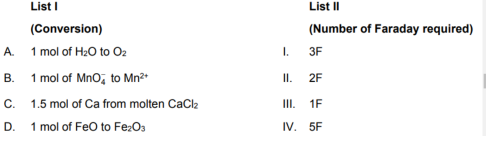
Match the following reduction processes with the number of Faradays required:
image
Q25mediummcqChemistryNEET (UG) 20242026
Mass of copper deposited by passing of current through copper sulfate solution for is:(Given: Molar mass of , )
Q26easymcqChemistryAIEEE 20042026
In a hydrogen – oxygen fuel cell, combustion of hydrogen occurs to:
Q27mediummcqChemistryAIEEE 20042026
Consider the following values: Under standard conditions the potential for the reaction: is:
Q28mediummcqChemistryAIEEE 20042026
The standard e.m.f. of a cell, involving one electron change is found to be at . The equilibrium constant of the reaction is ():
Q29mediummcqChemistryAIEEE 20042026
The limiting molar conductivities for and are and respectively. The for is:
Q30mediummcqChemistryAIEEE 20042026
In a cell that utilizes the reaction , the addition of to the cathode compartment will:
Q31mediummcqChemistryAIEEE2026
Given and . The potential for the cell is:
Q32mediummcqChemistryAIEEE 20092026
In a fuel cell methanol is used as fuel and oxygen gas is used as an oxidizer. The reaction is . At standard Gibb’s energies of formation for , and are , and respectively. If standard enthalpy of combustion of methanol is , efficiency of the fuel cell will be:
Q33mediummcqChemistryAIEEE 20092026
Given: , . The value of standard electrode potential for the change, will be:
Q34mediummcqChemistryAIEEE2026
The Gibbs energy for the decomposition of at is as follows: The potential difference needed for electrolytic reduction of at is at least:
Q35hardmcqChemistryFIITJEE AIEEE 2011 (Set Q)2026
The reduction potential of hydrogen half cell will be negative if:
Q36mediummcqChemistryAIEEE 20122026
The standard reduction potentials for , , and are , and respectively. The reaction will be spontaneous when:
Q37mediummcqChemistryJEE Main2026
Given: Based on the data given above, the strongest oxidising agent will be:
Q38mediummcqChemistryIndian Competitive Exams2026
What is deposited on iron in the process of Galvanization?
Q39hardmcqChemistryNEET 20172026
In the electrochemical cell: , the emf of this Daniel cell is . When the concentration of is changed to and that of changed to , the emf changes to . Which of the following is the relationship between and ? (Given, )
Q40mediummcqCHEMISTRYNEET 20192026
The standard electrode potential () values of , , , and are , , , and respectively. The correct decreasing order of the reducing power of the metal is:
Q41hardmcqChemistryChemistry
0% accuracy
If the molar conductivity () of a solution of a monobasic weak acid is , its extent (degree) of dissociation will be[Assume and ]
Q42mediummcqChemistryChemistry
0% accuracy
The electrode potentials for and are and respectively. The value of will be:
Q43mediummcqChemistryChemistry
0% accuracy
Standard electrode potential for couple is and that for the couple is . These two couples in their standard state are connected to make a cell. The cell potential will be:
Q44mediummcqChemistryChemistry
0% accuracy
Standard electrode potential of three metals and are and respectively. The reducing power of these metals will be:
Q45hardmcqChemistryChemistry
Given:(i) , (ii) , Electrode potential, for the reaction, , will be:
Q46mediummcqChemistryChemistry
A solution contains , and ions. It was treated with iodine at . for and for . The favourable redox reaction is:
Q47mediummcqChemistryChemistry
For the reduction of silver ions with copper metal, the standard cell potential was found to be at . The value of standard Gibbs energy, will be ():
Q48easymcqChemistryChemistry
An increase in equivalent conductance of a strong electrolyte with dilution is mainly due to:
Q49mediummcqChemistryChemistry
The equivalent conductance of solution of a weak monobasic acid is and at infinite dilution is . The dissociation constant of this acid is:
Q50mediummcqChemistryChemistry
is reduced by electrolysis. If of current is passed through molten for , what mass of aluminium is produced? (At. mass of )
Q51mediummcqChemistryChemistry
Zinc can be coated on iron to produce galvanized iron but the reverse is not possible. It is because:
Q52easymcqChemistryChemistry
On the basis of the standard reduction potential values, the strongest oxidizing agent is (assuming common values for Iron complexes):
Q53hardmcqChemistryChemistry
Standard free energies of formation at are and for and pentane respectively. The value of for the pentane-oxygen fuel cell is:
Q54easymcqChemistryChemistry
Kohlrausch's law states that at:
Q55mediummcqChemistryChemistry
A hypothetical electrochemical cell is shown below .The emf measured is . The cell reaction is :
Q56mediummcqChemistryChemistry
If and , the standard emf of the reaction : will be :
Q57easymcqChemistryChemistry
Assertion : Galvanised iron does not rust.Reason : Zinc has a more negative electrode potential than iron.
Q58mediummcqChemistryChemistry
The chemical reaction, taking place in a galvanic cell is represented by the notation:
Q59mediummcqChemistryChemistry
The number of electrons delivered at the cathode during electrolysis by a current of in is (charge on electron ):
Q60mediummcqChemistryChemistry
The Gibbs energy for the decomposition of at is as follows:

The potential difference needed for the electrolytic reduction of aluminium oxide () at is at least:
Q61mediummcqChemistryChemistry
Molar conductivities () at infinite dilution of , and are , and respectively. for will be:
Q62mediummcqChemistryChemistry
Standard reduction potentials of the half reactions are given below: The strongest oxidising and reducing agents respectively are:
Q63mediummcqChemistryChemistry
Limiting molar conductivity of (i.e., ) is equal to:
Q64mediummcqChemistryChemistry
A hydrogen gas electrode is made by dipping platinum wire in a solution of HCl of . The oxidation potential of the electrode would be:
Q65mediummcqChemistryChemistry
At , the molar conductance of a aqueous solution of ammonium hydroxide is and at infinite dilution its molar conductance is . The degree of ionisation of ammonium hydroxide at the same concentration and temperature is:
Q66mediummcqChemistryChemistry
A button cell used in watches functions as follows: Given: The cell potential is:
Q67mediummcqChemistryChemistry
When is oxidized, the quantity of electricity required to completely oxidize to is:
Q68mediummcqChemistryChemistry
The weight of silver (at. wt. ) displaced by a quantity of electricity which displaces of at STP will be:
Q69easymcqChemistryChemistry
Aqueous solution of which of the following compounds is the best conductor of electric current?
Q70hardmcqChemistryChemistry
The pressure of required to make the potential of – electrode zero in pure water at is:
Q71mediummcqChemistryChemistry
The molar conductivity of a solution of with electrolytic conductivity of at is:
Q72mediummcqChemistryChemistry
During the electrolysis of molten sodium chloride, the time required to produce of chlorine gas using a current of is:
Q73mediummcqChemistryChemistry
If the for a given reaction has a negative value, which of the following gives the correct relationships for the values of and ?

Frequently Asked Questions

How many Electrochemistry questions are on ExamTest.live?
We have 73 Electrochemistry questions spread across 1 pages, covering easy, medium, and hard difficulty levels with detailed explanations.
Are Electrochemistry MCQs free?
Yes. All Electrochemistry questions, answers, and explanations on ExamTest.live are completely free. No account or subscription required.
Which exams include Electrochemistry questions?
Electrochemistry questions are commonly asked in Chemistry, CHEMISTRY, General Chemistry. You can filter by exam using the links above.
How do I practice Electrochemistry questions effectively?
Start with easy questions to build confidence, then tackle medium and hard ones. Use the filter buttons to sort by difficulty. Reveal the answer only after attempting each question, and read the explanation thoroughly.