HomeTestsSearchRankProfile

Chemical Kinetics Questions

Practice 62 Chemical Kinetics questions with detailed answers and explanations. Free MCQs, PYQs, and mock test questions for NEET, JEE, GATE, SSC and more.

📚
62
Total Questions
🟢
10
Easy
🟡
42
Medium
🔴
10
Hard
Practice by Exam:Chemistry(60)CHEMISTRY(2)

About Chemical Kinetics — practice questions, PYQs & concepts

Chemical Kinetics is a frequently-tested topic on Chemistry, CHEMISTRY. ExamTest.live currently lists 62 Chemical Kinetics questions spanning previous-year papers from 2026 to 2026, each with worked solutions and a step-by-step explanation. Use the filters on this page to focus on a specific exam, difficulty level or year — every answer key is free, no sign-up required.

Chemical Kinetics weight in competitive exams

Across our Chemical Kinetics question bank, the largest sources are Chemistry (60) and CHEMISTRY (2). Click any exam chip above to drill down to that exam-specific question set.

How to use this page

  • Start easy: 10 easy Chemical Kinetics questions are available — build fluency before moving up.
  • Target weak years: Use the year filter to focus on the most recent 2026 paper or older PYQs you have not attempted.
  • Time yourself: Every question shows the average solve time so you can benchmark your speed against other students.
  • Read every explanation: Even on questions you got right — the explanation often surfaces a faster approach you can reuse.
All Chemical Kinetics Questions(162 of 62)

Filter:
Q1mediummcqChemistryAIEEE2026
0% accuracy
Consider an endothermic reaction, with the activation energies and for the backward and forward reactions, respectively. In general:
Q2easymcqChemistryAIEEE2026
0% accuracy
A reaction involving two different reactants can never be:
Q3mediummcqChemistryAIEEE2026
0% accuracy
is the time taken for the concentration of a reactant to drop to of its initial value. If the rate constant is , is:
Q4mediummcqChemistryNEET 20192026
0% accuracy
If the rate constant for a first order reaction is k, the time (t) required for the completion of 99% of the reaction is given by:
Q5mediummcqChemistryNEET (UG) 20172026
0% accuracy
A first order reaction has a specific reaction rate of . How much time will it take for of the reactant to reduce to ?
Q6hardmcqChemistryNEET (UG) 20172026
0% accuracy
Mechanism of a hypothetical reaction is given below:(i) (fast)(ii) (slow)(iii) (fast)The overall order of the reaction will be:
Q7easymcqChemistryAIEEE 20062026
0% accuracy
A reaction was found to be second order with respect to the concentration of carbon monoxide. If the concentration of carbon monoxide is doubled, with everything else kept the same, the rate of reaction will:
Q8easymcqChemistryAIEEE 20062026
0% accuracy
Rate of a reaction can be expressed by Arrhenius equation as . In this equation, represents:
Q9mediummcqChemistryAIEEE 20062026
0% accuracy
The following mechanism has been proposed for the reaction of with to form : If the second step is the rate determining step, the order of the reaction with respect to is:
Q10mediummcqChemistryAIEEE 20072026
0% accuracy
Consider the reaction, . When concentration of alone was doubled, the half-life did not change. When the concentration of alone was doubled, the rate increased by two times. The unit of rate constant for this reaction is:
Q11mediummcqChemistryAIEEE 20072026
0% accuracy
The energies of activation for forward and reverse reactions for are and respectively. The presence of a catalyst lowers the activation energy of both (forward and reverse) reactions by . The enthalpy change of the reaction () in the presence of catalyst will be (in ):
Q12mediummcqChemistryNEET (UG) 20182026
The correct difference between first and second order reactions is that:
Q13mediummcqChemistryJEE Main2026
The rate of a reaction doubles when its temperature changes from to . Activation energy of such a reaction will be ( and ):
Q14mediummcqChemistryAIEEE 20122026
For a first order reaction, , the concentration of A changes from to in minutes. The rate of reaction when the concentration of A is is:
Q15mediummcqCHEMISTRYNEET 20192026
For a reaction, activation energy and the rate constant at is . The rate constant at will be:
Q16hardmcqCHEMISTRYNEET 20192026
A first-order reaction has a rate constant of . The time required for of this reactant to reduce to will be: [Given ]
Q17mediummcqChemistryNEET 2020 E12026
An increase in the concentration of the reactants of a reaction leads to change in:
Q18hardmcqChemistryNEET 2020 E12026
The rate constant for a first order reaction is . The time required to reduce of the reactant to is:
Q19mediummcqChemistryNEET 20212026
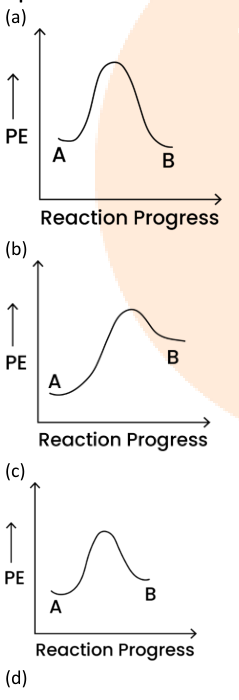
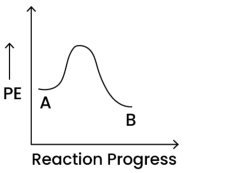
For a reaction , enthalpy of reaction is and enthalpy of activation is . The correct potential energy profile for the reaction is shown in option:
image
image
Q20mediummcqChemistryNEET 20212026
The slope of Arrhenius Plot ( vs ) of first order reaction is . The value of of the reaction is: [Given ]
Q21easymcqChemistryNEET 20232026
Given below are two statements: one is labelled as Assertion A and the other is labelled as Reason R:Assertion A: A reaction can have zero activation energy.Reason R: The minimum extra amount of energy absorbed by reactant molecules so that their energy becomes equal to threshold value, is called activation energy.In the light of the above statements, choose the correct answer from the options given below:
Q22easymcqChemistryNEET 20232026
For a certain reaction, the rate . When the initial concentration of A is tripled keeping concentration of B constant, the initial rate would:
Q23easymcqChemistryNEET (UG) 20242026
Activation energy of any chemical reaction can be calculated if one knows the value of:
Q24mediummcqChemistryNEET (UG) 20242026
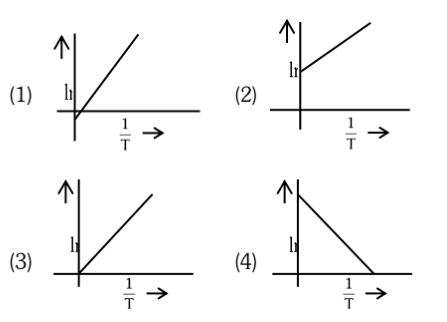
According to Arrhenius equation, the plot of vs yields a:
image
Q25mediummcqChemistryNEET (UG) 20242026
The rate of a reaction quadruples when temperature changes from to . Calculate the energy of activation. (Given )
Q26mediummcqChemistryFIITJEE AIEEE 2011 (Set Q)2026
The rate of a chemical reaction doubles for every rise of temperature. If the temperature is raised by , the rate of the reaction increases by about:
Q27mediummcqChemistryAIEEE2026
Consider the reaction: The rate equation for this reaction is .Which of these mechanisms is/are consistent with this rate equation?(A) (slow) (fast)(B) (fast equilibrium) (slow)
Q28mediummcqChemistryAIEEE2026
The time for half life period of a certain reaction is . When the initial concentration of the reactant ' ', is , how much time does it take for its concentration to come from to if it is a zero order reaction?
Q29mediummcqChemistryAIEEE 20042026
In a first order reaction, the concentration of the reactant decreases from to in minutes. The time taken for the concentration to change from to is:
Q30mediummcqChemistryAIEEE 20042026
The rate equation for the reaction is found to be: . The correct statement in relation to this reaction is that the:
Q31mediummcqChemistryAIEEE 20092026
The half life period of a first order chemical reaction is . The time required for the completion of of the chemical reaction will be ():
Q32mediummcqChemistryAIEEE2026
For a reaction , the rate of disappearance of ‘A’ is related to the rate of appearance of ‘B’ by the expression:
Q33hardmcqChemistryNEET 20172026
Mechanism of a hypothetical reaction is given below:(i) (fast)(ii) (slow)(iii) (fast)The overall order of the reaction will be:
Q34mediummcqChemistryNEET 20172026
A first order reaction has a specific reaction rate of . How much time will it take for of the reactant to reduce to ?
Q35easymcqChemistryNEET (UG) 20182026
When initial concentration of the reactant is doubled, the half-life period of a zero order reaction:
Q36mediummcqChemistryChemistry
3% accuracy
If the half-life () for a first order reaction is minute, then the time required for completion of the reaction is closest to:
Q37mediummcqChemistryChemistry
0% accuracy
Which one of the following statements for the order of a reaction is INCORRECT?
Q38hardmcqChemistryChemistry
For the reaction the value of rate of disappearance of is given as . The rate of formation of and is given respectively as:
Q39mediummcqChemistryChemistry
An endothermic reaction with high activation energy for the forward reaction is given by the diagram:
Q40mediummcqChemistryChemistry
For the reaction , it is observed that:(a) doubling the initial concentration of only, doubles the rate.(b) doubling the initial concentrations of both and , there is a change by a factor of in the rate.The rate of this reaction is:
Q41easymcqChemistryChemistry
Half life period of a first-order reaction is . The specific rate constant of the reaction is:
Q42mediummcqChemistryChemistry
In the reaction . The rate of appearance of bromine () is related to rate of disappearance of bromide ions as following:
Q43mediummcqChemistryChemistry
For the reaction , if , the value of would be:
Q44hardmcqChemistryChemistry
The rate constants and for two different reactions are and respectively. The temperature at which is:
Q45hardmcqChemistryChemistry
The bromination of acetone that occurs in acid solution is represented by the equation . Based on kinetic data showing the rate is independent of , what is the rate equation?
Q46mediummcqChemistryChemistry
The reaction of hydrogen and iodine monochloride is given as: This reaction is of first order with respect to and . The following mechanisms were proposed:Mechanism A: Mechanism B: (slow) (fast)Which mechanism is consistent with the rate law?
Q47mediummcqChemistryChemistry
Consider the reaction The equality relationship between and is :
Q48easymcqChemistryChemistry
For the reaction Which of the following does not express the reaction rate?
Q49hardmcqChemistryChemistry
For reaction , when , the rate was found to be . On reducing concentration of to half, the rate changes to . The order of reaction with respect to is:
Q50hardmcqChemistryChemistry
During the kinetic study of the reaction , the following results were obtained:| Run | (M) | (M) | Initial Rate () ||---|---|---|---|| I | | | || II | | | || III | | | || IV | | | |Based on the above data which one of the following is correct?
Q51mediummcqChemistryChemistry
For an endothermic reaction, energy of activation is and enthalpy of reaction is (both of these in ). The minimum value of will be:
Q52mediummcqChemistryChemistry
The unit of rate constant for a zero order reaction is:
Q53mediummcqChemistryChemistry
The rate of can be written as:, , .The relationship between is:
Q54mediummcqChemistryChemistry
The half life of an enzyme-catalysed reaction is . The time required for concentration to fall from to is:
Q55easymcqChemistryChemistry
Activation energy () and rate constants ( and ) of a chemical reaction at two different temperatures ( and ) are related by:
Q56mediummcqChemistryChemistry
In a reaction, , rate is doubled when the concentration of is doubled, and rate increases by a factor of when the concentrations of both the reactants ( and ) are doubled. The rate law for the reaction can be written as:
Q57mediummcqChemistryChemistry
In a zero-order reaction for every rise of temperature, the rate is doubled. If the temperature is increased from to , the rate of the reaction will become:
Q58mediummcqChemistryChemistry
What is the activation energy for a reaction if its rate doubles when the temperature is raised from to ? ()
Q59mediummcqChemistryChemistry
The rate constant of the reaction is . If the concentration of is , then concentration of after minutes is:
Q60mediummcqChemistryChemistry
The addition of a catalyst during a chemical reaction alters which of the following quantities?
Q61hardmcqChemistryChemistry
The rate of a first-order reaction is at and at after initiation of the reaction. The half-life period of the reaction is:
Q62mediummcqChemistryChemistry
The decomposition of phosphine () on tungsten at low pressure is a first-order reaction. It is because the:

Frequently Asked Questions

How many Chemical Kinetics questions are on ExamTest.live?
We have 62 Chemical Kinetics questions spread across 1 pages, covering easy, medium, and hard difficulty levels with detailed explanations.
Are Chemical Kinetics MCQs free?
Yes. All Chemical Kinetics questions, answers, and explanations on ExamTest.live are completely free. No account or subscription required.
Which exams include Chemical Kinetics questions?
Chemical Kinetics questions are commonly asked in Chemistry, CHEMISTRY. You can filter by exam using the links above.
How do I practice Chemical Kinetics questions effectively?
Start with easy questions to build confidence, then tackle medium and hard ones. Use the filter buttons to sort by difficulty. Reveal the answer only after attempting each question, and read the explanation thoroughly.