HomeTestsSearchRankProfile

Gadyansh Questions

Practice 55 Gadyansh questions with detailed answers and explanations. Free MCQs, PYQs, and mock test questions for NEET, JEE, GATE, SSC and more.

📚
55
Total Questions
🟢
0
Easy
🟡
55
Medium
🔴
0
Hard

About Gadyansh — practice questions, PYQs & concepts

Gadyansh is a frequently-tested topic on Hindi, Hindi Language, General Hindi. ExamTest.live currently lists 55 Gadyansh questions spanning previous-year papers from 2016 to 2026, each with worked solutions and a step-by-step explanation. Use the filters on this page to focus on a specific exam, difficulty level or year — every answer key is free, no sign-up required.

Gadyansh weight in competitive exams

Across our Gadyansh question bank, the largest sources are Hindi (33), Hindi Language (15), General Hindi (4) and Hindi Language & Literature (3). Click any exam chip above to drill down to that exam-specific question set.

How to use this page

  • Start easy: 0 easy Gadyansh questions are available — build fluency before moving up.
  • Target weak years: Use the year filter to focus on the most recent 2026 paper or older PYQs you have not attempted.
  • Time yourself: Every question shows the average solve time so you can benchmark your speed against other students.
  • Read every explanation: Even on questions you got right — the explanation often surfaces a faster approach you can reuse.
All Gadyansh Questions(155 of 55)

Filter:
Q1mediummcqHindiCompetitive Exam2026
0% accuracy
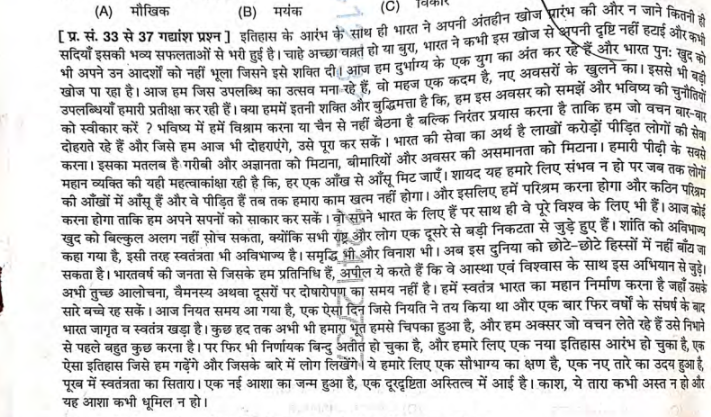
According to the passage in image_66e147.jpg, what has been the ambition of the greatest man of the author's generation?
Q2mediummcqHindiCompetitive Exam2026
0% accuracy
According to the passage in image_66e147.jpg, the future for the people of India is:
Q3mediummcqHindiCompetitive Exam2026
0% accuracy
Based on the text in image_66e147.jpg, what did India NOT forget during its endless search?
Q4mediummcqHindiCompetitive Exam2026
0% accuracy
According to the passage in image_66e147.jpg, which of the following is NOT implied by the phrase 'Service of India' (भारत की सेवा)?
Q5mediummcqHindiCompetitive Exam2026
0% accuracy
image

According to the passage in image_66e147.jpg, what must we do to realize our dreams?
Q6mediummcqHindiCompetitive Exam2026
निर्देश: प्र. सं. 43 से 47 के लिए दिए गए गद्यांश को ध्यानपूर्वक पढ़िए और प्रश्न का उत्तर दीजिए।
ईर्ष्या का काम जलाना है, मगर सबसे पहले वह उसी को जलाती है जिसके हृदय में उसका जन्म होता है। आप भी ऐसे बहुत से लोगों को जानते होंगे जो ईर्ष्या और द्वेष की साकार मूर्ति हैं, जो बराबर इस फिक्र में लगे रहते हैं कि कहाँ सुनने वाले मिलें कि अपने दिल का गुबार निकालने का मौका मिले। श्रोता मिलते ही उनका ग्रामोफोन बजने लगता है और वे बड़े ही होशियारी के साथ एक-एक काण्ड इस ढंग से सुनाते हैं, मानो विश्व कल्याण को छोड़कर उनका और कोई ध्येय नहीं हो। मगर, जरा उनके अपने इतिहास को भी देखिए और समझने की कोशिश कीजिए कि जबसे उन्होंने इस सुकर्म का आरंभ किया है, तबसे वे अपने क्षेत्र में आगे बढ़े हैं या पीछे हटे हैं। यह भी कि, अगर वे निंदा करने में समय और शक्ति का अपव्यय नहीं करते तो आज उनका स्थान कहाँ होता।

गद्यांश में ईर्ष्यालु व्यक्तियों की :
Q7mediummcqHindi LanguageCompetitive Exams2026
[Questions 33 to 37 Passage Question] Since the dawn of history, India has started her endless quest, and countless centuries are filled with her grand successes. Through good fortune or ill, India has never lost sight of this quest or forgotten the ideals which gave her strength. Today we are ending a period of ill fortune and India discovers herself again. The achievement we celebrate today is but a step, an opening of opportunity, to the greater triumphs and achievements that await us. Are we brave enough and wise enough to grasp this opportunity and accept the challenge of the future? Future is not one of ease or resting but of incessant striving so that we may fulfil the pledges we have so often taken and the one we shall take today. The service of India means the service of the millions who suffer. It means the ending of poverty and ignorance and disease and inequality of opportunity. The ambition of the greatest man of our generation has been to wipe every tear from every eye. That may be beyond us, but as long as there are tears and suffering, so long our work will not be over. And so we have to labour and to work hard, to give reality to our dreams. Those dreams are for India, but they are also for the world, for all the nations and peoples are too closely knit together today for any one of them to imagine that it can live apart. Peace has been said to be indivisible; so is freedom, so is prosperity now, and so also is disaster in this one world that can no longer be split into isolated fragments. To the people of India, whose representatives we are, we make an appeal to join with faith and confidence in this great adventure. This is no time for petty and destructive criticism, no time for ill-will or blaming others. We have to build the noble mansion of free India where all her children may dwell. The appointed time has come—the day appointed by destiny—and India stands forth again, after long struggle, awake and free. The past clings on to us still in some measure, and there is much to be done before we can fulfil the pledges we have so often taken. Yet the turning-point is past, and history begins anew for us, the history which we shall live and act and others will write about. It is a fateful moment for us, a new star rises, the star of freedom in the East. A new hope comes into being, a vision long cherished finds expression. May the star never set and that hope never be blurred! The future for Indians is:
Q8mediummcqHindiCompetitive Exam2026
निर्देश: प्र. सं. 43 से 47 के लिए दिए गए गद्यांश को ध्यानपूर्वक पढ़िए और प्रश्न का उत्तर दीजिए।
ईर्ष्या का काम जलाना है, मगर सबसे पहले वह उसी को जलाती है जिसके हृदय में उसका जन्म होता है। आप भी ऐसे बहुत से लोगों को जानते होंगे जो ईर्ष्या और द्वेष की साकार मूर्ति हैं, जो बराबर इस फिक्र में लगे रहते हैं कि कहाँ सुनने वाले मिलें कि अपने दिल का गुबार निकालने का मौका मिले। श्रोता मिलते ही उनका ग्रामोफोन बजने लगता है और वे बड़े ही होशियारी के साथ एक-एक काण्ड इस ढंग से सुनाते हैं, मानो विश्व कल्याण को छोड़कर उनका और कोई ध्येय नहीं हो। मगर, जरा उनके अपने इतिहास को भी देखिए और समझने की कोशिश कीजिए कि जबसे उन्होंने इस सुकर्म का आरंभ किया है, तबसे वे अपने क्षेत्र में आगे बढ़े हैं या पीछे हटे हैं। यह भी कि, अगर वे निंदा करने में समय और शक्ति का अपव्यय नहीं करते तो आज उनका स्थान कहाँ होता।

गद्यांश में प्रयुक्त 'ध्येय' का क्या अर्थ है ?
Q9mediummcqHindiCompetitive Exam2026
निर्देश: प्र. सं. 43 से 47 के लिए दिए गए गद्यांश को ध्यानपूर्वक पढ़िए और प्रश्न का उत्तर दीजिए।
ईर्ष्या का काम जलाना है, मगर सबसे पहले वह उसी को जलाती है जिसके हृदय में उसका जन्म होता है। आप भी ऐसे बहुत से लोगों को जानते होंगे जो ईर्ष्या और द्वेष की साकार मूर्ति हैं, जो बराबर इस फिक्र में लगे रहते हैं कि कहाँ सुनने वाले मिलें कि अपने दिल का गुबार निकालने का मौका मिले। श्रोता मिलते ही उनका ग्रामोफोन बजने लगता है और वे बड़े ही होशियारी के साथ एक-एक काण्ड इस ढंग से सुनाते हैं, मानो विश्व कल्याण को छोड़कर उनका और कोई ध्येय नहीं हो। मगर, जरा उनके अपने इतिहास को भी देखिए और समझने की कोशिश कीजिए कि जबसे उन्होंने इस सुकर्म का आरंभ किया है, तबसे वे अपने क्षेत्र में आगे बढ़े हैं या पीछे हटे हैं। यह भी कि, अगर वे निंदा करने में समय और शक्ति का अपव्यय नहीं करते तो आज उनका स्थान कहाँ होता।

ईर्ष्या का काम है:
Q10mediummcqHindiCompetitive Exam2026
निर्देश: प्र. सं. 43 से 47 के लिए दिए गए गद्यांश को ध्यानपूर्वक पढ़िए और प्रश्न का उत्तर दीजिए।
ईर्ष्या का काम जलाना है, मगर सबसे पहले वह उसी को जलाती है जिसके हृदय में उसका जन्म होता है। आप भी ऐसे बहुत से लोगों को जानते होंगे जो ईर्ष्या और द्वेष की साकार मूर्ति हैं, जो बराबर इस फिक्र में लगे रहते हैं कि कहाँ सुनने वाले मिलें कि अपने दिल का गुबार निकालने का मौका मिले। श्रोता मिलते ही उनका ग्रामोफोन बजने लगता है और वे बड़े ही होशियारी के साथ एक-एक काण्ड इस ढंग से सुनाते हैं, मानो विश्व कल्याण को छोड़कर उनका और कोई ध्येय नहीं हो। मगर, जरा उनके अपने इतिहास को भी देखिए और समझने की कोशिश कीजिए कि जबसे उन्होंने इस सुकर्म का आरंभ किया है, तबसे वे अपने क्षेत्र में आगे बढ़े हैं या पीछे हटे हैं। यह भी कि, अगर वे निंदा करने में समय and शक्ति का अपव्यय नहीं करते तो आज उनका स्थान कहाँ होता।

गद्यांश का उपयुक्त शीर्षक क्या होगा ?
Q11mediummcqHindiCompetitive Exam2026
निर्देश: प्र. सं. 43 से 47 के लिए दिए गए गद्यांश को ध्यानपूर्वक पढ़िए और प्रश्न का उत्तर दीजिए।
ईर्ष्या का काम जलाना है, मगर सबसे पहले वह उसी को जलाती है जिसके हृदय में उसका जन्म होता है। आप भी ऐसे बहुत से लोगों को जानते होंगे जो ईर्ष्या और द्वेष की साकार मूर्ति हैं, जो बराबर इस फिक्र में लगे रहते हैं कि कहाँ सुनने वाले मिलें कि अपने दिल का गुबार निकालने का मौका मिले। श्रोता मिलते ही उनका ग्रामोफोन बजने लगता है और वे बड़े ही होशियारी के साथ एक-एक काण्ड इस ढंग से सुनाते हैं, मानो विश्व कल्याण को छोड़कर उनका और कोई ध्येय नहीं हो। मगर, जरा उनके अपने इतिहास को भी देखिए और समझने की कोशिश कीजिए कि जबसे उन्होंने इस सुकर्म का आरंभ किया है, तबसे वे अपने क्षेत्र में आगे बढ़े हैं या पीछे हटे हैं। यह भी कि, अगर वे निंदा करने में समय और शक्ति का अपव्यय नहीं करते तो आज उनका स्थान कहाँ होता।

'अपव्यय' का क्या अर्थ होता है?
Q12mediummcqHindi LanguageCompetitive Exams2026
[Questions 90 to 94 Passage Question] Man has to make his own decisions in life, therefore a person must be self-reliant. Now, what you should do, its exact answer must be given by you alone, no one else can give it. No matter how trustworthy a friend is, he cannot take this task upon himself. We should listen to the words of experienced people with respect, accept the advice of the wise gratefully, but keeping it certain that our protection and our downfall will happen by our own actions, we must firmly maintain the freedom of our thoughts and decisions. A man whose vision is always low will never have his head held high. By keeping a low vision, although one will stay on the path, one will not see where this path leads. Keep your behavior gentle (mridul). There should be no harshness, rudeness, and stubbornness at all. Be soft in your behavior and keep your aims high, thus become both humble and high-minded. Never keep your heart/mind dead. Which of the following options is a maxim / idiomatic saying (Sukti)?
Q13mediummcqHindi LanguageCompetitive Exams2026
[Questions 90 to 94 Passage Question] Man has to make his own decisions in life, therefore a person must be self-reliant. Now, what you should do, its exact answer must be given by you alone, no one else can give it. No matter how trustworthy a friend is, he cannot take this task upon himself. We should listen to the words of experienced people with respect, accept the advice of the wise gratefully, but keeping it certain that our protection and our downfall will happen by our own actions, we must firmly maintain the freedom of our thoughts and decisions. A man whose vision is always low will never have his head held high. By keeping a low vision, although one will stay on the path, one will not see where this path leads. Keep your behavior gentle (mridul). There should be no harshness, rudeness, and stubbornness at all. Be soft in your behavior and keep your aims high, thus become both humble and high-minded. Never keep your heart/mind dead. The gentleness of behavior:
Q14mediummcqHindi LanguageCompetitive Exams2026
[Questions 90 to 94 Passage Question] Man has to make his own decisions in life, therefore a person must be self-reliant. Now, what you should do, its exact answer must be given by you alone, no one else can give it. No matter how trustworthy a friend is, he cannot take this task upon himself. We should listen to the words of experienced people with respect, accept the advice of the wise gratefully, but keeping it certain that our protection and our downfall will happen by our own actions, we must firmly maintain the freedom of our thoughts and decisions. A man whose vision is always low will never have his head held high. By keeping a low vision, although one will stay on the path, one will not see where this path leads. Keep your behavior gentle (mridul). There should be no harshness, rudeness, and stubbornness at all. Be soft in your behavior and keep your aims high, thus become both humble and high-minded. Never keep your heart/mind dead. How can we become self-reliant in making decisions in our lives?
Q15mediummcqHindi LanguageCompetitive Exams2026
[Questions 90 to 94 Passage Question] Man has to make his own decisions in life, therefore a person must be self-reliant. Now, what you should do, its exact answer must be given by you alone, no one else can give it. No matter how trustworthy a friend is, he cannot take this task upon himself. We should listen to the words of experienced people with respect, accept the advice of the wise gratefully, but keeping it certain that our protection and our downfall will happen by our own actions, we must firmly maintain the freedom of our thoughts and decisions. A man whose vision is always low will never have his head held high. By keeping a low vision, although one will stay on the path, one will not see where this path leads. Keep your behavior gentle (mridul). There should be no harshness, rudeness, and stubbornness at all. Be soft in your behavior and keep your aims high, thus become both humble and high-minded. Never keep your heart/mind dead. The most appropriate title for the given passage is:
Q16mediummcqHindi LanguageCompetitive Exams2026
[Questions 90 to 94 Passage Question] Man has to make his own decisions in life, therefore a person must be self-reliant. Now, what you should do, its exact answer must be given by you alone, no one else can give it. No matter how trustworthy a friend is, he cannot take this task upon himself. We should listen to the words of experienced people with respect, accept the advice of the wise gratefully, but keeping it certain that our protection and our downfall will happen by our own actions, we must firmly maintain the freedom of our thoughts and decisions. A man whose vision is always low will never have his head held high. By keeping a low vision, although one will stay on the path, one will not see where this path leads. Keep your behavior gentle (mridul). There should be no harshness, rudeness, and stubbornness at all. Be soft in your behavior and keep your aims high, thus become both humble and high-minded. Never keep your heart/mind dead. Which of the following words means 'soft' or 'gentle' (Komal)?
Q17mediummcqHindi LanguageCompetitive Exams2026
[Questions 33 to 37 Passage Question] Since the dawn of history, India has started her endless quest, and countless centuries are filled with her grand successes. Through good fortune or ill, India has never lost sight of this quest or forgotten the ideals which gave her strength. Today we are ending a period of ill fortune and India discovers herself again. The achievement we celebrate today is but a step, an opening of opportunity, to the greater triumphs and achievements that await us. Are we brave enough and wise enough to grasp this opportunity and accept the challenge of the future? Future is not one of ease or resting but of incessant striving so that we may fulfil the pledges we have so often taken and the one we shall take today. The service of India means the service of the millions who suffer. It means the ending of poverty and ignorance and disease and inequality of opportunity. The ambition of the greatest man of our generation has been to wipe every tear from every eye. That may be beyond us, but as long as there are tears and suffering, so long our work will not be over. And so we have to labour and to work hard, to give reality to our dreams. Those dreams are for India, but they are also for the world, for all the nations and peoples are too closely knit together today for any one of them to imagine that it can live apart. Peace has been said to be indivisible; so is freedom, so is prosperity now, and so also is disaster in this one world that can no longer be split into isolated fragments. To the people of India, whose representatives we are, we make an appeal to join with faith and confidence in this great adventure. This is no time for petty and destructive criticism, no time for ill-will or blaming others. We have to build the noble mansion of free India where all her children may dwell. The appointed time has come—the day appointed by destiny—and India stands forth again, after long struggle, awake and free. The past clings on to us still in some measure, and there is much to be done before we can fulfil the pledges we have so often taken. Yet the turning-point is past, and history begins anew for us, the history which we shall live and act and others will write about. It is a fateful moment for us, a new star rises, the star of freedom in the East. A new hope comes into being, a vision long cherished finds expression. May the star never set and that hope never be blurred! What has been the ambition of the greatest man of the author's generation?
Q18mediummcqGeneral HindiExamination Question2026
Read the following passage carefully and answer the question that follows:
About five centuries ago, the Portuguese historian Domingos Paes called Hampi (Vijayanagara) the city of dreams. It was the capital of the rulers of the Sangama dynasty who laid the foundation of the Vijayanagara Empire in 1336 at the construction site of ancient Hampi. But it was Krishnadeva Raya (1509-1529) who adorned the capital with grand palaces and temples and extended the boundaries of the Vijayanagara Empire far and wide, making it the most powerful Hindu empire in South India. However, the decline of the power of this empire began with the joint invasion in 1565 by a coalition of neighboring Bahmani kingdoms. This Vijayanagara was defeated and destroyed. This was the sad end of an empire that once stretched from the Arabian Sea to the Bay of Bengal and from the Deccan Plateau to the Indian peninsula. The ruins of Vijayanagara are scattered amidst a desolate landscape of giant boulders hanging over each other. Long before its rise on the political landscape of South India, Hampi was an eminent holy site for several centuries. As described in the Ramayana, it was a part of Kishkindha, a region ruled by Bali. Many events related to Bali and Sugriva, Hanuman, Rama, Sita, and Lakshmana have taken place in this location. The current Anegundi Fort, located across the Tungabhadra River, was the main center of this monkey kingdom. The rocky mountains of Hampi like Hemakuta Hill, Matanga Hill, and Malyavanta Hill are mentioned in the Ramayana. The ancient name of Tungabhadra and the name of Parvati is Pampa, who married Shiva in the form of Virupaksha. This city is named after this name.

The ruins of Vijayanagara are scattered amidst what kind of landscape?
Q19mediummcqHindi LanguageUP Police Constable2026
[Questions 136 to 140 Passage Question] The world of sports has also not been able to escape the storm of commercialization. Today sports have their own distinct economics. The Indian Premier League (IPL) organized in India recently proved to what extent the marketization of sports can be done and how highly profitable a deal it is. Although there has already been a plethora of money in cricket, IPL has given such an expansion to the economy of this sport that its impact will remain for a long time. According to an estimate, the size of the sports industry in India has reached ten thousand crore rupees annually. Sports have taken the form of a festival. It affects our day-to-day life. The market has transformed sports into such an industry that it has started affecting common public life. People have started setting their daily routines according to the matches. Apart from cricket, if we look, the interference of money has also increased in other sports in India. The 2008 Olympics held in Beijing also proved that sports have their own separate economics and in this era of globalization, it cannot be ignored. However, now the situation has become such that sports competitions have started affecting the budgets of many multi-national companies. No one should have any doubt that sports have taken the form of an industry. However, this time the Beijing Olympics had twelve main sponsors. This included a company like Kodak, which has supported modern sports since 1896. Apart from this, Coca-Cola was also among the major sponsors of the Olympics, which has been associated with the Olympics since 1928. The combined income of the organizers from these twelve main sponsors has reached 866 million dollars. Whose grip has the world of sports fallen into?
Q20mediummcqHindi LanguageUP Police Constable2026
[Questions 136 to 140 Passage Question] The world of sports has also not been able to escape the storm of commercialization. Today sports have their own distinct economics. The Indian Premier League (IPL) organized in India recently proved to what extent the marketization of sports can be done and how highly profitable a deal it is. Although there has already been a plethora of money in cricket, IPL has given such an expansion to the economy of this sport that its impact will remain for a long time. According to an estimate, the size of the sports industry in India has reached ten thousand crore rupees annually. Sports have taken the form of a festival. It affects our day-to-day life. The market has transformed sports into such an industry that it has started affecting common public life. People have started setting their daily routines according to the matches. Apart from cricket, if we look, the interference of money has also increased in other sports in India. The 2008 Olympics held in Beijing also proved that sports have their own separate economics and in this era of globalization, it cannot be ignored. However, now the situation has become such that sports competitions have started affecting the budgets of many multi-national companies. No one should have any doubt that sports have taken the form of an industry. However, this time the Beijing Olympics had twelve main sponsors. This included a company like Kodak, which has supported modern sports since 1896. Apart from this, Coca-Cola was also among the major sponsors of the Olympics, which has been associated with the Olympics since 1928. The combined income of the organizers from these twelve main sponsors has reached 866 million dollars. What gave a boost/expansion to the economy of sports?
Q21mediummcqHindi LanguageUP Police Constable2026
[Questions 136 to 140 Passage Question] The world of sports has also not been able to escape the storm of commercialization. Today sports have their own distinct economics. The Indian Premier League (IPL) organized in India recently proved to what extent the marketization of sports can be done and how highly profitable a deal it is. Although there has already been a plethora of money in cricket, IPL has given such an expansion to the economy of this sport that its impact will remain for a long time. According to an estimate, the size of the sports industry in India has reached ten thousand crore rupees annually. Sports have taken the form of a festival. It affects our day-to-day life. The market has transformed sports into such an industry that it has started affecting common public life. People have started setting their daily routines according to the matches. Apart from cricket, if we look, the interference of money has also increased in other sports in India. The 2008 Olympics held in Beijing also proved that sports have their own separate economics and in this era of globalization, it cannot be ignored. However, now the situation has become such that sports competitions have started affecting the budgets of many multi-national companies. No one should have any doubt that sports have taken the form of an industry. However, this time the Beijing Olympics had twelve main sponsors. This included a company like Kodak, which has supported modern sports since 1896. Apart from this, Coca-Cola was also among the major sponsors of the Olympics, which has been associated with the Olympics since 1928. The combined income of the organizers from these twelve main sponsors has reached 866 million dollars. On whom else is the impact of the market's influence on sports being seen?
Q22mediummcqHindi LanguageUP Police Constable2026
[Questions 136 to 140 Passage Question] The world of sports has also not been able to escape the storm of commercialization. Today sports have their own distinct economics. The Indian Premier League (IPL) organized in India recently proved to what extent the marketization of sports can be done and how highly profitable a deal it is. Although there has already been a plethora of money in cricket, IPL has given such an expansion to the economy of this sport that its impact will remain for a long time. According to an estimate, the size of the sports industry in India has reached ten thousand crore rupees annually. Sports have taken the form of a festival. It affects our day-to-day life. The market has transformed sports into such an industry that it has started affecting common public life. People have started setting their daily routines according to the matches. Apart from cricket, if we look, the interference of money has also increased in other sports in India. The 2008 Olympics held in Beijing also proved that sports have their own separate economics and in this era of globalization, it cannot be ignored. However, now the situation has become such that sports competitions have started affecting the budgets of many multi-national companies. No one should have any doubt that sports have taken the form of an industry. However, this time the Beijing Olympics had twelve main sponsors. This included a company like Kodak, which has supported modern sports since 1896. Apart from this, Coca-Cola was also among the major sponsors of the Olympics, which has been associated with the Olympics since 1928. The combined income of the organizers from these twelve main sponsors has reached 866 million dollars. Whose budget is being affected by sports competitions?
Q23mediummcqHindi LanguageUP Police Constable2026
[Questions 136 to 140 Passage Question] The world of sports has also not been able to escape the storm of commercialization. Today sports have their own distinct economics. The Indian Premier League (IPL) organized in India recently proved to what extent the marketization of sports can be done and how highly profitable a deal it is. Although there has already been a plethora of money in cricket, IPL has given such an expansion to the economy of this sport that its impact will remain for a long time. According to an estimate, the size of the sports industry in India has reached ten thousand crore rupees annually. Sports have taken the form of a festival. It affects our day-to-day life. The market has transformed sports into such an industry that it has started affecting common public life. People have started setting their daily routines according to the matches. Apart from cricket, if we look, the interference of money has also increased in other sports in India. The 2008 Olympics held in Beijing also proved that sports have their own separate economics and in this era of globalization, it cannot be ignored. However, now the situation has become such that sports competitions have started affecting the budgets of many multi-national companies. No one should have any doubt that sports have taken the form of an industry. However, this time the Beijing Olympics had twelve main sponsors. This included a company like Kodak, which has supported modern sports since 1896. Apart from this, Coca-Cola was also among the major sponsors of the Olympics, which has been associated with the Olympics since 1928. The combined income of the organizers from these twelve main sponsors has reached 866 million dollars. Whose combined income has increased from various sponsors?
Q24mediummcqHindiCompetitive Exam Paper2026
Directions: Read the given passage carefully and answer the question that follows:
Connoisseur Dr. Vogel did not call Chamba a wonder ("achambha") without reason. And tourists are also not drawn to this city for nothing. There is definitely some hypnosis in the valleys of Chamba that mesmerizes the tourists and they keep visiting here again and again. Where the rising melodic waves in the temples make the environment spiritual, the majestic flow of the Ravi river and the cool breeze coming from the mountains give a feeling of freshness to the tourists. Chamba is a beautiful blend of history, art, religion, and tourism, and the people of Chamba are carefree and eccentric by nature. As we cross the hills of Chamba, many pages of wonders open up before us. Nature shows a glimpse of its divine beauty. Dr. Vogel must have called it a wonder only after absorbing the beauty of Chamba. It has been Chamba's good fortune that it got one after another great art-loving, religious, and public servant kings. During the reign of these kings, not only did the local folk arts flourish here, but their fame spread beyond the borders of Chamba all over India. Among these art-loving rulers, the names of Raj Sri Singh (1844), Raja Ram Singh (1873), and Raja Bhuri Singh (1904) are particularly noteworthy. Whether it is architecture or mural painting, sculpture or woodcraft, the kind of encouragement they received in Chamba was hardly found anywhere else. Chamba's Kalam style (pen style) has created its own distinct identity. If you look standing from the height of any valley, the entire Chamba city looks like a unique piece of art.

Question: What kind of a mix is Chamba's history, religion, and tourism?
Q25mediummcqHindiCompetitive Exam Paper2026
Directions: Read the given passage carefully and answer the question that follows:
Connoisseur Dr. Vogel did not call Chamba a wonder ("achambha") without reason. And tourists are also not drawn to this city for nothing. There is definitely some hypnosis in the valleys of Chamba that mesmerizes the tourists and they keep visiting here again and again. Where the rising melodic waves in the temples make the environment spiritual, the majestic flow of the Ravi river and the cool breeze coming from the mountains give a feeling of freshness to the tourists. Chamba is a beautiful blend of history, art, religion, and tourism, and the people of Chamba are carefree and eccentric by nature. As we cross the hills of Chamba, many pages of wonders open up before us. Nature shows a glimpse of its divine beauty. Dr. Vogel must have called it a wonder only after absorbing the beauty of Chamba. It has been Chamba's good fortune that it got one after another great art-loving, religious, and public servant kings. During the reign of these kings, not only did the local folk arts flourish here, but their fame spread beyond the borders of Chamba all over India. Among these art-loving rulers, the names of Raj Sri Singh (1844), Raja Ram Singh (1873), and Raja Bhuri Singh (1904) are particularly noteworthy. Whether it is architecture or mural painting, sculpture or woodcraft, the kind of encouragement they received in Chamba was hardly found anywhere else. Chamba's Kalam style (pen style) has created its own distinct identity. If you look standing from the height of any valley, the entire Chamba city looks like a unique piece of art.

Question: When did Dr. Vogel call Chamba a wonder?
Q26mediummcqHindiCompetitive Exam Paper2026
Directions: Read the given passage carefully and answer the question that follows:
Connoisseur Dr. Vogel did not call Chamba a wonder ("achambha") without reason. And tourists are also not drawn to this city for nothing. There is definitely some hypnosis in the valleys of Chamba that mesmerizes the tourists and they keep visiting here again and again. Where the rising melodic waves in the temples make the environment spiritual, the majestic flow of the Ravi river and the cool breeze coming from the mountains give a feeling of freshness to the tourists. Chamba is a beautiful blend of history, art, religion, and tourism, and the people of Chamba are carefree and eccentric by nature. As we cross the hills of Chamba, many pages of wonders open up before us. Nature shows a glimpse of its divine beauty. Dr. Vogel must have called it a wonder only after absorbing the beauty of Chamba. It has been Chamba's good fortune that it got one after another great art-loving, religious, and public servant kings. During the reign of these kings, not only did the local folk arts flourish here, but their fame spread beyond the borders of Chamba all over India. Among these art-loving rulers, the names of Raj Sri Singh (1844), Raja Ram Singh (1873), and Raja Bhuri Singh (1904) are particularly noteworthy. Whether it is architecture or mural painting, sculpture or woodcraft, the kind of encouragement they received in Chamba was hardly found anywhere else. Chamba's Kalam style (pen style) has created its own distinct identity. If you look standing from the height of any valley, the entire Chamba city looks like a unique piece of art.

Question: Why is Chamba called fortunate?
Q27mediummcqHindiCompetitive Exam Paper2026
Directions: Read the given passage carefully and answer the question that follows:
Connoisseur Dr. Vogel did not call Chamba a wonder ("achambha") without reason. And tourists are also not drawn to this city for nothing. There is definitely some hypnosis in the valleys of Chamba that mesmerizes the tourists and they keep visiting here again and again. Where the rising melodic waves in the temples make the environment spiritual, the majestic flow of the Ravi river and the cool breeze coming from the mountains give a feeling of freshness to the tourists. Chamba is a beautiful blend of history, art, religion, and tourism, and the people of Chamba are carefree and eccentric by nature. As we cross the hills of Chamba, many pages of wonders open up before us. Nature shows a glimpse of its divine beauty. Dr. Vogel must have called it a wonder only after absorbing the beauty of Chamba. It has been Chamba's good fortune that it got one after another great art-loving, religious, and public servant kings. During the reign of these kings, not only did the local folk arts flourish here, but their fame spread beyond the borders of Chamba all over India. Among these art-loving rulers, the names of Raj Sri Singh (1844), Raja Ram Singh (1873), and Raja Bhuri Singh (1904) are particularly noteworthy. Whether it is architecture or mural painting, sculpture or woodcraft, the kind of encouragement they received in Chamba was hardly found anywhere else. Chamba's Kalam style (pen style) has created its own distinct identity. If you look standing from the height of any valley, the entire Chamba city looks like a unique piece of art.

Question: Which style of Chamba made its own distinct identity?
Q28mediummcqGeneral HindiExamination Question2026
Read the following passage carefully and answer the question that follows:
About five centuries ago, the Portuguese historian Domingos Paes called Hampi (Vijayanagara) the city of dreams. It was the capital of the rulers of the Sangama dynasty who laid the foundation of the Vijayanagara Empire in 1336 at the construction site of ancient Hampi. But it was Krishnadeva Raya (1509-1529) who adorned the capital with grand palaces and temples and extended the boundaries of the Vijayanagara Empire far and wide, making it the most powerful Hindu empire in South India. However, the decline of the power of this empire began with the joint invasion in 1565 by a coalition of neighboring Bahmani kingdoms. This Vijayanagara was defeated and destroyed. This was the sad end of an empire that once stretched from the Arabian Sea to the Bay of Bengal and from the Deccan Plateau to the Indian peninsula. The ruins of Vijayanagara are scattered amidst a desolate landscape of giant boulders hanging over each other. Long before its rise on the political landscape of South India, Hampi was an eminent holy site for several centuries. As described in the Ramayana, it was a part of Kishkindha, a region ruled by Bali. Many events related to Bali and Sugriva, Hanuman, Rama, Sita, and Lakshmana have taken place in this location. The current Anegundi Fort, located across the Tungabhadra River, was the main center of this monkey kingdom. The rocky mountains of Hampi like Hemakuta Hill, Matanga Hill, and Malyavanta Hill are mentioned in the Ramayana. The ancient name of Tungabhadra and the name of Parvati is Pampa, who married Shiva in the form of Virupaksha. This city is named after this name.

Whose rule was the part of Kishkindha a portion of?
Q29mediummcqGeneral HindiExamination Question2026
Read the following passage carefully and answer the question that follows:
About five centuries ago, the Portuguese historian Domingos Paes called Hampi (Vijayanagara) the city of dreams. It was the capital of the rulers of the Sangama dynasty who laid the foundation of the Vijayanagara Empire in 1336 at the construction site of ancient Hampi. But it was Krishnadeva Raya (1509-1529) who adorned the capital with grand palaces and temples and extended the boundaries of the Vijayanagara Empire far and wide, making it the most powerful Hindu empire in South India. However, the decline of the power of this empire began with the joint invasion in 1565 by a coalition of neighboring Bahmani kingdoms. This Vijayanagara was defeated and destroyed. This was the sad end of an empire that once stretched from the Arabian Sea to the Bay of Bengal and from the Deccan Plateau to the Indian peninsula. The ruins of Vijayanagara are scattered amidst a desolate landscape of giant boulders hanging over each other. Long before its rise on the political landscape of South India, Hampi was an eminent holy site for several centuries. As described in the Ramayana, it was a part of Kishkindha, a region ruled by Bali. Many events related to Bali and Sugriva, Hanuman, Rama, Sita, and Lakshmana have taken place in this location. The current Anegundi Fort, located across the Tungabhadra River, was the main center of this monkey kingdom. The rocky mountains of Hampi like Hemakuta Hill, Matanga Hill, and Malyavanta Hill are mentioned in the Ramayana. The ancient name of Tungabhadra and the name of Parvati is Pampa, who married Shiva in the form of Virupaksha. This city is named after this name.

Who called Hampi the city of dreams?
Q30mediummcqGeneral HindiExamination Question2026
Read the following passage carefully and answer the question that follows:
About five centuries ago, the Portuguese historian Domingos Paes called Hampi (Vijayanagara) the city of dreams. It was the capital of the rulers of the Sangama dynasty who laid the foundation of the Vijayanagara Empire in 1336 at the construction site of ancient Hampi. But it was Krishnadeva Raya (1509-1529) who adorned the capital with grand palaces and temples and extended the boundaries of the Vijayanagara Empire far and wide, making it the most powerful Hindu empire in South India. However, the decline of the power of this empire began with the joint invasion in 1565 by a coalition of neighboring Bahmani kingdoms. This Vijayanagara was defeated and destroyed. This was the sad end of an empire that once stretched from the Arabian Sea to the Bay of Bengal and from the Deccan Plateau to the Indian peninsula. The ruins of Vijayanagara are scattered amidst a desolate landscape of giant boulders hanging over each other. Long before its rise on the political landscape of South India, Hampi was an eminent holy site for several centuries. As described in the Ramayana, it was a part of Kishkindha, a region ruled by Bali. Many events related to Bali and Sugriva, Hanuman, Rama, Sita, and Lakshmana have taken place in this location. The current Anegundi Fort, located across the Tungabhadra River, was the main center of this monkey kingdom. The rocky mountains of Hampi like Hemakuta Hill, Matanga Hill, and Malyavanta Hill are mentioned in the Ramayana. The ancient name of Tungabhadra and the name of Parvati is Pampa, who married Shiva in the form of Virupaksha. This city is named after this name.

How did the power of the Hampi empire decline?
Q31mediummcqHindiCompetitive Exam2026
Directions: Read the following passage and answer the question that follows.
Culture and civilization are two words, and their meanings are also different. Civilization is that quality of man by which he makes his external progress. Culture is that quality by which he makes his internal progress, learns compassion, love, and charity. Today, trains, motors and airplanes, long and wide roads and big houses, good food and good dress, these are the hallmarks of civilization, and the more abundance of these in a country, the more civilized we consider that country to be. But culture is something much more subtle than all of them. It is not the motor, but the art of making the motor; not the house, but the interest in making the house. Culture is not wealth, but virtue. Culture is not pomp, but humility and politeness. There is a saying that civilization is what we have, but culture is the quality that is hidden within us. We have houses, clothes, but all these things are evidence of our civilization, whereas culture is not visible in such a coarse way; it is a very subtle and great thing and it remains hidden in our every choice, every habit. Building a house is the work of civilization, but which design of the house we like—our culture tells us this. Inside man, lust, anger, greed, arrogance, attachment, and jealousy—these six vices are given by nature. But if these vices are left unchecked, man would fall so low that there would be no difference between him and an animal. Therefore, man puts a check on these vices. The more a man is able to control these vices, the higher his culture is considered to be. The nature of culture is that it grows through exchange. When people of two countries or races meet, their cultures affect each other. Therefore, from the point of view of culture, that race or country is considered very rich which has developed its culture by taking advantage of the cultures of as many countries or races as possible.

The basic nature of culture is that it:
Q32mediummcqHindi Language & LiteraturePractice Test2026
Directions: Read the following passage carefully and answer the question that follows based on the passage.
Education is the cornerstone of human life. An educated person develops not only himself but also the society and the country. Education removes the darkness of ignorance and spreads the light of knowledge. It teaches a person to distinguish between good and bad. In ancient India, the Gurukul education system was prevalent where disciples acquired knowledge by staying in the Guru's ashram. Today, the form of education has changed. Digital technology has brought education to every home. Government schemes like Sarva Shiksha Abhiyan and Mid-Day Meal have connected children to schools. Special attention needs to be paid to women's education because an educated mother educates the entire family. Investment in education is the most profitable investment for the country.

According to the passage, what argument is given in the context of women's education?
Q33mediummcqHindi Language & LiteraturePractice Test2026
Directions: Read the following passage carefully and answer the question that follows based on the passage.
Education is the cornerstone of human life. An educated person develops not only himself but also the society and the country. Education removes the darkness of ignorance and spreads the light of knowledge. It teaches a person to distinguish between good and bad. In ancient India, the Gurukul education system was prevalent where disciples acquired knowledge by staying in the Guru's ashram. Today, the form of education has changed. Digital technology has brought education to every home. Government schemes like Sarva Shiksha Abhiyan and Mid-Day Meal have connected children to schools. Special attention needs to be paid to women's education because an educated mother educates the entire family. Investment in education is the most profitable investment for the country.

According to the passage, which education system was prevalent in ancient India?
Q34mediummcqHindi Language & LiteraturePractice Test2026
Directions: Read the following passage carefully and answer the question that follows based on the passage.
Education is the cornerstone of human life. An educated person develops not only himself but also the society and the country. Education removes the darkness of ignorance and spreads the light of knowledge. It teaches a person to distinguish between good and bad. In ancient India, the Gurukul education system was prevalent where disciples acquired knowledge by staying in the Guru's ashram. Today, the form of education has changed. Digital technology has brought education to every home. Government schemes like Sarva Shiksha Abhiyan and Mid-Day Meal have connected children to schools. Special attention needs to be paid to women's education because an educated mother educates the entire family. Investment in education is the most profitable investment for the country.

How is education described in the passage?
Q35mediummcqHindiUP Police Constable2026
भूषण महाराज ने विषय और विशेषतः नायक चुनने में बड़ी बुद्धिमत्ता से काम लिया है। शिवाजी और छत्रसाल से महानुभावों के पवित्र चरित्रों का वर्णन करने वालों की जितनी प्रशंसा की जाए थोड़ी है। शिवाजी ने एक जमींदार और बीजापुरधीश के नौकर के पुत्र होकर चक्रवर्ती राज्य स्थापित करने की इच्छा को पूर्ण-सा कर दिखाया और छत्रसाल बुन्देला ने जिस समय मुग़लों का सामना करने का साहस किया उस समय उनके पास केवल पाँच सवार और पच्चीस पैदल थे। इसी सेना से इस महानुभाव ने दिल्ली का सामना करने की हिम्मत की और मरते समय अपने उत्तराधिकारियों के लिए दो करोड़ वार्षिक मुनाफे का स्वतंत्र राज्य छोड़ा। छत्रपति शिवाजी की प्रशस्ति में लिखे गए दो काव्य ग्रंथ हैं- शिवा बावनी और शिवराज भूषण। इस पाठ बोधन में भूषण का वीर काव्य रस दर्शाया गया है।
छत्रसाल बुन्देला ने जिस समय मुग़लों का सामना किया, उस समय उनके पास थे :
Q36mediummcqHindiUP Police Constable2026
भूषण महाराज ने विषय और विशेषतः नायक चुनने में बड़ी बुद्धिमत्ता से काम लिया है। शिवाजी और छत्रसाल से महानुभावों के पवित्र चरित्रों का वर्णन करने वालों की जितनी प्रशंसा की जाए थोड़ी है। शिवाजी ने एक जमींदार और बीजापुरधीश के नौकर के पुत्र होकर चक्रवर्ती राज्य स्थापित करने की इच्छा को पूर्ण-सा कर दिखाया और छत्रसाल बुन्देला ने जिस समय मुग़लों का सामना करने का साहस किया उस समय उनके पास केवल पाँच सवार और पच्चीस पैदल थे। इसी सेना से इस महानुभाव ने दिल्ली का सामना करने की हिम्मत की और मरते समय अपने उत्तराधिकारियों के लिए दो करोड़ वार्षिक मुनाफे का स्वतंत्र राज्य छोड़ा। छत्रपति शिवाजी की प्रशस्ति में लिखे गए दो काव्य ग्रंथ हैं- शिवा बावनी और शिवराज भूषण। इस पाठ बोधन में भूषण का वीर काव्य रस दर्शाया गया है।
महाकवि भूषण दरबारी कवि थे, उनके आश्रयदाता राजा का नाम था :
Q37mediummcqHindiUP Police Constable2026
भूषण महाराज ने विषय और विशेषतः नायक चुनने में बड़ी बुद्धिमत्ता से काम लिया है। शिवाजी और छत्रसाल से महानुभावों के पवित्र चरित्रों का वर्णन करने वालों की जितनी प्रशंसा की जाए थोड़ी है। शिवाजी ने एक जमींदार abuses और बीजापुरधीश के नौकर के पुत्र होकर चक्रवर्ती राज्य स्थापित करने की इच्छा को पूर्ण-सा कर दिखाया और छत्रसाल बुन्देला ने जिस समय मुग़लों का सामना करने का साहस किया उस समय उनके पास केवल पाँच सवार और पच्चीस पैदल थे। इसी सेना से इस महानुभाव ने दिल्ली का सामना करने की हिम्मत की और मरते समय अपने उत्तराधिकारियों के लिए दो करोड़ वार्षिक मुनाफे का स्वतंत्र राज्य छोड़ा। छत्रपति शिवाजी की प्रशस्ति में लिखे गए दो काव्य ग्रंथ हैं- शिवा बावनी और शिवराज भूषण। इस पाठ बोधन में भूषण का वीर काव्य रस दर्शाया गया है।
इस गद्यांश का सार्थक शीर्षक हो सकता है :
Q38mediummcqHindiUP Police Constable2026
भूषण महाराज ने विषय और विशेषतः नायक चुनने में बड़ी बुद्धिमत्ता से काम लिया है। शिवाजी और छत्रसाल से महानुभावों के पवित्र चरित्रों का वर्णन करने वालों की जितनी प्रशंसा की जाए थोड़ी है। शिवाजी ने एक जमींदार और बीजापुरधीश के नौकर के पुत्र होकर चक्रवर्ती राज्य स्थापित करने की इच्छा को पूर्ण-सा कर दिखाया और छत्रसाल बुन्देला ने जिस समय मुग़लों का सामना करने का साहस किया उस समय उनके पास केवल पाँच सवार और पच्चीस पैदल थे। इसी सेना से इस महानुभाव ने दिल्ली का सामना करने की हिम्मत की और मरते समय अपने उत्तराधिकारियों के लिए दो करोड़ वार्षिक मुनाफे का स्वतंत्र राज्य छोड़ा। छत्रपति शिवाजी की प्रशस्ति में लिखे गए दो काव्य ग्रंथ हैं- शिवा बावनी और शिवराज भूषण। इस पाठ बोधन में भूषण का वीर काव्य रस दर्शाया गया है।
भूषण का प्रिय काव्य रस था :
Q39mediummcqHindiUP Police Constable2026
भूषण महाराज ने विषय और विशेषतः नायक चुनने में बड़ी बुद्धिमत्ता से काम लिया है। शिवाजी और छत्रसाल से महानुभावों के पवित्र चरित्रों का वर्णन करने वालों की जितनी प्रशंसा की जाए थोड़ी है। शिवाजी ने एक जमींदार और बीजापुरधीश के नौकर के पुत्र होकर चक्रवर्ती राज्य स्थापित करने की इच्छा को पूर्ण-सा कर दिखाया और छत्रसाल बुन्देला ने जिस समय मुग़लों का सामना करने का साहस किया उस समय उनके पास केवल पाँच सवार और पच्चीस पैदल थे। इसी सेना से इस महानुभाव ने दिल्ली का सामना करने की हिम्मत की और मरते समय अपने उत्तराधिकारियों के लिए दो करोड़ वार्षिक मुनाफे का स्वतंत्र राज्य छोड़ा। छत्रपति शिवाजी की प्रशस्ति में लिखे गए दो काव्य ग्रंथ हैं- शिवा बावनी और शिवराज भूषण। इस पाठ बोधन में भूषण का वीर काव्य रस दर्शाया गया है।
छत्रपति शिवाजी की प्रशस्ति में लिखे गए दो काव्य ग्रंथों के नाम हैं:
Q40mediummcqHindiUPTET Paper 2 (Social Science)2026
निर्देश – निम्नलिखित गद्यांश के आधार पर सही विकल्प चुनिए।
कला और जीवन का सम्बन्ध अन्योंन्याश्रित है। कलाकार, कल्पना और यथार्थ का समन्वय कर समाज के समक्ष आदर्श रूप प्रस्तुत करता है। इसी कारण जीवन का कला के स्वरूप पर व्यापक प्रभाव पड़ता है। कलाकार जीवन के यथार्थ रूप को ही चित्रित नहीं करता, वरन् वह आदर्श रूप को भी प्रस्तुत करता है। इस प्रकार जीवन का कला पर और कला का जीवन पर व्यापक प्रभाव पड़ता है। कलावाद अर्थात कला, कला के लिए सम्बन्धी विचारो में जीवन के लिए उपयोगी कला ही श्रेयस्कर मानी गयी है।

कौन-सी कला श्रेष्ठ मानी गई है?
Q41mediummcqHindiUPTET Paper 2 (Social Science)2026
निर्देश – निम्नलिखित गद्यांश के आधार पर सही विकल्प चुनिए।
कला और जीवन का सम्बन्ध अन्योंन्याश्रित है। कलाकार, कल्पना और यथार्थ का समन्वय कर समाज के समक्ष आदर्श रूप प्रस्तुत करता है। इसी कारण जीवन का कला के स्वरूप पर व्यापक प्रभाव पड़ता है। कलाकार जीवन के यथार्थ रूप को ही चित्रित नहीं करता, वरन् वह आदर्श रूप को भी प्रस्तुत करता है। इस प्रकार जीवन का कला पर और कला का जीवन पर व्यापक प्रभाव पड़ता है। कलावाद अर्थात कला, कला के लिए सम्बन्धी विचारो में जीवन के लिए उपयोगी कला ही श्रेयस्कर मानी गयी है।

'कला और जीवन अन्योंन्याश्रित है' का तात्पर्य है:
Q42mediummcqHindi LanguageCompetitive Exams2026
[Questions 33 to 37 Passage Question] Since the dawn of history, India has started her endless quest, and countless centuries are filled with her grand successes. Through good fortune or ill, India has never lost sight of this quest or forgotten the ideals which gave her strength. Today we are ending a period of ill fortune and India discovers herself again. The achievement we celebrate today is but a step, an opening of opportunity, to the greater triumphs and achievements that await us. Are we brave enough and wise enough to grasp this opportunity and accept the challenge of the future? Future is not one of ease or resting but of incessant striving so that we may fulfil the pledges we have so often taken and the one we shall take today. The service of India means the service of the millions who suffer. It means the ending of poverty and ignorance and disease and inequality of opportunity. The ambition of the greatest man of our generation has been to wipe every tear from every eye. That may be beyond us, but as long as there are tears and suffering, so long our work will not be over. And so we have to labour and to work hard, to give reality to our dreams. Those dreams are for India, but they are also for the world, for all the nations and peoples are too closely knit together today for any one of them to imagine that it can live apart. Peace has been said to be indivisible; so is freedom, so is prosperity now, and so also is disaster in this one world that can no longer be split into isolated fragments. To the people of India, whose representatives we are, we make an appeal to join with faith and confidence in this great adventure. This is no time for petty and destructive criticism, no time for ill-will or blaming others. We have to build the noble mansion of free India where all her children may dwell. The appointed time has come—the day appointed by destiny—and India stands forth again, after long struggle, awake and free. The past clings on to us still in some measure, and there is much to be done before we can fulfil the pledges we have so often taken. Yet the turning-point is past, and history begins anew for us, the history which we shall live and act and others will write about. It is a fateful moment for us, a new star rises, the star of freedom in the East. A new hope comes into being, a vision long cherished finds expression. May the star never set and that hope never be blurred! Which of the following is NOT meant by 'service of India'?
Q43mediummcqHindiCompetitive Exam2026
Directions: Read the following passage and answer the question that follows.
Culture and civilization are two words, and their meanings are also different. Civilization is that quality of man by which he makes his external progress. Culture is that quality by which he makes his internal progress, learns compassion, love, and charity. Today, trains, motors and airplanes, long and wide roads and big houses, good food and good dress, these are the hallmarks of civilization, and the more abundance of these in a country, the more civilized we consider that country to be. But culture is something much more subtle than all of them. It is not the motor, but the art of making the motor; not the house, but the interest in making the house. Culture is not wealth, but virtue. Culture is not pomp, but humility and politeness. There is a saying that civilization is what we have, but culture is the quality that is hidden within us. We have houses, clothes, but all these things are evidence of our civilization, whereas culture is not visible in such a coarse way; it is a very subtle and great thing and it remains hidden in our every choice, every habit. Building a house is the work of civilization, but which design of the house we like—our culture tells us this. Inside man, lust, anger, greed, arrogance, attachment, and jealousy—these six vices are given by nature. But if these vices are left unchecked, man would fall so low that there would be no difference between him and an animal. Therefore, man puts a check on these vices. The more a man is able to control these vices, the higher his culture is considered to be. The nature of culture is that it grows through exchange. When people of two countries or races meet, their cultures affect each other. Therefore, from the point of view of culture, that race or country is considered very rich which has developed its culture by taking advantage of the cultures of as many countries or races as possible.

Culture is also different from civilization in the sense that culture:
Q44mediummcqHindiCompetitive Exam2026
Directions: Read the following passage and answer the question that follows.
Culture and civilization are two words, and their meanings are also different. Civilization is that quality of man by which he makes his external progress. Culture is that quality by which he makes his internal progress, learns compassion, love, and charity. Today, trains, motors and airplanes, long and wide roads and big houses, good food and good dress, these are the hallmarks of civilization, and the more abundance of these in a country, the more civilized we consider that country to be. But culture is something much more subtle than all of them. It is not the motor, but the art of making the motor; not the house, but the interest in making the house. Culture is not wealth, but virtue. Culture is not pomp, but humility and politeness. There is a saying that civilization is what we have, but culture is the quality that is hidden within us. We have houses, clothes, but all these things are evidence of our civilization, whereas culture is not visible in such a coarse way; it is a very subtle and great thing and it remains hidden in our every choice, every habit. Building a house is the work of civilization, but which design of the house we like—our culture tells us this. Inside man, lust, anger, greed, arrogance, attachment, and jealousy—these six vices are given by nature. But if these vices are left unchecked, man would fall so low that there would be no difference between him and an animal. Therefore, man puts a check on these vices. The more a man is able to control these vices, the higher his culture is considered to be. The nature of culture is that it grows through exchange. When people of two countries or races meet, their cultures affect each other. Therefore, from the point of view of culture, that race or country is considered very rich which has developed its culture by taking advantage of the cultures of as many countries or races as possible.

'Culture' means:
Q45mediummcqHindiCompetitive Exam2026
Directions: Read the following passage and answer the question that follows.
Culture and civilization are two words, and their meanings are also different. Civilization is that quality of man by which he makes his external progress. Culture is that quality by which he makes his internal progress, learns compassion, love, and charity. Today, trains, motors and airplanes, long and wide roads and big houses, good food and good dress, these are the hallmarks of civilization, and the more abundance of these in a country, the more civilized we consider that country to be. But culture is something much more subtle than all of them. It is not the motor, but the art of making the motor; not the house, but the interest in making the house. Culture is not wealth, but virtue. Culture is not pomp, but humility and politeness. There is a saying that civilization is what we have, but culture is the quality that is hidden within us. We have houses, clothes, but all these things are evidence of our civilization, whereas culture is not visible in such a coarse way; it is a very subtle and great thing and it remains hidden in our every choice, every habit. Building a house is the work of civilization, but which design of the house we like—our culture tells us this. Inside man, lust, anger, greed, arrogance, attachment, and jealousy—these six vices are given by nature. But if these vices are left unchecked, man would fall so low that there would be no difference between him and an animal. Therefore, man puts a check on these vices. The more a man is able to control these vices, the higher his culture is considered to be. The nature of culture is that it grows through exchange. When people of two countries or races meet, their cultures affect each other. Therefore, from the point of view of culture, that race or country is considered very rich which has developed its culture by taking advantage of the cultures of as many countries or races as possible.

The humanity of man lies in the fact that he:
Q46mediummcqHindiCompetitive Exam2026
Directions: Read the following passage and answer the question that follows.
Culture and civilization are two words, and their meanings are also different. Civilization is that quality of man by which he makes his external progress. Culture is that quality by which he makes his internal progress, learns compassion, love, and charity. Today, trains, motors and airplanes, long and wide roads and big houses, good food and good dress, these are the hallmarks of civilization, and the more abundance of these in a country, the more civilized we consider that country to be. But culture is something much more subtle than all of them. It is not the motor, but the art of making the motor; not the house, but the interest in making the house. Culture is not wealth, but virtue. Culture is not pomp, but humility and politeness. There is a saying that civilization is what we have, but culture is the quality that is hidden within us. We have houses, clothes, but all these things are evidence of our civilization, whereas culture is not visible in such a coarse way; it is a very subtle and great thing and it remains hidden in our every choice, every habit. Building a house is the work of civilization, but which design of the house we like—our culture tells us this. Inside man, lust, anger, greed, arrogance, attachment, and jealousy—these six vices are given by nature. But if these vices are left unchecked, man would fall so low that there would be no difference between him and an animal. Therefore, man puts a check on these vices. The more a man is able to control these vices, the higher his culture is considered to be. The nature of culture is that it grows through exchange. When people of two countries or races meet, their cultures affect each other. Therefore, from the point of view of culture, that race or country is considered very rich which has developed its culture by taking advantage of the cultures of as many countries or races as possible.

'Civilization' means:
Q47mediummcqHindiCompetitive Exam2026
Passage:
The success of scientific experiments has led to an unprecedented development of human intelligence. In the Second World War, the power of the atom bomb defeated the unconquerable power of Japan in just a few moments. The wartime success of this power inspired all countries like America, Russia, Britain, France, etc., to manufacture such weapons that everyone started making dangerous and omnicidal weapons. Now, instead of manufacturing weapons to defeat the army and attack the enemy country with infantry, weapons are being made in the direction of destroying the country. If these weapons are used, most of the population and property of the enemy countries can be destroyed in a short time. Since some of these weapons have come into the museums/arsenals of almost all independent countries, their use will also become inevitable in the event of war. Therefore, the total destruction or majority destruction of the world will surely happen. That is why disarmament plans are being made. According to the direction adopted in the manufacture of weaponry, such advanced weapons have been made today, whose use makes widespread destruction appear imminent. Even now, ways are being sought to prevent testing and to stop the use of manufactured weapons. A terrible terror and fear of world destruction is working at the root of these efforts. Why are big countries making modern destructive weapons?

Question: Why are big countries making modern destructive weapons?
Q48mediummcqHindiCompetitive Exam2026
Passage:
[Same as above]

Question: Modern wars are terrifying and destructive because:
Q49mediummcqHindiCompetitive Exam2026
Passage:
[Same as above]

Question: What is the core theme/message (मूल कथ्य) of this passage?
Q50mediummcqHindiCompetitive Exam2026
Passage:
[Same as above]

Question: Who gave the inspiration to manufacture terrifyingly destructive modern weaponry?
Q51mediummcqHindiCompetitive Exam2026
Passage:
[Same as above]

Question: How was the first experience of the immense power of the atom bomb obtained?
Q52mediummcqHindi LanguageCompetitive Exams2026
[Questions 33 to 37 Passage Question] Since the dawn of history, India has started her endless quest, and countless centuries are filled with her grand successes. Through good fortune or ill, India has never lost sight of this quest or forgotten the ideals which gave her strength. Today we are ending a period of ill fortune and India discovers herself again. The achievement we celebrate today is but a step, an opening of opportunity, to the greater triumphs and achievements that await us. Are we brave enough and wise enough to grasp this opportunity and accept the challenge of the future? Future is not one of ease or resting but of incessant striving so that we may fulfil the pledges we have so often taken and the one we shall take today. The service of India means the service of the millions who suffer. It means the ending of poverty and ignorance and disease and inequality of opportunity. The ambition of the greatest man of our generation has been to wipe every tear from every eye. That may be beyond us, but as long as there are tears and suffering, so long our work will not be over. And so we have to labour and to work hard, to give reality to our dreams. Those dreams are for India, but they are also for the world, for all the nations and peoples are too closely knit together today for any one of them to imagine that it can live apart. Peace has been said to be indivisible; so is freedom, so is prosperity now, and so also is disaster in this one world that can no longer be split into isolated fragments. To the people of India, whose representatives we are, we make an appeal to join with faith and confidence in this great adventure. This is no time for petty and destructive criticism, no time for ill-will or blaming others. We have to build the noble mansion of free India where all her children may dwell. The appointed time has come—the day appointed by destiny—and India stands forth again, after long struggle, awake and free. The past clings on to us still in some measure, and there is much to be done before we can fulfil the pledges we have so often taken. Yet the turning-point is past, and history begins anew for us, the history which we shall live and act and others will write about. It is a fateful moment for us, a new star rises, the star of freedom in the East. A new hope comes into being, a vision long cherished finds expression. May the star never set and that hope never be blurred! According to the passage, what do we have to do to realize our dreams?
Q53mediummcqHindi LanguageCompetitive Exams2026
[Questions 33 to 37 Passage Question] Since the dawn of history, India has started her endless quest, and countless centuries are filled with her grand successes. Through good fortune or ill, India has never lost sight of this quest or forgotten the ideals which gave her strength. Today we are ending a period of ill fortune and India discovers herself again. The achievement we celebrate today is but a step, an opening of opportunity, to the greater triumphs and achievements that await us. Are we brave enough and wise enough to grasp this opportunity and accept the challenge of the future? Future is not one of ease or resting but of incessant striving so that we may fulfil the pledges we have so often taken and the one we shall take today. The service of India means the service of the millions who suffer. It means the ending of poverty and ignorance and disease and inequality of opportunity. The ambition of the greatest man of our generation has been to wipe every tear from every eye. That may be beyond us, but as long as there are tears and suffering, so long our work will not be over. And so we have to labour and to work hard, to give reality to our dreams. Those dreams are for India, but they are also for the world, for all the nations and peoples are too closely knit together today for any one of them to imagine that it can live apart. Peace has been said to be indivisible; so is freedom, so is prosperity now, and so also is disaster in this one world that can no longer be split into isolated fragments. To the people of India, whose representatives we are, we make an appeal to join with faith and confidence in this great adventure. This is no time for petty and destructive criticism, no time for ill-will or blaming others. We have to build the noble mansion of free India where all her children may dwell. The appointed time has come—the day appointed by destiny—and India stands forth again, after long struggle, awake and free. The past clings on to us still in some measure, and there is much to be done before we can fulfil the pledges we have so often taken. Yet the turning-point is past, and history begins anew for us, the history which we shall live and act and others will write about. It is a fateful moment for us, a new star rises, the star of freedom in the East. A new hope comes into being, a vision long cherished finds expression. May the star never set and that hope never be blurred! What did India not forget during its endless quest?
Q54mediummcqHindiUPTET Paper 2 Social Science2016
निर्देश: दिए गए गद्यांश को पढ़कर निम्नलिखित प्रश्न का सही विकल्प छाँटिए।
...इस संसार में जितने बड़े-बड़े लोग हुए हैं सभी ने अपने कर्तव्य को सबसे श्रेष्ठ माना है, क्योंकि जितने कर्म उन्होंने किए उन सबने अपने कर्तव्य पर ध्यान देकर न्याय का बर्ताव किया। जिन जातियों में यह गुण पाया जाता है, वे ही संसार में उन्नति करती हैं और संसार में उनका नाम आदर से लिया जाता है...

प्रश्न: संसार के बड़े-बड़े लोगों ने सबसे श्रेष्ठ किसे माना है?
Q55mediummcqHindiUPTET Paper 2 Social Science2016
निर्देश: दिए गए गद्यांश को पढ़कर निम्नलिखित प्रश्न का सही विकल्प छाँटिए।
धर्म पालन करने के मार्ग में सबसे अधिक बाधा चित्त की चंचलता, उद्देश्य की अस्थिरता और मन की निर्बलता से पड़ती है। मनुष्य के कर्तव्य मार्ग में एक ओर तो आत्मा के बुरे-भले कामों का ज्ञान दूसरी ओर आलस्य और स्वार्थपरता रहती है। बस मनुष्य इन्हीं दोनों के बीच में पड़ा रहा है। अंत में यदि उसका मन पक्का हुआ तो वह आत्मा की आज्ञा मानकर अपना धर्म पालन करता है, पर उसका मन दुविधा में पड़ा रहा है तो स्वार्थपरता करता है स्वार्थपरता उसे निश्चित ही घेरेगी और उसका चरित्र घृणा के योग्य हो जायेगा...

प्रश्न: धर्म पालन करने में बाधा डालने वाली प्रवृत्तियाँ कौन-सी हैं?

Frequently Asked Questions

How many Gadyansh questions are on ExamTest.live?
We have 55 Gadyansh questions spread across 1 pages, covering easy, medium, and hard difficulty levels with detailed explanations.
Are Gadyansh MCQs free?
Yes. All Gadyansh questions, answers, and explanations on ExamTest.live are completely free. No account or subscription required.
Which exams include Gadyansh questions?
Gadyansh questions are commonly asked in Hindi, Hindi Language, General Hindi, Hindi Language & Literature. You can filter by exam using the links above.
How do I practice Gadyansh questions effectively?
Start with easy questions to build confidence, then tackle medium and hard ones. Use the filter buttons to sort by difficulty. Reveal the answer only after attempting each question, and read the explanation thoroughly.