AIEEE 2003
kinematics Questions
34 kinematics questions from AIEEE 2003 with detailed answers and explanations. Free previous year questions and MCQs.
📚
34
Questions
🟢
4
Easy
🟡
28
Medium
🔴
2
Hard
Years:2026 (34)
kinematics — AIEEE 2003(1–34 of 34)
Filter:
An automobile travelling with speed of , can brake to stop within a distance of . If the car is going twice as fast, i.e , the stopping distance will be:
A ball is released from the top of a tower of height metres. It takes seconds to reach the ground. What is the position of the ball in seconds?
Which of the following statements is false for a particle moving in a circle with a constant angular speed?
A ball is thrown from a point with a speed at an angle of projection . From the same point and at the same instant a person starts running with a constant speed to catch the ball. Will the person be able to catch the ball? If yes, what should be the angle of projection?
A point mass oscillates along the -axis according to the law . If the acceleration of the particle is written as , then:
The displacement of an object attached to a spring and executing simple harmonic motion is given by metres. The time at which the maximum speed first occurs is:
A particle is projected at to the horizontal with a kinetic energy . The kinetic energy at the highest point is:
A body falling from rest under gravity passes a certain point . It was at a distance of from , prior to passing through . If , then the height above the point from where the body began to fall is:
A particle located at at time , starts moving along the positive -direction with a velocity that varies as . The displacement of the particle varies with time as:
The velocity of a particle is . If its position is at , then its displacement after unit time () is:
A body starts from rest at with constant acceleration . Simultaneously another body passes with constant speed . The position of the first is and the second is . Which graph describes vs ?
Two cars of masses and are moving in circles of radii and , respectively. Their speeds are such that they make complete circles in the same time . The ratio of their centripetal acceleration is:
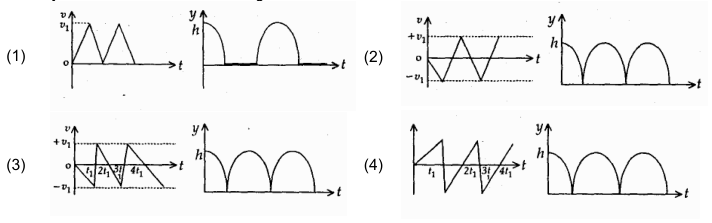
Consider a rubber ball freely falling from a height onto a horizontal elastic plate. Assume that the duration of collision is negligible and the collision with the plate is totally elastic. Then the velocity as a function of time and the height as function of time will be:
A particle has an initial velocity and an acceleration of . Its speed after is:
A point moves in counter-clockwise direction on a circular path of radius . The movement of ' ' is such that it sweeps out a length , where is in metres and is in seconds. The acceleration of ' ' when is nearly:
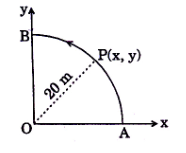
For a particle in uniform circular motion the acceleration at a point on the circle of radius is (here is measured from the -axis):
A particle is moving with velocity , where is a constant. The general equation for its path is:
A water fountain on the ground sprinkles water all around it. If the speed of water coming out of the fountain is , the total area around the fountain that gets wet is:
An object, moving with a speed of , is decelerated at a rate given by:
where is the instantaneous speed. The time taken by the object, to come to rest, would be:
where is the instantaneous speed. The time taken by the object, to come to rest, would be:
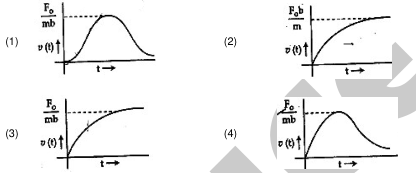
A particle of mass is at rest at the origin at time . It is subjected to a force in the direction. Its speed is depicted by which of the following curves?
A boy can throw a stone up to a maximum height of . The maximum horizontal distance that the boy can throw the same stone up to will be:
Two points and move from rest along a straight line with constant acceleration and respectively. If takes more than and describes units more than in acquiring the same speed then:
A body is moved along a straight line by a machine delivering a constant power. The distance moved by the body in time is proportional to:
The co-ordinates of a moving particle at any time are given by and . The speed of the particle at time is given by:
A boy playing on the roof of a high building throws a ball with a speed of at an angle of with the horizontal. How far from the throwing point will the ball be at the height of from the ground? (Take )
A car moving with a speed of , can be stopped by brakes after at least . If the same car is moving at a speed of , the minimum stopping distance is:
Two particles start simultaneously from the same point and move along two straight lines, one with uniform velocity and the other from rest with uniform acceleration . Let be the angle between their directions of motion. The relative velocity of the second particle with respect to the first is least after a time:
A body travels a distance in seconds. It starts from rest and ends at rest. In the first part of the journey, it moves with constant acceleration and in the second part with constant retardation . The value of is given by:
A projectile can have the same range for two angles of projection. If and be the times of flights in the two cases, then the product of the two time of flights is proportional to:
A parachutist after bailing out falls without friction. When parachute opens, it decelerates at . He reaches the ground with a speed of . At what height, did he bail out?
The relation between time and distance is where and are constants. The acceleration is:
A particle is moving eastwards with a velocity of . In the velocity changes to northwards. The average acceleration in this time is:
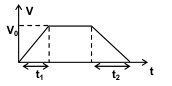
A car starting from rest accelerates at the rate through a distance , then continues at constant speed for time and then decelerates at the rate to come to rest. If the total distance traversed is , then:
AIEEE 2003 kinematics — FAQ
How many kinematics questions come in AIEEE 2003?▼
Our database has 34 kinematics questions from AIEEE 2003 covering 2026 to 2026.
What difficulty are AIEEE 2003 kinematics questions?▼
The 34 AIEEE 2003 kinematics questions include 4 easy, 28 medium and 2 hard level questions.
Where can I find more kinematics questions for other exams?▼
Visit /tag/kinematics to see all kinematics questions across all exams including Physics, NEET 2019, AIEEE 2004.