Chemistry
Organic Chemistry Questions
170 Organic Chemistry questions from Chemistry with detailed answers and explanations. Free previous year questions and MCQs.
📚
170
Questions
🟢
34
Easy
🟡
121
Medium
🔴
15
Hard
Organic Chemistry — Chemistry(1–100 of 170)
Filter:
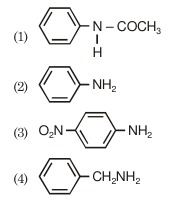
The correct order of decreasing basic strength of the given amines is:
Which one of the following reactions does NOT give benzene as the product?
Predict the major product 'P' in the following sequence of reactions:
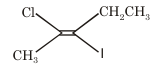
Which one of the following compounds can exist as cis-trans isomers?
Total number of possible isomers (both structural as well as stereoisomers) of cyclic ethers of molecular formula is :
Which one of the following alkenes will react faster with H2 under catalytic hydrogenation conditions ?
(R = Alkyl substituent)
(R = Alkyl substituent)
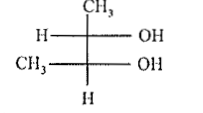
Which one of the following pairs represents stereoisomerism ?
In Dumas' method of estimation of nitrogen of an organic compound gave of nitrogen collected at temperature and pressure. The percentage composition of nitrogen in the compound would be: (Aqueous tension at )
Clemmensen reduction of a ketone is carried out in the presence of which of the following?
Which one of the following is most reactive towards electrophilic reagent?
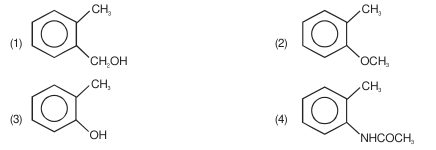
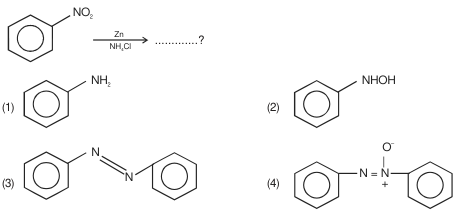
In the following reactions, the major products and are respectively:
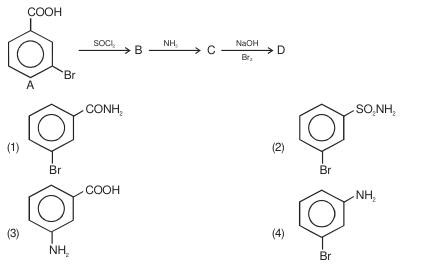
In a set of reactions -bromobenzoic acid gave a product . Identify the product .
Which one is a nucleophilic substitution reaction among the following?
Considering the state of hybridization of carbon atoms, find out the molecule among the following which is linear?
The Lassaigne's extract is boiled with conc. while testing for halogens. By doing so it:
If there is no rotation of plane polarized light by a compound in a specific solvent, thought to be chiral, it may mean that:
For the following anions: (i) , (ii) , (iii) . (Question implies adding (iv) based on options). The increasing order of nucleophilicity in a polar protic solvent would be:
The order of decreasing reactivity towards an electrophilic reagent for the following: (i) Benzene, (ii) Toluene, (iii) Chlorobenzene, and (iv) Phenol would be:
Which of the following represents the correct order of the acidity in the given compounds?
has a chiral center. Which one of the following represents its configuration?
Which one of the following on reduction with lithium aluminium hydride yields a secondary amine?
Reduction of aldehydes and ketones into hydrocarbons using zinc amalgam and conc. is called:


Self condensation of two moles of ethyl acetate in presence of sodium ethoxide yields :
Trichloroacetaldehyde, reacts with chlorobenzene in presence of sulphuric acid and produces:
The reaction of toluene with in presence of gives and reaction in presence of light gives . Thus, and are:
 would be:
The correct order regarding the electronegativity of hybrid orbitals of carbon is:
Given are cyclohexanol (I), acetic acid (II), 2, 4, 6-trinitrophenol (III) and phenol (IV). In these the order of decreasing acidic character will be:
Acetamide is treated with the following reagents separately. Which one of these would yield methyl amine?
Which of the following reactions will not result in the formation of carbon-carbon bonds?
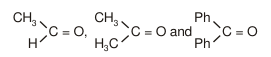
Among the given compounds, the most susceptible to nucleophilic attack at the carbonyl group is:
Among the following which one does not act as an intermediate in Hofmann rearrangement?
Which compound undergoes nucleophilic substitution reaction most easily?
Match the compounds with their reactions/products: Benzaldehyde Phenolphthalein Phthalic anhydride Benzoin condensation Phenyl benzoate Oil of wintergreen Methyl salicylate Fries rearrangement
In a set of reactions, acetic acid yielded a product D.
The structure of D would be :
The structure of D would be :
The mechanisms of reactions and are: Isobutyl bromide Ether Isobutyl bromide Ether
In the hydrocarbon , the state of hybridization of carbons 1, 3 and 5 are:
A carbonyl compound reacts with hydrogen cyanide to form cyanohydrin which on hydrolysis forms a racemic mixture of -hydroxy acid. The carbonyl compound is :
Which of the following compounds will exhibit cis-trans (geometrical) isomerism?
Nitrobenzene can be prepared from benzene by using a mixture of conc. and conc. . In this mixture, nitric acid acts as a/an:
Aniline in a set of the following reactions yielded a coloured product Y: 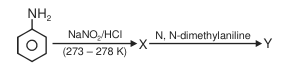 The structure of Y would be:
The structure of Y would be:Liquid hydrocarbons can be converted to a mixture of gaseous hydrocarbons by:
Assertion : Rate of hydrolysis of methyl chloride to methanol is higher in than in water.Reason : Hydrolysis of methyl chloride follows second order kinetics.
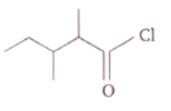 is :
is : on reaction with sodium ethoxide in ethanol gives , which on heating in the presence of acid gives . Compound is:
The correct order of increasing reactivity of bond towards nucleophile in the following compound is:
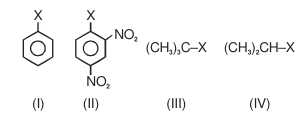
Aniline in a set of reactions yielded a product D.
The structure of the product D would be :
The structure of the product D would be :
The stability of carbanions in the following (alkynyl, alkenyl, alkyl) is in the order of:
Assertion : Rates of nitration of benzene and hexadeuterobenzene are different.Reason : bond is stronger than bond.
The relative reactivities of acyl compounds towards nucleophilic substitution are in the order of:
Assertion : -Butyl methyl ether is not prepared by the reaction of -butyl bromide with sodium methoxide.Reason : Sodium methoxide is a strong nucleophile.
The major product of the reaction between an alkene and in the presence of peroxides is governed by:
Assertion : Alkyl isocyanides in acidified water give alkyl formamides.Reason : In isocyanides, carbon first acts as a nucleophile and then as an electrophile.
In a substitution reaction, which one of the following has the highest relative rate?
Acetophenone when reacted with a base, , yields a stable compound which has the structure:
Assertion : Cyclopentadienyl anion is much more stable than allyl anion.Reason : Cyclopentadienyl anion is aromatic in character.
In the reaction of aniline with at followed by phenol, a coloured product C is obtained. The structure of C would be:
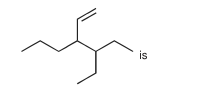
The state of hybridization of and of the hydrocarbon: 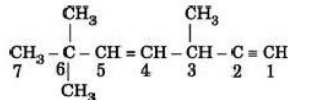 is in the following sequence:
is in the following sequence:In a set of reactions propanoic acid yielded a compound D. The structure of D would be :
Which of the following reactions is an example of nucleophilic substitution reaction?

Chemistry Organic Chemistry — FAQ
How many Organic Chemistry questions come in Chemistry?▼
Our database has 170 Organic Chemistry questions from Chemistry.
What difficulty are Chemistry Organic Chemistry questions?▼
The 170 Chemistry Organic Chemistry questions include 34 easy, 121 medium and 15 hard level questions.
Where can I find more Organic Chemistry questions for other exams?▼
Visit /tag/organic-chemistry to see all Organic Chemistry questions across all exams including AIEEE, NEET 2019, AIEEE 2004.