Thermodynamics Questions
Practice 200 Thermodynamics questions with detailed answers and explanations. Free MCQs, PYQs, and mock test questions for NEET, JEE, GATE, SSC and more.
📚
200
Total Questions
🟢
31
Easy
🟡
145
Medium
🔴
24
Hard
Page 2 of 2(101–200 of 200)
2 pages
Filter:
In which of the following processes does entropy increase?(A) Liquid evaporating to vapor.(B) Lowering the temperature of a gas.(C) Decomposition of to , , and .(D) Dissociation of into .
The temperature of gas is . To what temperature the gas should be heated so that the RMS speed is increased by times?
Match List I with List II:
| List I (Process) | List II (Conditions) |
| (A) Isothermal process | (I) No heat exchange |
| (B) Isochoric process | (II) Carried out at constant temperature |
| (C) Isobaric process | (III) Carried out at constant volume |
| (D) Adiabatic process | (IV) Carried out at constant pressure |
| List I (Process) | List II (Conditions) |
| (A) Isothermal process | (I) No heat exchange |
| (B) Isochoric process | (II) Carried out at constant temperature |
| (C) Isobaric process | (III) Carried out at constant volume |
| (D) Adiabatic process | (IV) Carried out at constant pressure |
The work done during reversible isothermal expansion of one mole of hydrogen gas at from a pressure of to is:(Given , )
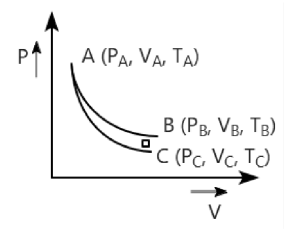
Reversible expansion of an ideal gas under isothermal and adiabatic conditions are as shown in the figure (AB Isothermal, AC Adiabatic). Which of the following options is not correct?
of water of volume at is converted into steam at the same temperature under normal atmospheric pressure . The volume of steam formed equals . If the specific latent heat of vaporization of water is , the change in internal energy is:
The following graph represents the curves of an ideal gas at three pressures and .
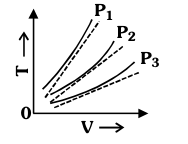
Then the correct relation is:
Then the correct relation is:
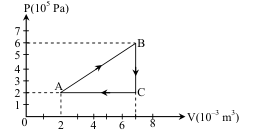
A thermodynamic system is taken through the cycle . The work done by the gas along the path is:
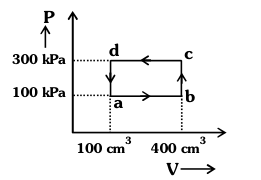
An ideal gas expands isothermally from to at against a constant pressure of . The work done by the gas is:
A gaseous mixture consists of of helium and of oxygen. The ratio of the mixture is:
The figure shows a system of two concentric spheres of radii and and kept at temperatures and respectively. The radial rate of flow of heat in a substance between the two concentric sphere is proportional to:

A system goes from A to B via two processes I and II as shown in the figure. If and are the changes in internal energies in the processes I and II respectively, then:
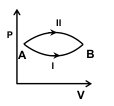
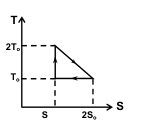
The temperature-entropy diagram of a reversible engine cycle is given in the figure. Its efficiency is:
Which of the following is incorrect regarding the first law of thermodynamics?
"Heat cannot by itself flow from a body at lower temperature to a body at higher temperature" is a statement of consequence of:
According to Newton’s law of cooling, the rate of cooling of a body is proportional to , where is the difference of the temperature of the body and the surroundings, and is equal to:
Two cylinders and of equal capacity are connected to each other via a stop cock. contains an ideal gas at standard temperature and pressure. is completely evacuated. The entire system is thermally insulated. The stop cock is suddenly opened. The process is:
During an adiabatic process, the pressure of a gas is found to be proportional to the cube of its absolute temperature. The ratio for the gas is:
. Which of the following diagrams gives an accurate representation of the above reaction? [ reactants; products]
A container has two chambers of volumes and separated by a partition made of a thermal insulator. The chambers contains and moles of ideal gas at pressures and , respectively. When the partition is removed, the mixture attains an equilibrium pressure of:
An oxygen cylinder of volume has of oxygen. After some oxygen is withdrawn from the cylinder, its gauge pressure drops to at temperature . The mass of the oxygen withdrawn from the cylinder is nearly equal to:[Given, , molecular mass of , ]
Two gases A and B are filled at the same pressure in separate cylinders with movable pistons of radius and , respectively. On supplying an equal amount of heat to both the systems reversibly under constant pressure, the pistons of gas A and B are displaced by and , respectively. If the change in their internal energy is the same, then the ratio is equal to:
An ideal gas heat engine operates in Carnot cycle between 227°C and 127°C. It absorbs 6 x 10^4 cal of heat at higher temperature. Amount of heat converted to work is :
The temperature of inversion of a thermocouple is 620°C and the neutral temperature is 300°C. what is the temperature of cold junction ?
When of ice at melts to water at , the resulting change in its entropy, taking latent heat of ice to be is approximately:
During an isothermal expansion, a confined ideal gas does of work against its surrounding. This implies that:
Which of the following is correct option for free expansion of an ideal gas under adiabatic condition?
If the enthalpy change for the transition of liquid water to steam is at , the entropy change for the process would be:
If the for a given reaction has a negative value, then which of the following gives the correct relationships for the values of and ?
Enthalpy change for the reaction is . The dissociation energy of bond is:
In which of the following the hydration energy is higher than the lattice energy?
Consider the following reactions:(i) , (ii) , (iii) , (iv) , The enthalpy of formation of is:
Given that bond energy of and is and respectively and for is . The bond enthalpy of is:
An ideal gas is compressed to half its initial volume by means of several processes. Which of the process results in the maximum work done on the gas?
Standard entropies of and are and respectively. For the reaction to be at equilibrium, the temperature should be:
The value of coefficient of volume expansion of glycerin is . The fractional change in the density of glycerin for a rise of in its temperature is:
The correct thermodynamic conditions for the spontaneous reaction at all temperatures is:
Assume each reaction is carried out in an open container. For which reaction will ?
For an endothermic reaction, energy of activation is and enthalpy of reaction is (both of these in ). The minimum value of will be:
Consider the following liquid – vapour equilibrium: . Which of the following relations is correct?
The molecules of a given mass of a gas have r.m.s velocity of at and pressure. When the temperature and pressure of the gas are respectively and , the r.m.s. velocity of its molecules in is:
A diatomic gas () at is compressed adiabatically so temp rises from to . Final pressure is:
A gas is compressed isothermally to half its initial volume. The same gas is compressed separately through an adiabatic process until its volume is again reduced to half. Then:
A refrigerator works between and . It is required to remove of heat every second in order to keep the temperature of the refrigerated space constant. The power required is: (Take )
The enthalpy and entropy change for the reaction: Are and respectively. The temperature at which the reaction will be in equilibrium is:
For a sample of perfect gas when its pressure is changed isothermally from to , the entropy change is given by:
Two identical bodies are made of a material for which the heat capacity increases with temperature. One of these is at , while the other one is at . If the two bodies are brought into contact, then assuming no heat loss, the final common temperature is:
A body cools from a temperature to in . The room temperature is . Assume that Newton's law of cooling is applicable. The temperature of the body at the end of next will be:
The enthalpy of combustion of , cyclohexene () and cyclohexane () are -241, -3800 and -3920 kJ per mol respectively. Heat of hydrogenation of cyclohexene is :
One mole of an ideal monatomic gas undergoes a process described by the equation . The heat capacity of the gas during this process is:
The temperature inside a refrigerator is and the room temperature is . The amount of heat delivered to the room for each joule of electrical energy consumed ideally will be:
Assertion: Reversible systems are difficult to find in real world.Reason: Most processes are dissipative in nature.
A Carnot engine whose sink is at has an efficiency of . By how much should the temperature of the source be increased so as to increase its efficiency by of original efficiency?
A given sample of an ideal gas occupies a volume at a pressure and absolute temperature . The mass of each molecule of the gas is . Which of the following gives the density of the gas?
The molar specific heat at a constant pressure of an ideal gas is . The ratio of specific heat at constant pressure to that at constant volume is:
Assertion: Air quickly leaking out of a balloon becomes cooler.Reason: The leaking air undergoes adiabatic expansion.
Equal volumes of two monoatomic gases, and , at same temperature and pressure are mixed. The ratio of specific heats () of the mixture will be:
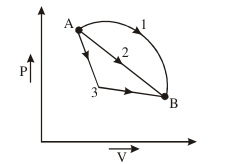
An ideal gas goes from state to state via three different processes. If indicate the heat absorbed and indicate the change in internal energy:
The enthalpy of fusion of water is . The molar entropy change for the melting of ice at is:
In which of the following reactions, standard reaction entropy change () is positive and standard Gibb’s energy change () decreases sharply with increasing temperature?
Assertion: In pressure-temperature ( -) phase diagram of water, the slope of the melting curve is found to be negative.Reason: Ice contracts on melting to water.
Standard enthalpy of vapourisation for water at is . The internal energy of vapourisation of water at (in ) is:
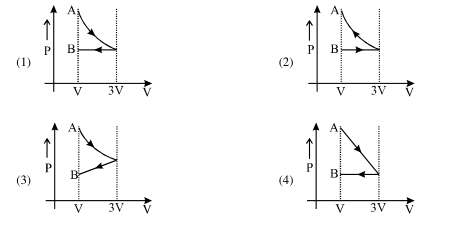
One mole of an ideal gas goes from an initial state to final state via two processes: It first undergoes isothermal expansion from volume to and then its volume is reduced from to at constant pressure. The correct diagram representing the two processes is:
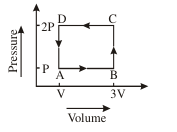
A thermodynamic system is taken through the cycle as shown in figure. Heat rejected by the gas during the cycle is:
If , , and denote respectively the heat added, change in internal energy, and the work done in a closed cycle process, then:
The molar specific heats of an ideal gas at constant pressure and volume are denoted by and , respectively. If and is the universal gas constant, then is equal to:
A gas is taken through the cycle , where , , and in coordinates ( in , in ). What is the net work done by the gas?
During an adiabatic process, the pressure of a gas is found to be proportional to the cube of its temperature. The ratio of for the gas is:
A reaction having equal energies of activation for forward and reverse reactions has:
Bond dissociation enthalpy of , and are , and respectively. Enthalpy of formation of is:
Steam at is passed into of water at . When water acquires a temperature of , the mass of water present will be: [Take specific heat of water and latent heat of steam ]
Certain quantity of water cools from to in the first and to in the next . The temperature of the surroundings is:
For the reaction of one mole of zinc dust with one mole of sulphuric acid in a bomb calorimeter, and corresponds to:
For the gas phase reaction , which of the following conditions is correct?
A monoatomic gas at a pressure , having a volume expands isothermally to a volume and then adiabatically to a volume . The final pressure of the gas is: (take )
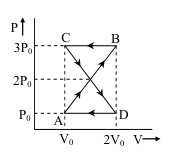
A thermodynamic system undergoes cyclic process as shown in figure. The work done by the system in the cycle is:[Image shows a figure of two identical triangles meeting at a point, forming an 8-shape. Loop 1 is clockwise, Loop 2 is anti-clockwise.]
Using the Gibbs energy change, , for the reaction:
The of in water at is: ()
The of in water at is: ()
For the chemical equilibrium, , can be determined from which one of the following plots?
The internal energy change in a system that has absorbed of heat and done of work is:
The formation of the oxide ion, , from oxygen atom requires first an exothermic and then an endothermic step as shown below: Thus the process of formation of in gas phase is unfavourable though is isoelectronic with neon. It is due to the fact that:
The heat of combustion of carbon to is . The heat released upon formation of of from carbon and oxygen gas is:
The values of and for the reaction are and respectively. This reaction will be spontaneous at:
Two vessels separately contain two ideal gases and at the same temperature, the pressure of being twice that of . Under such conditions, the density of is found to be times the density of . The ratio of molecular weight of and is:
of a gas occupies liters at NTP. The specific heat capacity of the gas at constant volume is . If the speed of sound in this gas at NTP is , then the molar heat capacity at constant pressure is (Take gas constant ):
An ideal gas heat engine operates in Carnot cycle between 227°C and 127°C. It absorbs 6 x 10⁴ cal of heat at higher temperature. Amount of heat converted to work is :
Identify the correct statement for change of Gibbs energy for a system () at constant temperature and pressure:
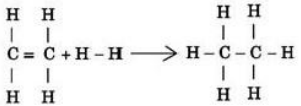 will be:
Frequently Asked Questions
How many Thermodynamics questions are on ExamTest.live?▼
We have 200 Thermodynamics questions spread across 2 pages, covering easy, medium, and hard difficulty levels with detailed explanations.
Are Thermodynamics MCQs free?▼
Yes. All Thermodynamics questions, answers, and explanations on ExamTest.live are completely free. No account or subscription required.
Which exams include Thermodynamics questions?▼
Thermodynamics questions are commonly asked in Physics, Chemistry, General Science, CHEMISTRY, General Knowledge and General Awareness. You can filter by exam using the links above.
How do I practice Thermodynamics questions effectively?▼
Start with easy questions to build confidence, then tackle medium and hard ones. Use the filter buttons to sort by difficulty. Reveal the answer only after attempting each question, and read the explanation thoroughly.